Sal Da Vinci is perfect for Eurovision (but that’s not necessarily good news)
We left off like this, with Lucio Corsi who at the Eurovision 2025 had essentially represented a short circuit: a quality singer-songwriter, who had even brought with him a translation of the lyrics I wanted to be tough (how many texts here are worth a translation?), who played an instrument, the harmonica, challenging the rules of competition (and this says a lot…), effectively clashing with the kitsch aesthetic – all form, and what form, and very little substance – of ESC until passing, in that context, as meaningless. Before him, in no particular order, Mahmood and Blanco, Marco Mengoni, Angelina Mango, obviously Måneskin. In short, the most contemporary Italy, the one that looks to the world, which leaves behind the usual pizza & mandolin clichés and tries to follow other, more refined paths. Then? Then came Sal Da Vinci.
All the way back, or rather no
It is still early to talk about the restoration of Italian music, for that, even just to understand whether the victory of the Festival could have created a precedent, we will at least have to wait for the choices of the next artistic director, Stefano De Martino. There is one certainty, however: while we have tried to keep up with the times, ESC has remained the usual bandwagon where the only currency of exchange is trash and in which the participating countries communicate almost only through stereotypes. Well, there in the middle Forever yes it’s perfect and you can see it already after the first performance: it wallows in it, indeed, it’s the best version of it, without giving itself away. It’s a match!.
Let’s be clear, in terms of depth we are light years ahead of the assorted horrors going around Vienna these days. Sal Da Vinci himself – who, as is well known, has a career that can be said to have ended at the last Sanremo or, at 57 years of age – maintains a completely different pace compared to his competitors and can be seen, despite the emotion of the first performance, nevertheless overcome with skill. But it is precisely the story that it embodies, the spirit of this sort of sphinx, imperturbable to everything except its own emotions, which does not feel criticism, influences, updates of sensitivity and of the worldto mark the difference.
“Forever yes” fully represents what Eurovision and the international public that follows it want from a song: an exaggerated and simplistic piece, in this case held up by the paraphernalia of an artist who is in any case experienced (have some, there) and which above all conveys a reassuring message. Which gives certainties, well, in this case both in content (love that conquers all, the “always” used as a panacea for all ills, were it so simple) and in form, with a pop far from the ambitions of those who preceded it, other than Angelina Mango or Lucio Corsi, this is an updated version from that of Pupo and company’s arrival in Eastern Europe, in the middle of the Eighties.
Telling, truly, Italy
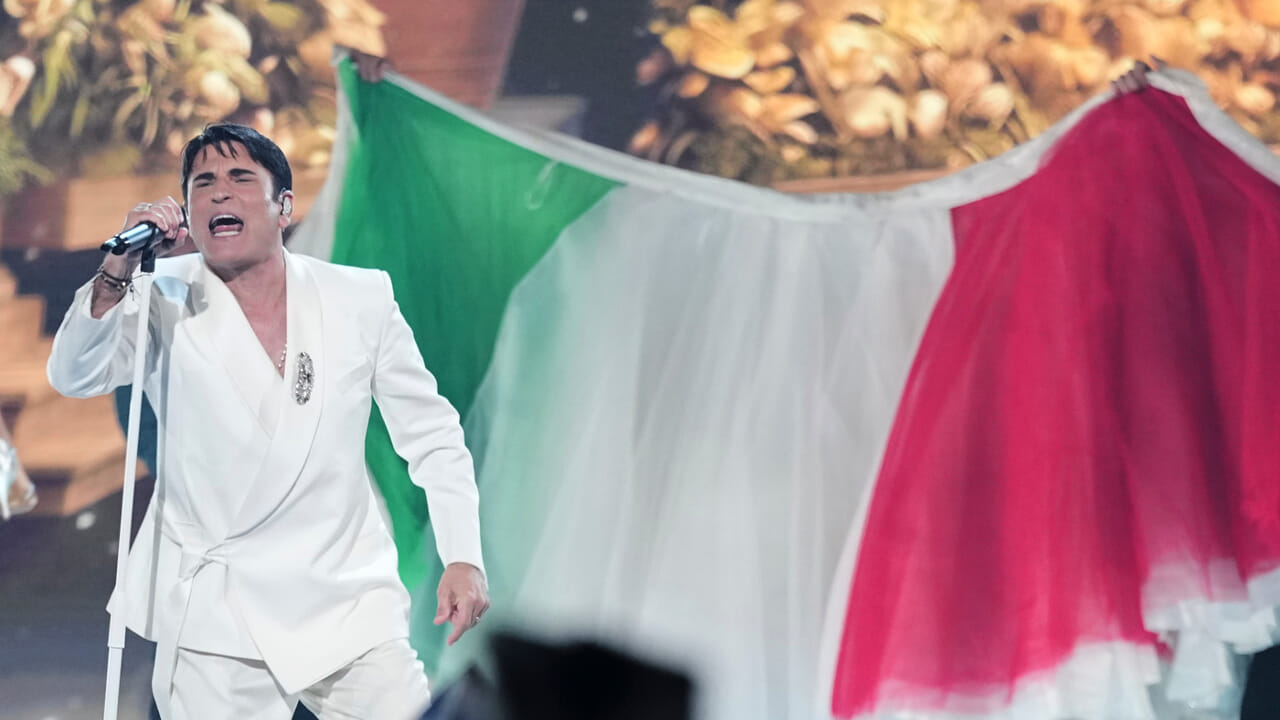
Italy already wins it is knownzero surprises. Better: Italy wins than the international Eurovision audience wants know. As it turns out, if the song itself wasn’t enough, with all its references to tradition, there’s the performance, which as always plays the lion’s share at ESC. Imagine: the wedding sung as the most important day of life, the scenography of a castle that looks like that of Boss of ceremoniesSal Da Vinci dressed to the nines as if he were the singer of the party, obviously the twist of the tricolor obtained from the dancer’s skirt. We are adapting to the game of others: plain and reassuring messages, again, exactly the postcard Italy that many tourists look for when they come to our country. Forever yesin some ways, is a tour in 2026 in the center of Naples – but it also applies to other large cities – in which all the local history is packaged and served to suit tourists, clichés, clichés.
Does it really represent us? Doesn’t he represent us? Half and half. Of course the world, including our country, is not a postcard, yet the desire for, let’s put it this way, simplicity of Forever yes, starting from the success he had here, it still says a lot about us. In the sense: he doesn’t tell Really Italy, but if you count how little we are interested in first, being told Reallyreflects us fully and, in fact, describes us, indeed. And, for the final, be careful: it’s a perfect piece for Eurovision, alone Done Better of others; where disruptive characters such as Corsi and Mango themselves have not won, this sort of arch-Italian could please everyone.
