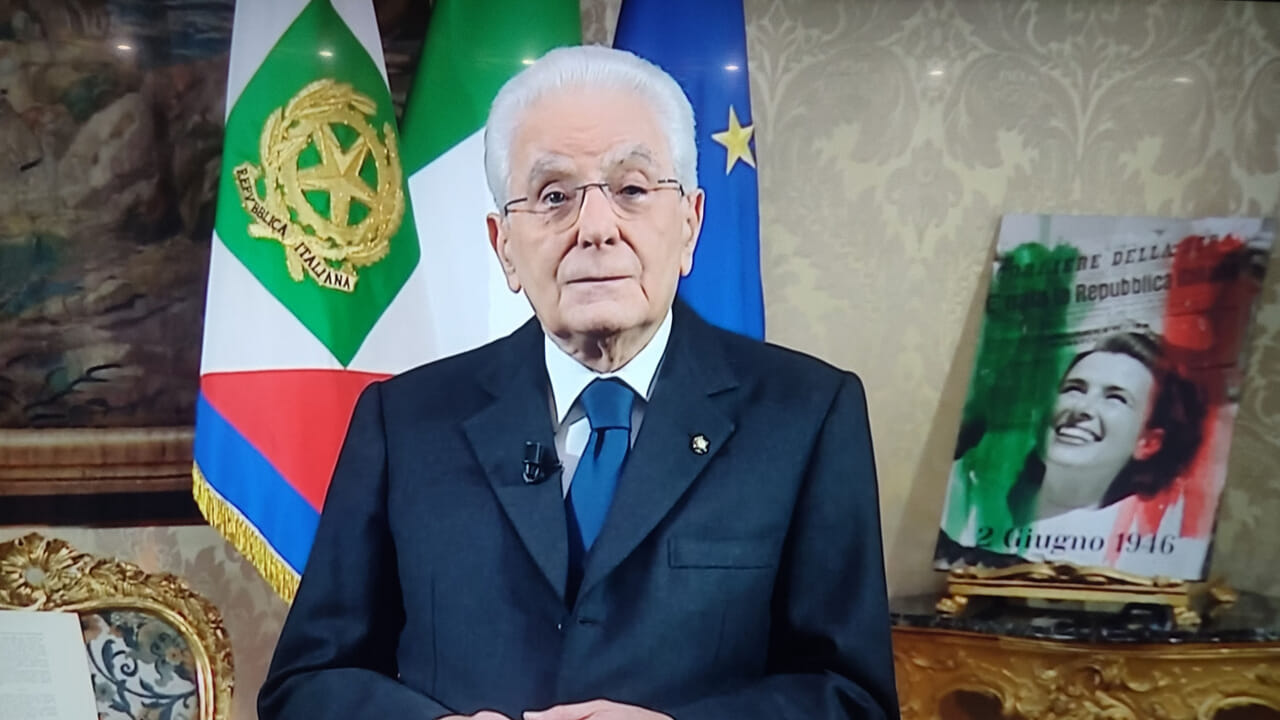
Search for peace and reforms together, here is Mattarella’s invitation
The eleven million Italians who followed the message of the President of the Republic Sergio Mattarella confirm the high degree of trust that the Head of State commands from the population. In fact, there is no opinion poll on the approval of politicians in which the resident of the Colle is not at the top of the ranking.
On the eve of a very complex political turning point, with two appointments that will soon spark controversy between the parties (referendum on justice and the possibility of changing the electoral law), Mattarella has wisely avoided overly explicit references to current political events. But the salient points of the message were not lacking and are essentially two. The first is the reference to peace, with that extremely explicit adjective (“repugnant”) reserved for those who do not agree to seriously discuss the end of the war, the second is the long excursus on the agreement that was found in ’46-’47 to arrive at a shared draft of the Constitution.
The war in Ukraine and the indirect recipients of Mattarella’s warning
The reference to the war in Europe, although not mentioned but still evident, is not surprising at all. Ever since Russia invaded Ukraine, Mattarella has never failed to give an unequivocal indication of the side on which our country must find itself, so much so that the Kremlin’s barbs have arrived on several occasions, with crude messages and para-threatening tones.
The use of the word “repugnant” confirms the idea that the Head of State has of what is happening, and of the negotiations started and immediately interrupted by Putin and his claim to obtain a substantially unconditional surrender such as the request to also obtain the part of Donbass not yet conquered. The adjective is aimed at Russia but in some way its indirect recipients are those Italian political forces that more or less covertly support, albeit at a distance, the reasons of the Kremlin: Matteo Salvini’s League and Giuseppe Conte’s 5 Star Movement, both locked in a sort of equidistance between Kiev and Moscow. An attitude that certainly does not please the Quirinale, even if obviously the Head of State respects the maximum freedom with which political forces express their opinions.
The appeal to the unitary spirit
The second reference full of meaning contained in the message is the insistence with which Mattarella recalled the unitary spirit that characterized the post-war reforms, those that led to the birth of the Constitution. “In the morning the parties discussed the rules to write together and then in the afternoon they divided on other political issues”, was the meaning of the president’s words.
Here, on the eve of a referendum on justice and the probable confrontation with the proposals for reform of the electoral law, a reminder of this type is certainly significant. An invitation to all political forces to seek a constructive dialogue because the rules belong to everyone and when possible they should be thought of together. An invitation therefore to the majority to involve the opposition without being crushed by the majoritarian logic of numbers and in the same way an invitation to the opposition to agree to sit at a common table, and not lock themselves in the ivory tower of No regardless.
