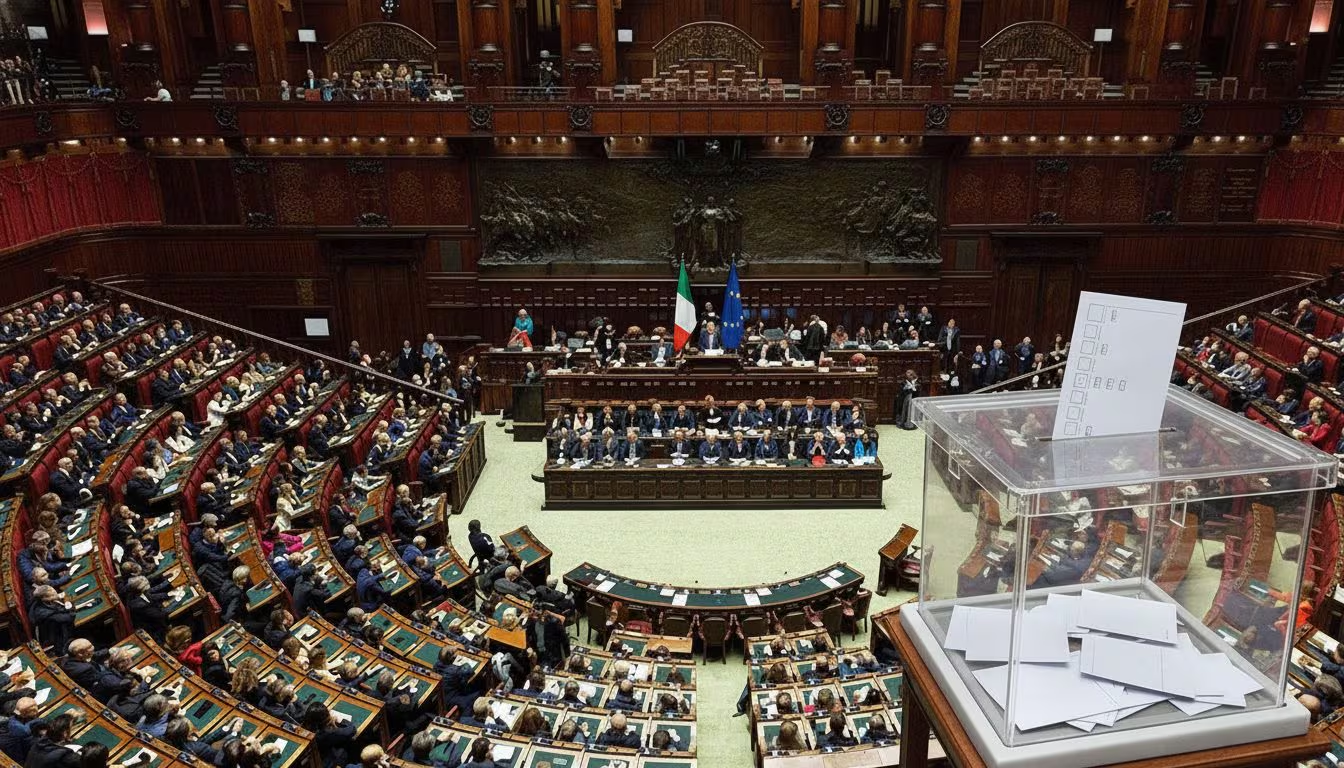
Today, 8 October 2026, the Chamber definitively approved the new electoral lawrenamed Stabilicum (or Melonellum by opposition parties) which will be applied to the next general elections, scheduled for 2027. The electoral reform introduces a proportional system with strong majority bonus: to the coalition that will obtain at least the 42% of the votes (both in the House and in the Senate) will be attributed 70 seats additional to the Chamber e 35 seats additions to the Senate, a significant number.
The law also provides for partial return of preferences (with the leaders blocked) and the barrier thresholds for parties and coalitions. The mechanisms to guarantee the gender equalityforeseen by the previous law, are instead more limited. Coalitions and parties are finally obliged to indicate the name of the prime minister candidate (which however will not appear on the card). Important news also for non-residents: article 8, in fact, recognizes the possibility for non-resident voters to vote in political and European elections, as well as referendums, a right also extended to caregiver family members.
The new electoral law has sparked heated controversy on the part of the opposition (and some discontent even within the majority that approved it), especially due to the risk of political instability in the event that no coalition reaches 42%.
What is Stabilicum and how does it work
The new electoral law is based on a proportional mechanism: the seats in the House and Senate are distributed proportionally based on the votes that the coalitions and parties obtain. The law, however, provides a strong majority premium: the coalition that reaches at least the 42% is in the Chamber that al Senate gets a award of 70 deputies and 35 additional senatorsin addition to those already elected proportionally. If no coalition reaches 42% of the votes, the majority prize is not awarded and all seats are assigned proportionally. This is an important number of seats: just think that, after the constitutional reform to cut the number of parliamentarians which came into force in 2020, the seats at the Chamber of Deputies they went from 630 to 400while those at Senate of the Republic fell from 315 to 200.
In more detail, as reported by the official Dossier of the Electoral Reform, of the 400 seats of the Room8 go to the foreign constituency, 7 to Trentino-Alto Adige, 1 to Valle d’Aosta and 70 constitute the prize: in practice, therefore, they remain 314 seats to be distributed in proportion to the votes. Assuming that a coalition reaches 42% of the votes (and that there are no votes dispersed below the thresholds) it would obtain 42% of those 314 seats, approximately 132. To these are added the 70 seats of the prize, for a total of approximately 202 (excluding the seats in the Estero constituency, Valle d’Aosta and Trentino Alto-Adige).
Same operation for the Senate: of the 200 total senators, 4 belong to Abroad, 1 to Valle d’Aosta, 6 to Trentino Alto-Adige and 35 are the prize. The seats to be distributed proportionally, therefore, are 154: 42% is equivalent to approximately 65 seatswhich added to the 35 of the prize lead to approximately 100 senators, to which those elected in special constituencies and abroad could be added.
In any case, the electoral law establishes how maximum ceiling of seats attributable to the winning coalition in the Chamber was set at 220 deputies and in the Senate a 113 senators.
The law provides that voters can express up to three preferencesbut i leaders are blocked: each party chooses its own leader, who will in any case be the first of those elected, regardless of the voters’ decision. The barrier thresholdsinstead, are fixed to 10% for them coalitions, 3% for i parties not forming part of the coalition.
Furthermore, each coalition or party will have to indicate the name of the candidate for the Presidency of the Council at the time of presentation of the symbol. However, the name will not be present on the ballot (the fact that a party or coalition can decide to include the name in its symbol, as often happens, has nothing to do with the law) because, according to the Constitution, the task must be conferred by the President of the Republic: Voters do not directly choose the government and its president.
With the stabilicum/melonellum we will vote in 2027, except for interventions by the Constitutional Court which could nullify all or part of the law if it were found to violate the Constitution.
Pros and cons: the controversies of the opposition and the responses of the majority
The new electoral law has sparked heated controversy for various reasons. First of all, they were disputed the times: the opposition claims that approving a new electoral law less than a year after the vote is functional to the interests of the current majority and risks compromising democratic guarantees.
Various criticisms have also been leveled against the strong majority premiumwhich, according to detractors, does not guarantee adequate representation and, combined with the blocked lead principle, leaves parties great discretion in the choice of deputies and senators.
In this regard, a clarification is necessary on electoral systems, which are divided into two main types: proportional and majoritarian. Generally speaking, the proportional system assigns seats in Parliament in proportion to the votes obtained by parties or coalition of parties: a party that obtains 10% of the votes will have 10% of the seats and so on. Often the proportional system provides one barrier thresholdi.e. a minimum level that parties must reach to obtain seats, necessary to avoid excessive fragmentation (but sometimes used to limit representation). In many cases, the proportional also includes a majority bonus: the party or coalition of parties that obtains the most votes is entitled to a bonus in terms of seats, in order to guarantee that there is a solid and stable majority in parliament.
The majoritarian systeminstead, assigns seats to the candidates or to the list that obtain the most votes in a given constituency: whoever gets the most votes is elected, while all the others remain outside parliament and the votes they have obtained are dispersed. The majority can be a single shift or predict a ballot (after the first round, the two candidates who obtained the most votes compete again). When each constituency elects only one candidate, the system is called single member.
In extreme summary: proportional favors representativeness, reflecting the voters’ vote more closely, the majority governability, producing clearer and more solid parliamentary majorities.
The majority bonus included in the current law should help governability, while according to the opposition it will prevent parliament from fully reflecting the will of the voters.
Other controversies arose due to the fact that, compared to the previous law, the principle of alternation between men and women is severely limited: according to the opposition, this would risk drastically reduce the number of women present in parliament.
According to some scholars of constitutional law, the electoral law could be partially considered unconstitutional, because it provides for the nomination of the candidate for prime minister, a task which instead falls to the President of the Republic.
The promoters of the electoral law, on the contrary, reject the accusations, maintaining that it serves to give stability to the countrypreventing the elections from ending with “draws” and therefore making the creation of a stable majority in Parliament more complex, with important repercussions on the governability of the country.
