
A gigantic Russian battle vehicle heavy 40 tons and with two high wheels 9 meters: this is the Tsar tankalso known as Lebedenko or Nepotir. This is a military vehicle of which only one example was built between 1914 and 1915: given the poor results in the testing phase, it was never actually used on the battlefield. But where did the idea for such a particular design come from? And why was it considered a failure?
Concept and characteristics of the Zar tank
The vehicle was commissioned in 1914 give it Tsar Nicholas II to the engineer Nikolay Lebedenkowho at the time worked for a private company that collaborated with the Russian War Ministry. He had the idea of creating a battle machine that, on paper, would be able to overcome any type of obstacle. From a technical point of view it consisted of one hull a shape of “tuning fork” from 40 tons connected to a three-roller carriage posterior and to two front wheels from the diameter Of 9 meters. Each of these was powered by an engine 240 horsepower Maybach recovered by German Zeppelins. Specifically, the engine drove the wheel of a car which, resting on the internal wooden covering of the front wheel, allowed it to be started. In theory this tank would have been able to reach the 17 km/ha value that was not bad at all for the time.
As regards the armament, the hull would have been equipped with a central turret equipped with machine guns And light cannonswhile they would have been prepared on the external sides and on the belly of the vehicle small machine gun turrets.

Before creating a first working version, the designers created a wooden scale model whose goal was to impress the Tsar… and they actually succeeded, so much so that they got the green light for the production of the first example.
The first field test
In the July 1915 the vehicle was ready for his first field test. Given its size, it was first dismantled into parts and then reassembled in a wooded location approximately 60 km from Moscow. Precisely during the assembly phase we realized that the weight exceeded the expected values by 50%.reaching the 60 tons. The reason? Too thick metal plates were used.
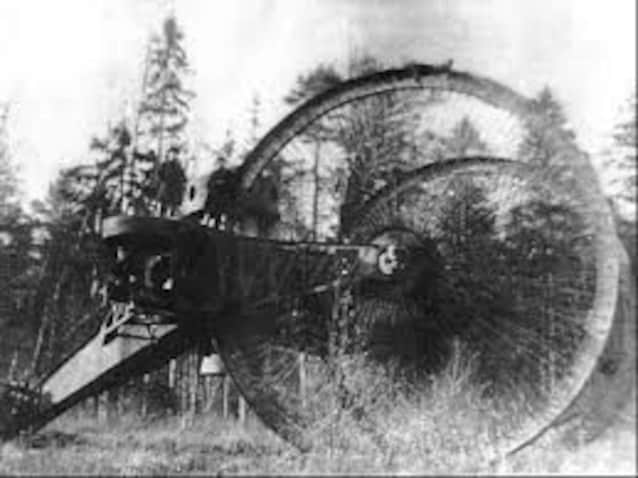
When the tests began, however, the vehicle seemed to work well on compact ground, even crushing a tree, but as soon as it entered a more swampy area a rear wheel got stuck in a ditchimmobilizing the tank.
It was later understood that the engines were too small but it Zar decided not to continue further: he had already spent 250 thousand rubles in the project and was not willing to invest further. Also some members of the army raised doubts regarding the vulnerability of the medium to the enemy artillery, officially putting an end to the project.
The Lebedenko specimen used for testing remained bogged down until the end of the war and was scrapped only in 1923.

