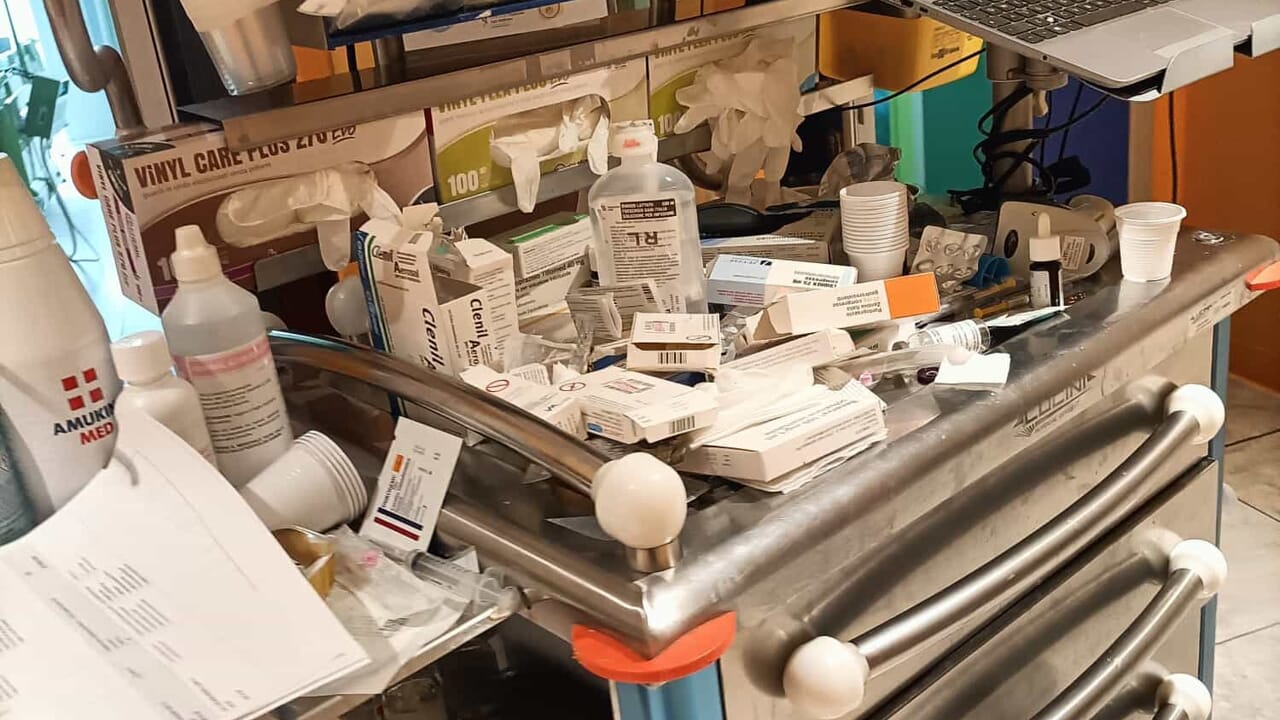
The chaos in Italian hospitals
The San Raffaele Hospital in Milan, a private hospital in agreement with the State and a center of national excellence, has ended up in the newspapers due to the effects of a structural problem that has been affecting nursing staff in Italy for some time. Iceberg is not just the name of the “indicted pavilion” of the hospital, but the actual metaphor: what we see is only the tip of a profoundly flawed system in personnel management.
Nurses paid a thousand euros a night: after the chaos, record expenses and resignations
On the night between 5 and 6 December 2025, the high-intensity medicine department of the “Iceberg pavilion” literally collapsed. On duty there were nurses hired by a cooperative and sent to work without the necessary clinical and interpersonal skills. They were unaware of procedures, pathways, equipment, department culture and clinical responsibilities. In some cases, the picture was exacerbated by language barriers. The consequences, unfortunately predictable, were immediate: a dose of drug administered ten times more than prescribed, unregistered therapies, inability to activate the doctor on call or to carry out complex procedures on patients. It was Dossier uisjournal.com that uncovered the case by publishing a shocking report.
“Incompetent contract nurses, dangerous situation and chaos in Medicine at San Raffaele”: read the shock report
This is not an accident, but the direct consequence of a failing organization that has stopped recognizing competence as a necessary condition for safety. This inevitably led to the resignation of the sole administrator of San Raffaele, Francesco Galli, and the San Donato Group entrusted the clinical and strategic coordination of the departments to Alberto Zangrillo. But what needs to change in the organizational culture so that similar situations do not happen again?
The modular units
In addition to the incompetence of some nurses – as some managers were quick to point out – the problem is much broader and more structural. It is a model that has been shaping Italian healthcare for years and which today explodes in all its evidence: the use of units that can be “modulated” according to needs.
This modus operandi is not only used in the private sector, but also in public healthcare companies. What does it entail? The company uses a professional as a “modular” workforce, that is, it can be moved anywhere, regardless of training and competence. Another dynamic is to ask specialized personnel to move within other departments of the so-called “area to which they belong”. Example: let’s say a critical area includes the emergency room, intensive care unit and operating room; the specialized staff of one of these three settings is then asked to “move” to the others.
The paradox that causes professional abandonment
On the one hand, the path to becoming a nurse requires high specialization. In addition to the university path, each department is a world: protocols, drugs, machinery, risks, technical languages, workflows. To clarify, a Hematology nurse (branch of medicine that studies the blood, bone marrow and lymphatic organs to diagnose and treat diseases that affect them) does not do the same job as an Intensive Care nurse (a place where vital functions are supported with the aim of bringing them back to normal, often through sedation and mechanical ventilation). An Oncology nurse cannot improvise in Psychiatry.
Just as no one would dream of saying to a cardiologist specialist: “Tonight you’re doing a shift in the emergency room, you’re still a doctor anyway.” If for doctors this concept is unthinkable, for nurses, however, it is normalized. The result is an organizational culture that ignores training, experience and patient safety. Need anyone? You take anyone, move them, “modulate” them. What if that person doesn’t know the department, the language, the technology? It is a risk that companies have always been willing to take to meet budget objectives. At least until now: the San Raffaele report could become a case report of clinical risk, a warning for the future.
Cooperatives and contractual dumping
And cooperatives have become the carpet under which to hide problems. They pay less, train less, monitor less: this is how nurses come into service who have never seen a high-intensity department, who do not speak enough Italian to understand a complex prescription, who have never used a ventilator or do not know how to manage a syringe pump for drug dosages.
However, there is also the flip side of the coin, and it is right to say it: there are nurses who accept being moved, working anywhere and doing what they don’t know. They often do this out of fear of losing a contract or being judged “uncooperative.” Is saying “yes” to everything part of the problem? Yes, because a professional who accepts to work without competence in a high-intensity department puts himself and others at risk. Professional courage is not doing everything, but saying, “I am not competent to do this.”
Private healthcare contracts discounted
Another crucial point of the San Raffaele case report is the resignation of 16 ward nursing units, together with the coordinator. This occurred before the cooperative’s staff came on board to replace the workforce shortage. The mass resignations in the accredited private facility also depend on the failure to adjust the salary to that of colleagues in public hospitals.
In the public sector, nurses’ salaries are regulated by the national collective agreement for the sector. Salaries vary based on the classification: they start from around 24,000 euros gross for the initial levels and can reach over 32,000 euros gross. Added to these figures are allowances for night shifts, overtime and on-call, which can bring the monthly net up to around 1,900 euros. Introduction: these amounts are significantly lower than the European averages. But in the private sector the situation is still different. In the private sector, nurses’ salaries depend on the healthcare facility. Private structures can apply the Aiop Ccnl, which offers conditions similar to those of the public sector, or other contracts, such as the Anaste Ccnl, used in RSAs and cooperatives, with generally lower compensation. We are talking about net monthly salaries between 1,300 and 1,700 euros.
San Raffaele, today, is the case report of an organizational failure that affects everyone: the public, private affiliates, cooperatives and those who allowed this drift to become normal. The solution must start from a paradigm shift that is no longer based on “modular” personnel, but on the real recognition (including economic) of skills.
