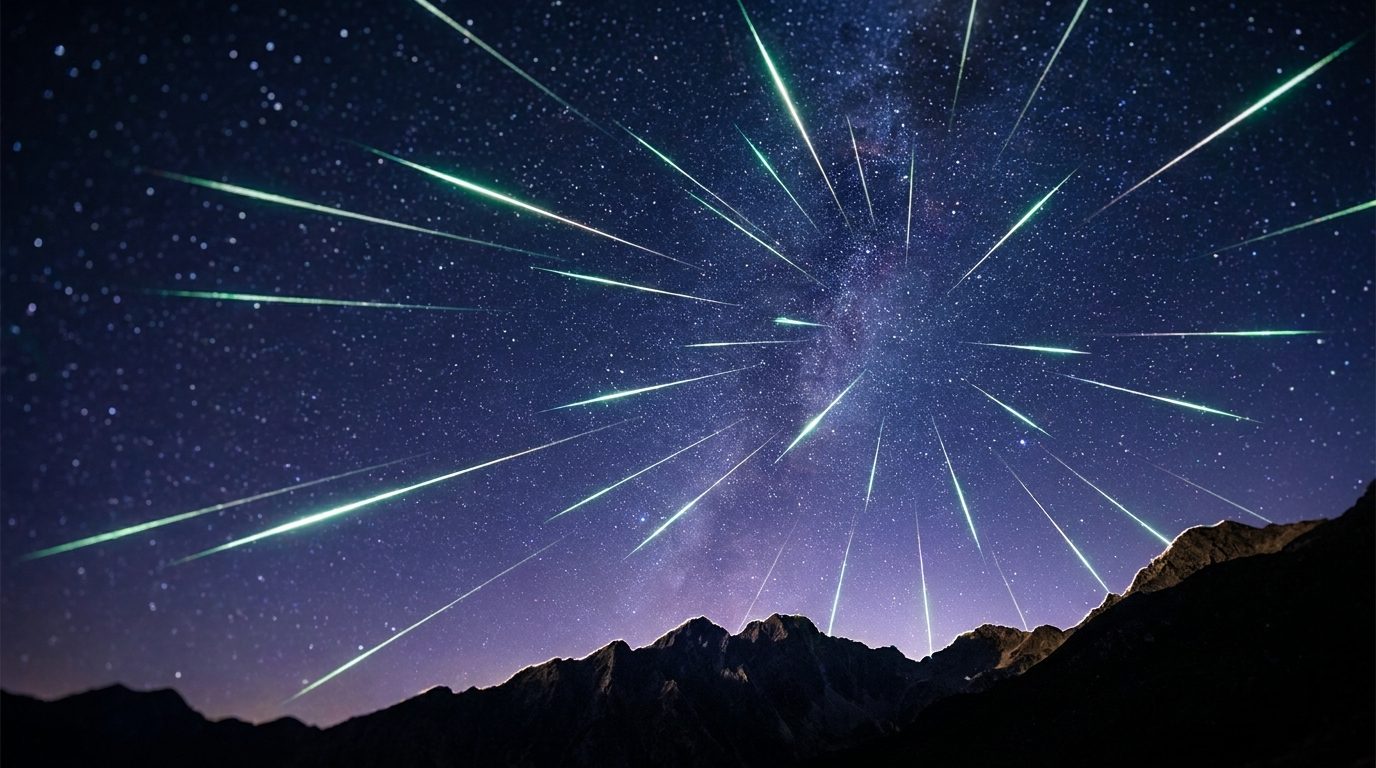
Eyes aimed at the sky in the night between 5 and 6 May 2026 to observe the peak of the meteor shower Eta Aquaridsthe “shooting stars” (but the technical term is meteors) of May. The Eta Aquarids are one of the most abundant and suggestive meteor showers of the first part of the year, generated by the passage of the Earth in the trail of debris left by Halley’s comet. The swarm will be visible to the naked eye starting from 3:00 in the morning, with the maximum show expected between 4 and 5when the constellation of Aquarius (from which direction the light trails appear to come) will be sufficiently high on the east-southeast horizon. It must be said that this year the observation will not be particularly lucky due to the Moon illuminated at 84%therefore particularly bright, which will rise in the second part of the night, reducing the visibility of the weakest meteors and lowering the expected frequency to less than 10 meteors per hour (against an average of 10 to 30 meteors per hour). The peak window of the Eta Aquarids is however quite wide, with the nights between 4 and 7 May all favorable.
The origin of the shower is the most famous comet: Halley’s
When we talk about meteor shower we mean a set of debris left by a progenitor body (generally a comet) along its orbit, which are periodically intercepted by the Earth in its orbit around the Sun. Well, every year between the end of April and the end of May the Earth intersects the innermost part of the orbit of the Halley’s cometcrowded with countless tiny fragments left by the comet itself during its close passages in the inner Solar System. In short, these days our planet is passing through the “trail of crumbs” left by this celestial body. When this debris, generally no more than a few millimeters large, enters our atmosphere, it burns due to the enormous friction (it can also fall to more than 60 km/s) leaving the light trails what we commonly call “shooting stars”.

The swarm is named after him radiantthat is, the point in the sky from which the trails seem to depart: it is located in the constellation of Aquarius, near the star Eta Aquarii. Halley’s comet is also the progenitor body of the October Orionid swarm (which occurs when the Earth re-intersects the comet’s orbit), but the Eta Aquarids are decidedly more generous: according to the International Meteor Organization, they produce a maximum frequency of 50 meteors per hour2-3 times that of the Orionids. The Eta Aquarids are also characteristic for persistent trails that they leave in the sky, unlike many other swarms.
How and at what time to observe the peak of the Eta Aquarids in May 2026
The peak of the swarm is expected in night between 5 and 6 Maybut the window of intense activity is quite wide: the nights between 4 and 7 May all offer good chances of sightings, weather permitting.
The most favorable time to observe is in the last hours of the nightbefore dawn. The constellation Aquarius rises in the east around 3:00 in the morning, but at that time the radiant is still too low on the horizon to offer a satisfactory sight. There best window is between 4:00 and 5:00when the star Eta Aquarii has risen above the east-southeast horizon (the Moon will be approximately in a southerly direction). As the minutes continue, the radiant will rise further, but around 5:30 the sky will begin to lighten due to the rising of the Sun, nullifying the advantage.
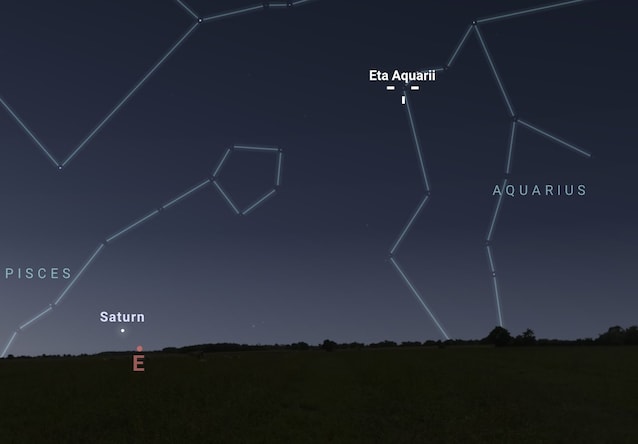
As with all meteor showers, it is not necessary to precisely identify the constellation of Aquarius or use telescopes or binoculars: in fact, we do not recommend the use of optical instruments because they narrow the field of vision, while the objective is to observe the largest possible portion of the sky. Enough point your gaze eastkeeping it low on the horizon. It is good practice to concede 20-30 minutes eyes to adapt to the dark before starting observations.
How to prevent the Moon from “ruining” the show
Here comes the sore point of this 2026 edition. The full moon was on May 1st, so on the night between May 5th and 6th we will have a Very bright waning gibbous moon (with lighting around the84%) which will rise in the second part of the night and will therefore be not very far from the radiant of the swarm. In these conditions the meteors visible per hour could also fall under 10because the moonlight will be enough to “bury” the trails of the weakest meteors.
The practical advice is to exploit geometry: position yourself in a place where the Moon is physically “hidden” behind an obstacle natural or artificial (for example a mountain or buildings) and point your gaze towards the opposite portion of the sky, the darker one. This reduces natural light pollution and increases the number of visible meteors. Even from places with partially shielded moonlight, the brightest meteors and persistent trails that characterize this shower will remain clearly visible.
As always, to maximize the chances of a good sighting is good move away from artificial lights of the cities and choose a point with the east-southeast horizon as clear as possible.
