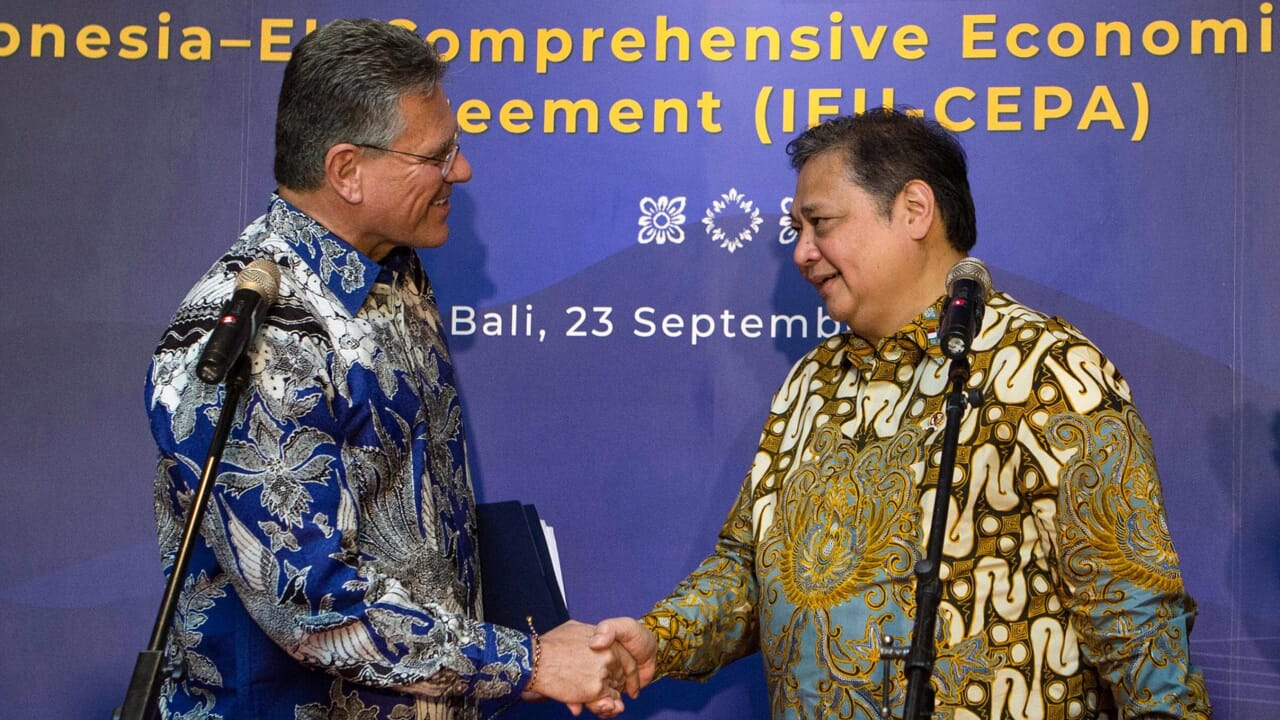
After the Treaty with Mercosur, the European Union signs a commercial agreement with the fourth most populous country in the world: Indonesia. Brussels’ goal is to continue towards commercial diversification, to at least partially avoid the consequent damage of the agreement with the United States.
Away 98.5 percent of the duties
“This agreement eliminates over 98.5 percent of customs duties, removing almost all commercial barriers and opening up new investments routes,” said the EU commissioner to the Maros Sefkovic trade, illustrating the heart of the cessation. After nine years of negotiations, the European Union and Indonesia have aimed at the points for the global agreement of economic partnership (CEPA) and for the investment protection agreement (IPA). In fact, a free trade area of over 700 million consumers is created.
The agreement in four points
The new agreement between the European Union and Indonesia aims to guarantee European companies a privileged access to the Indonesian market through four key tools. First, the elimination of duties on over 98 percent of the tariff lines and the simplification of customs procedures for EU exports, with significant reductions: cars (-50 percent), machinery (-15 percent), chemicals (-25 percent) and pharmaceuticals (-15 percent). Second, the agreement allows European companies to operate with full ownership in the strategic sectors of services, such as computer science and telecommunications. Third, the pact opens new investment opportunities, in particular in electric vehicles, electronics and pharmaceutical products, promoting the integration of supply chains between Europe and Indonesia. Fourth, the agreement strengthens the protection of intellectual property, protecting brands and patents, contrasting counterfeiting and supporting small businesses, also for the benefit of Indonesian consumers.
A savings of approximately 600 million euros
The new bilateral agreement will allow European companies to operate with full ownership in key sectors such as computer science and telecommunications, opening the way for strategic investments in electric vehicles, electronics and pharmaceutical products. “The Indonesian customs rate of 50 percent on cars imports will be gradually eliminated over five years, opening the doors to EU cars exports and at the same time promoting EU investments, including those in electric vehicles,” Safcovic specified again. The commissioner provided the numerical coordinates of the current commercial relationship between the two parties. “In 2024, the exchanges of goods exceeded 27 billion euros, with Indonesia that has maintained a commercial surplus. In the meantime, the EU holds a record in the exchanges of services, which have recorded an increase of almost 9 billion euros. European investments in Indonesia exceed 25 billion euros, demonstrating the growing trust and opportunities. Yet Indonesia is only the fifth commercial partner. of the European Union in the ASEAN area.
For Brussels, the agreement will bring significant benefits to European farmers, reducing duties on agri -food products and protecting traditional EU products, key industrial sectors, such as the automotive, chemical and machinery sectors. Overall, according to Brussels calculations, the reduction of Indonesian duties, which are currently on average 10 percent and in some cases reach 150 percent, will save money from the EU exporters about 600 million euros. Thus, European products will be more accessible and available for the 283 million consumers than what is the largest-archipelago in the world.
Now, negotiated text drafts will be published and subjected to legal review and translation in all official EU languages. The European Commission will therefore present its proposal to the Council for the signature and conclusion of the Cepa and the IPA. Once adopted by the Council, the EU and Indonesia will be able to sign the agreements. At that point, the texts will be transmitted to the European Parliament for approval. Once the Indonesia has also ratified, the Cepa and the IPA will be able to come into force.
