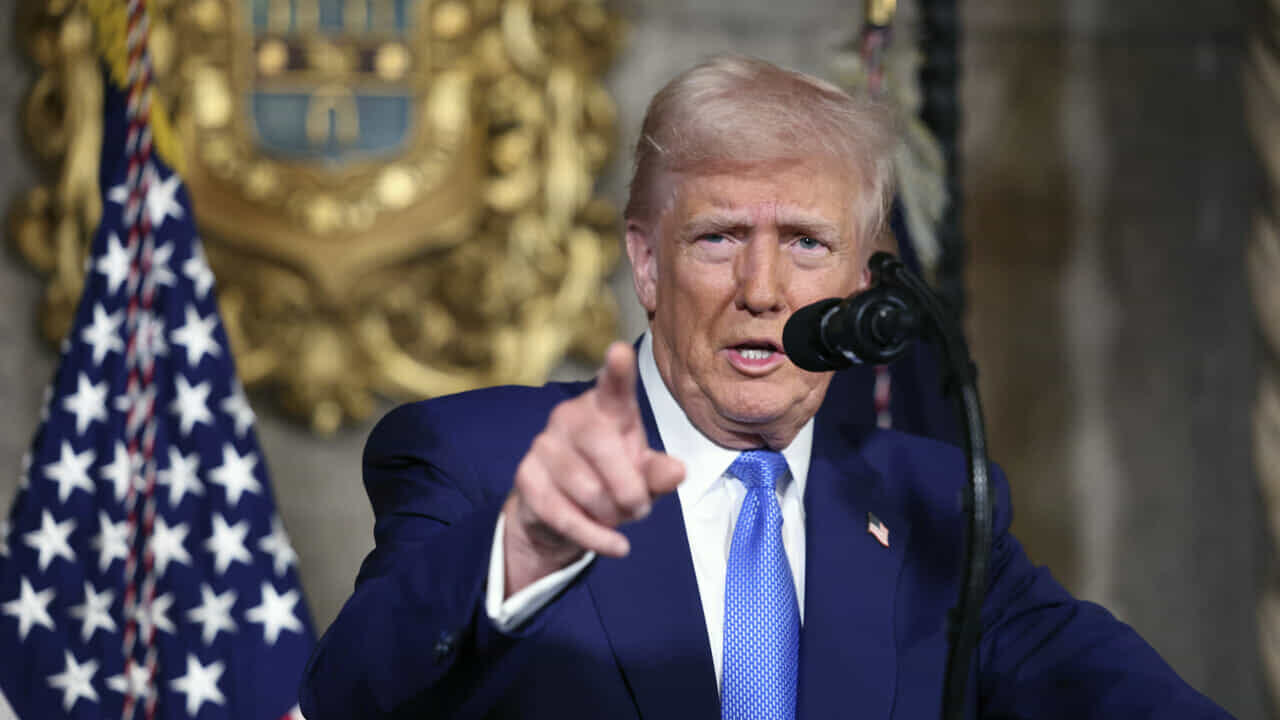
There is high tension between Europe and the United States. Many international analysts speak of a real “rift” in relations between the US and the EU. What’s happening? Let’s start from the beginning. “If Europe does not change, it risks the erasure of its civilization.” These are the very harsh words of American President Donald Trump, pronounced as he revealed to the world the new “National security strategy”, a 33-page document on the new US national security strategy. The US leader outlined his priorities and criticized the old continent on all fronts: from migration policies to “censorship of free speech”, passing through his “unrealistic expectations” on the war in Ukraine.
Trump’s attack
The US administration “finds itself at odds with European officials who have unrealistic expectations for the war” in Ukraine, “perched on unstable minority governments, many of whom trample on fundamental principles of democracy to repress the opposition”, reads the National Security Strategy. In the document, the reproaches against Europe are across the board: “If it continues with the current trend, in 20 years it will be unrecognizable”, including “the activities of the EU and other international bodies that undermine political freedom and sovereignty, the migration policies that are transforming the continent, the censorship of free speech and the suppression of political opposition”.
The US demolishes Europe: Moscow appreciates it
Russia, meanwhile, appreciates it. The changes adopted by Trump on the national security strategy are “consistent” with Moscow’s vision and can guarantee “constructive work” with the US on the Ukrainian solution, Kremlin spokesman Dmitry Peskov said, quoted by the Russian news agency Tass. “The adjustments are largely consistent with our vision,” he noted. “Perhaps we can hope that this will be a modest guarantee that we will be able to constructively continue joint work to find a peaceful solution in Ukraine.”
The Brussels reply
Brussels’ response to the American president’s words quickly arrived, via a spokesperson: “When it comes to decisions that concern the European Union, these are made by the European Union, for the European Union, including those that concern our regulatory autonomy, the protection of freedom of expression and the rules-based international order. The transatlantic partnership is unique and, as always, allies are stronger together.”
Meloni’s intervention
However, looking at “our home”, Prime Minister Giorgia Meloni does not see a rift between the EU and the USA. “I wouldn’t speak of a crack in relations between the United States and Europe. I think that what is written in the US strategic document, beyond judgments on European politics – some of which I share, such as those on immigration which we are correcting – says in assertive tones something that has been going on in the debate between the US and Europe for a long time. And it speaks of what some of us had the courage to define a long time ago as an inevitable historical path”, the Prime Minister told La7.
Tusk and Kallas: “We have common enemies”
“Dear American friends, Europe is your closest ally, not your problem. And we have common enemies. At least that’s how it has been for the last 80 years. We must stick to this strategy, the only reasonable one for our common security. Unless something has changed”, wrote Polish Prime Minister Donald Tusk on
As did the EU’s high representative for foreign policy, Kaja Kallas, stating that the United States is still Europe’s main ally. “There are many criticisms” in the American document, “but I think some of them are also true,” Kallas said at the Doha Forum, in response to a question about US strategy. “The United States is still our greatest ally. I think we haven’t always agreed on many issues, but I think the general principle is still valid. We are the greatest ally and we should stick together,” he said.
The reasons for Trump’s attack
What is behind Trump’s violent attack on Europe? As international analysts explain, with Europe destined to have a marginal role in international issues, Trump’s national strategy looks at other priorities, such as the Western hemisphere, immigration and China. “We will rebalance economic relations with Beijing by prioritizing reciprocity and fairness to restore American economic independence”, states the National Security Strategy. The American president also pledges to “reaffirm and enforce the Monroe Doctrine to restore American preeminence in the Western Hemisphere and to protect the country.”
Crosetto’s reading
Defense Minister Guido Crosetto also explained the rationale behind Trump’s words: the United States’ competitor is China, and in this duel Europe is not useful to Washington’s interests. The EU (and therefore also Italy) will increasingly have to provide for its own security, without counting on “gifts” from the USA. This is why Crosetto is not surprised by the document on national strategic security signed by the American president. “I have been saying for three years that the relationship with the EU would change and that the defense guarantees given after 1945 would end quickly. It was clear, evident. With a more accelerated timescale than I feared – I thought they would grant 2-3 more years – what was expected happened”, said the minister.
According to Crosetto, the EU is useless “because it does not have particularly relevant or useful natural resources. Because it is losing the competition on innovation and technology. Because it has no military power. Because, compared to the new players in the world, it is small, slow and ‘old’. The reasons why it has done so even with a bit of harshness are not even a surprise to them because its judgments (and those of many republican or Maga representatives) on some positions and political choices of the Union have been known for years”.
The scenarios
As the minister explains, “the bad news is that we should think about what our US allies had provided us with for free until now: security, defense and deterrence. I’m not just talking about military ones.” Crosetto insists: “It is this scenario (as I said was widely expected) in which the choices, decisions and strategies of the smaller nations (like us) must be defined.” And this is because “we too need resources. Because we too need technologies. Because we too need to grow our economy and defend our space of wealth. Not to exercise supremacy over someone, but to guarantee our future”.
According to Crosetto, “Europe is also a natural place where we can find partners to do what we are too small to achieve on our own. For example, it is clear that the financial ‘entry threshold’ to make up for lost time on fundamental technologies requires a quantity of public and private investments that are heavy even for 27 nations. But they must be done, to survive. The same goes for Defence: the more we are, the stronger, the less it costs. We are in the midst of epochal changes. We need to see them, understand them and steer the ship, like at sea during a storm. Because, as happens at sea, no one, not even the greatest, are able to control the flows of the times in which we live, but everyone is forced to face them by navigating as best they can”.
New “friends”
Minister Crosetto then states that by “political choice in recent years we have built and consolidated a large number of bilateral relationships with nations that can help us on the future path (in Africa, the Gulf, Asia, South America, Australia) to guarantee and strengthen economic, energy and strategic supply security. By choice we have contributed to giving a small positive impulse to a Europe that had lost contact with the trajectories of the world thinking it could shape it in its image and likeness. Small, because the resistance ideological and bureaucratic policies that refuse a fast and pragmatic approach to the evolution of reality are very strong and sedimented”.
