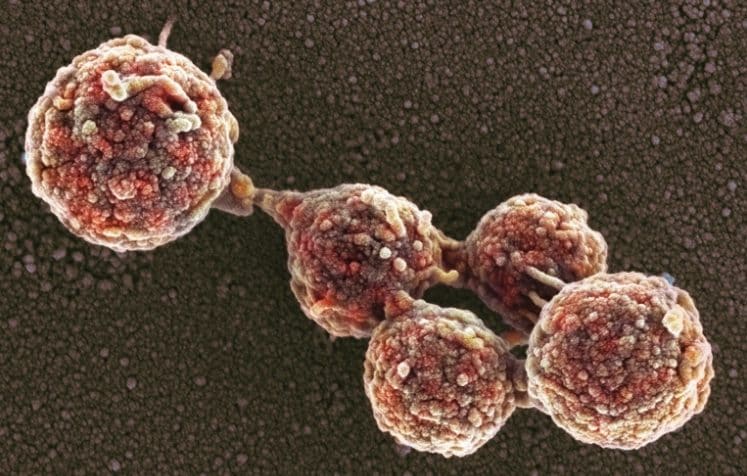
Now dead bacteria cells, with the Inactivated DNAwhich come back to life after receiving the genome of another species. This is what was done by a group of researchers from J. Craig Venter Institute (JCVI) of La Jolla, California, reported in a preprint (scientific article not yet peer-reviewed) published on bioRxiv in March 2026 and commented by the magazine Nature. The researchers named them Zombie cells – zombie cells – and, despite the name recalling horror films, their applications could open up new scenarios in synthetic biology, from the production of drugs to that of biofuels.
What is the zombie bacterium and how does it work
The experiment by researchers at the J. Craig Venter Institute starts from a technical problem that had blocked researchers for years. Every time you tried to transfer a genome into a bacterial cell, there was a risk of false positives: some cells survive not because they have truly “absorbed” the donor genome, but because their original DNA manages to incorporate some fragments of antibiotic resistance through a process called homologous recombination. This made it impossible to understand whether the transfer had actually succeeded.
The solution found by JCVI researchers was first inactivate the DNA of the recipient cells. The team treated the cells of the bacterium M. capricolum with the mitomycin Ca chemotherapy drug that damages DNA. Cells treated in this way can neither reproduce nor incorporate fragments of external DNA by recombination. At this point, he was “given” the synthetic DNA of M. mycoidesa bacterium of a related but different species.
The result was that a small portion of the cells “dead”. awakenedstarting to grow and divide normally again, thanks to the DNA of the donor species. Precisely for this reason the term was coined “zombie cells”. Not for their ability to wander aimlessly looking for humans to infect, as happens in horror films, but – as he explains Zumra Peksaglam Seidelsynthetic biologist at the JCVI and co-author of the study – because in effect these are “cells destined to die that have been brought back to life”.
Why studying is important
This research could pave the way to new applications in synthetic biologythe science of redesigning organisms for useful purposes, engineering them to give them new capabilities.
Extend this technique to other bacteria, including those most studied in the laboratory such as Escherichia coliwould allow researchers to testing engineered genomes on a large scale. Simply put, the idea would be to insert the genetic “instructions” needed to manufacture these molecules directly into microorganisms, transforming them into tiny bio-factories. Today a similar process already occurs, for example for the production of insulin, but with the difference that the technique is limited to inserting a single gene into the DNA of a living, functioning bacterium.
However, as this is a study that has not yet been officially reviewed by the scientific communitythe road towards these practical applications is still long and the results will have to be further confirmed by future experiments.
Who is Craig Venter and what has he done so far
To understand the context of this research it is important to know the man after whom the Institute is named: the biologist and entrepreneur John Craig Venter. In 2000, as part of the Human Genome ProjectVenter sequenced the DNA in parallel with the international public consortium. He subsequently founded the JCVI, with the aim of studying the applications of synthetic biology.
In the 2010scientists from the American institute synthesized the entire genome of a bacterium in the laboratory and transferred it into live cells, generating what the researchers called the first synthetic cell of history (JCVI-syn1.0), an organism whose entire genetic heritage had been designed by computer.
Furthermore, as the National Institute of Standards and Technology (NIST) reports, in 2021 the same group created JCVI-syn3A: a cell with less than 500 geniuses (compared to around 4,000 Escherichia Coli and the approximately 30,000 of a human cell) capable of growing and dividing normally. The goal was to understand the fundamental information of life by removing everything superfluous and leaving only the essential.
