Forty years ago, in 1987inside the underground of a villa of Bolognaone was discovered copper funerary cistcontaining gods partially mummified human remains, green in color. The particular color of the body is due to the copper that contained it: copper ionsproduced by metal corrosion, they interacted with bones and tissuesand the humid, oxygen-poor environment favored saponification and slowed down decomposition. The remains, analyzed byInstitute of Forensic Medicine of the University of Bolognathey turned out to belong to a young male individual (probably died between 12 and 14 years of age), in a fetal position. The method of radiocarbon he dated the mummy to a period between 1617 and 1814. What surprised the researchers, however, was the coloring of the mummy: except for the right leg, the bones and soft tissues are in fact mummified green.
To understand why the remains of the young man took on this particular color, some samples of bones and soft tissues were analyzed by a research group fromTor Vergata University of Romecoordinated by Dr. Annamaria Alabiso. The scholars took 7 samplesof which 4 bones (the twelfth rib, a phalanx, a scapula and the fibula of the leg not colored green) and 3 from mummified soft tissues (two from the chest and one from the left leg).
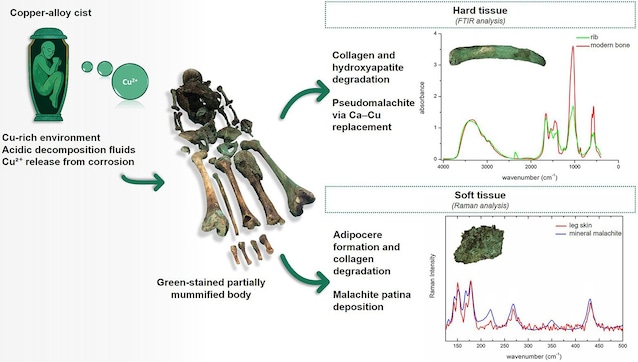
The samples were subjected to infrared spectroscopy, Raman spectroscopy and analysis with scanning electron microscope. The data obtained from these analyzes allowed the Tor Vergata researchers to understand how the boy’s remains managed to be preserved so well and above all why they hired this one particular green color.
A strong concentration of was noted in the green-stained bones pseudomalachite (product ofoxidation of copper), replaced the soccer. The proteins of collagen they were strongly degradedboth in bone and skin samples. On the latter the presence of malachite (another product of copper oxidation) and adipoceresubstance produced in the process of saponification of a corpse, when decomposition processes occur in an environment humid but devoid of oxygen. The substances produced byoxidation of copper they caused the green color of bones and soft tissues.
The remains of the young man from Bologna went towards more unique than rare decomposition processesa sort of “natural chemical mummification“. The body, after being inserted inside the copper funerary cist, began to putrefy. The normal decomposition process was slowed down both from low underground temperatureboth from little presence of oxygen inside the cystboth by the fact that this, suffering a break on the bottom (which probably caused the loss of the remains of the feet, absent), allowed the cadaveric fluids to drain gradually. The latter, in contact with the copper of the cist, caused the corrosionwith the release of copper ions that interacted with bones and soft tissues. These have affected strongly collagen proteins, but thanks to biocidal properties of copper they also have further slowed down the putrefaction process. In short, the “green mummy” of Bologna is the particular result of one combination of environmental factors: low temperatures, low oxygen levels, and biocidal action of copper ions.
