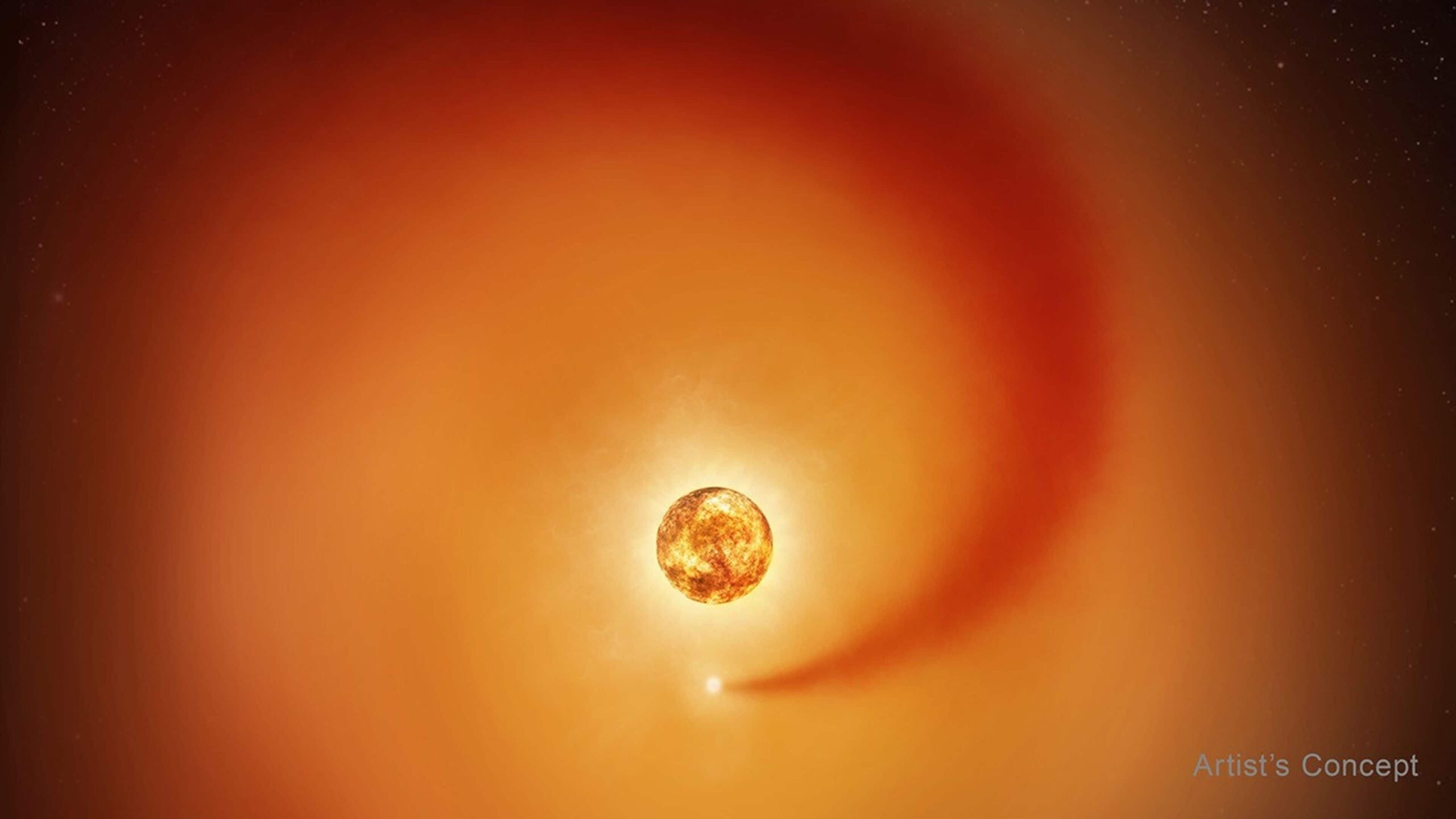
Betelgeusethe red supergiant in the constellation of Orionhas a companion, which astronomers have renamed Siwarha (“her bracelet” in Arabic): a star that had already been discovered, but now there is confirmation from a team of astronomers led by Andrea Dupree of the Smithsonian Center for Astrophysics at Harvard thanks to years of observations conducted with the space telescope Hubble and ground-based telescopes. This work gives us new information about Siwarha that could solve a mystery that has surrounded Betelgeuse for years: its drastic, sudden and enigmatic variations in brightness.
How Siwarha’s existence was confirmed
Siwarha is a blue-white star that is difficult to observe because it is located at a very small distance (“just” 600 million km) from Betelgeuse, so much so that it is surrounded by the external layers ofplasma atmosphere surrounding the red supergiant. As it orbits its massive companion, Siwarha leaves a trail in Betelgeuse’s atmosphere much like a boat leaves a trail on the surface of the water. We know it’s a trail because it comes back every 6 years about.
Specifically, astronomers did not directly observe the trail but its effect on Betelgeuse’s outer atmosphere in terms of chemical composition and of speed and direction of the material. Practically, after the star has crossed the disk of Betelgeuse with respect to our line of sight, the gas that follows it “disturbs” the light emitted by Betelgeuse.
Why this discovery matters: The mystery of Betelgeuse’s brightness
The key to solving the “mystery” of Betelgeuse’s brightness variations lies in the period in which its companion orbits around it and the trail manifests itself: as we said, about 6 years. This number is important because Betelgeuse, as well as a cyclical variation in brightness with a period of approx 400 days due to internal instabilities in its structure, it also shows another cyclical variation precisely with a period of approx 2100 days (about 6 years, in fact), which however astronomers could not explain. For a long time the presence of a companion transiting in front of Betelgeuse was hypothesized, and the work of Dupree and colleagues gives us confirmation of this.
Basically, when Siwarha’s wake passes in front of Betelgeuse, in addition to causing the variations we listed before it also absorbs some of the red supergiant’s light. And it does so, coincidentally, every 2100 days or so: so we have a perfectly natural explanation for the strange behavior of the brightness of the star of Orion.
Betelgeuse is no stranger to surprising astronomers from this point of view. In the’October 2019for example, Betelgeuse had a dramatic and inexplicable reduction in its brightness. At first it was even thought that the star might be close to exploding, given that it is a very massive star (at least 15 solar masses) destined to end its life as supernova anytime within the next 100,000 years (a blink of an eye in astronomical terms). The “great darkening” of Betelgeuse actually ended a few months later and the situation returned to normal. Astronomers have attributed this anomalous behavior to a dust cloud, but Siwarha may have contributed: the passage along our line of sight of Siwarha’s trail in the plasma surrounding Betelgeuse may have played a role in significantly reducing the apparent brightness of the Orion supergiant.
Siwartha is currently “behind” Betelgeuse. His “return” is scheduled for 2027: astronomers will then be able to point their telescopes at the celestial body to discover something more about the companion of one of the most important stars in the entire firmament.
