For centuries man’s dream has been to fly, and Franz Reichelt, the “flying tailor” of Paris, was no different from other men: in 1912 he built and wore a sort of parachute suit with which he jumped from the Eiffel Tower. The invention, however, did not work, and Reichelt died instantly. But to tell this story which in all respects is decidedly incredible, we must take a few steps back.
We are at the beginning of the twentieth century, precisely in the early 1910s. Franz Reichelt, an Austrian Bohemian tailor born in 1878 with a well-known fashion atelier in Rue Gaillon (near the Opera), takes a leap beyond the meters of fabric that surround him. Fascinated by the advances in aviation made by the Wright brothers and those in the nautical field by Louis Blériot, he decides to give his contribution to the military cause and invest his money in something completely different from the clothes sewn until then: a parachute dress.
At the time, in fact, there was a great need to find a system that would allow pilots to get to the ground without getting hurt or dying, in case they had to abandon their aircraft. When in 1911 theAero-Club de France (the oldest aeronautical research institution in France, of which the writer Jules Verne was also a member) announced that it would offer the Lalance prize 10,000 francs who had invented a safe parachute for pilots, Reichelt felt even more motivated, and got busy.
The tailor began to create a series of parachutes integrated inside an aviator suit, which he then had mannequins wear who in turn were thrown down from the windows of the fifth floor of the building in which he lived. At one point he even developed a rubberized suit with internal pistons, but the result was still not the desired one: the dummies kept crashing on the ground, and Reichelt even broke his leg while testing one of his prototypes.
Although the ancient institution had ordered the inventor to interrupt his projects in this regard and not to present any because “they were too dangerous”, the stubborn tailor did not stop, and managed to obtain permission from the prefect of police to prove the “success” of his invention directly from the Eiffel Tower. In fact, he was convinced that his experiments failed because the launch altitude was not sufficient. In short, he had to jump from an even higher height.
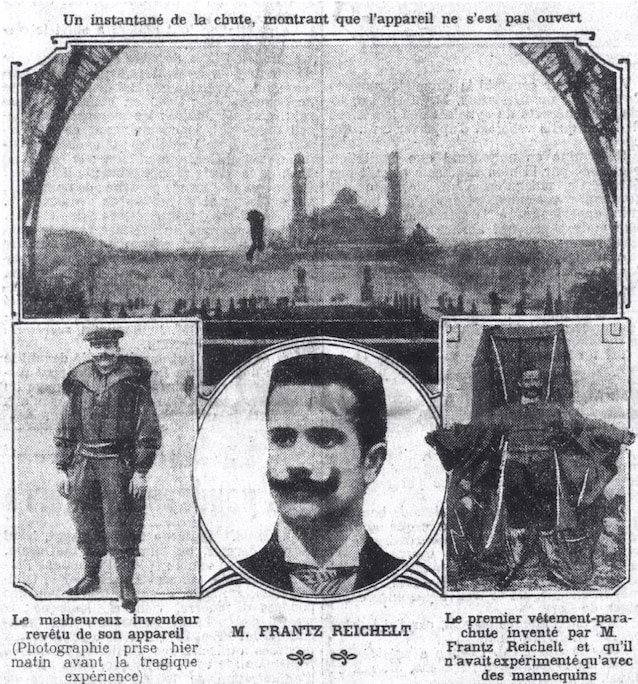
Not finding any obstacle in his path, on the morning of February 4, 1912 the young tailor (he was only 33 years old) showed up on the first floor of the tower with his parachute suit with him. The bystanders wondered why he hadn’t brought one of his mannequins with him, and were astonished to find that the tailor had decided to cast himself in their place. Yet, no one stopped him.
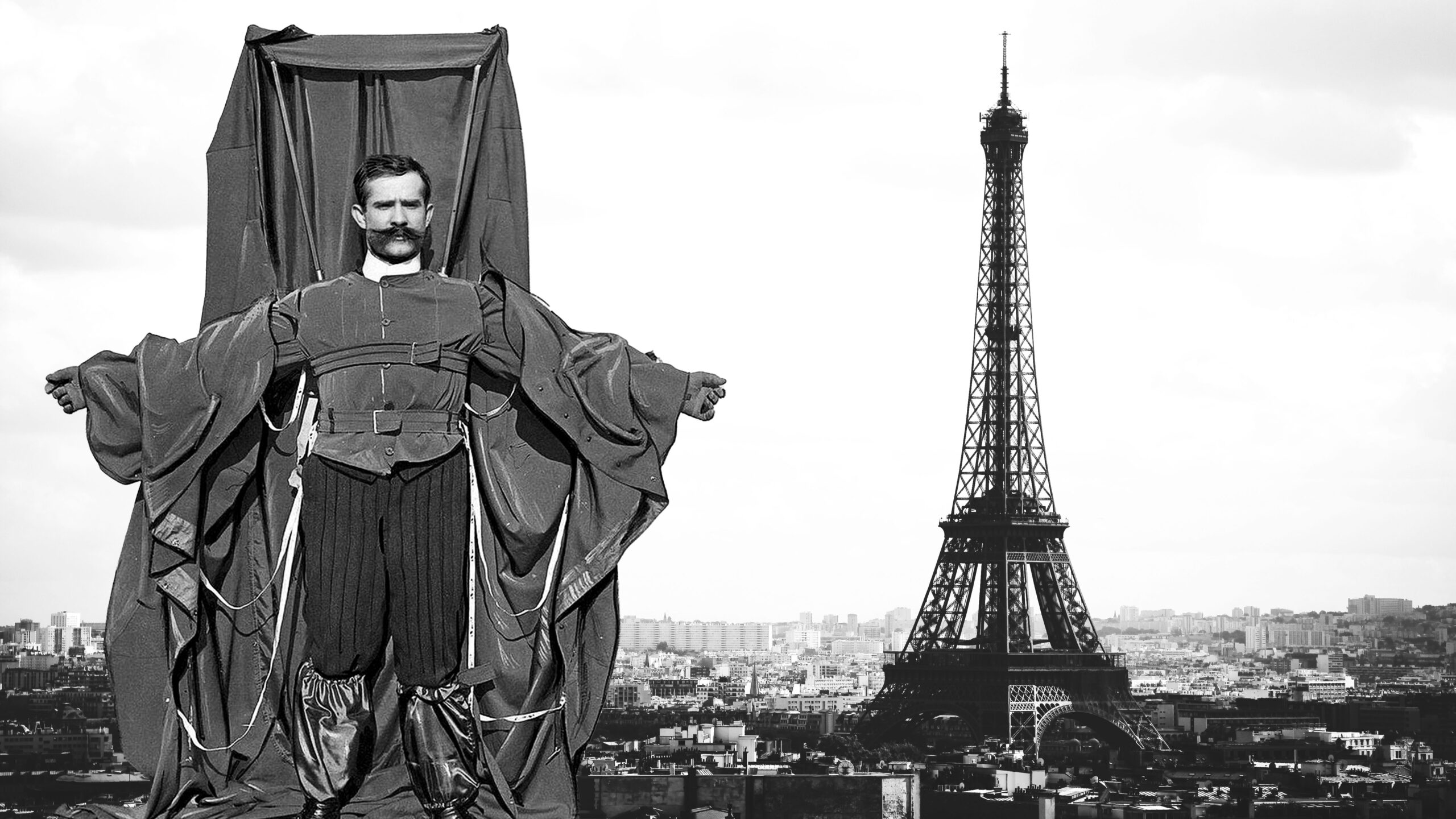
Reichelt put on his bulky and uncomfortable creation (which made him look like an enormous bat), climbed onto a stool and then, after a few moments of hesitation, jumped off the stool and went over the balustrade. With his long mustache blowing in the wind, he flew plummeting towards the ground, with the cloth wrapped around his body, and then ended up crashing to the ground, dying instantly. On the pavement in front of the most famous work in France, a small had been created crater. Inside, the body of the stubborn flying tailor, surrounded by a crowd of onlookers.
The tailor’s invention — which opened only shortly before the crash — had a big problem, namely the the device loadwhich was the detail that was fatal to him: it weighed 70 kilos and it had some decidedly non-negligible technical shortcomings.
When someone asked who had given him permission to do such a stupid thing, the police prefect justified himself by saying that he didn’t think the tailor would have jumped himself, but that he would have sacrificed a mannequin.
We then wondered what had led the tailor to make such an absurd gesture, and whether he was aware that he would die. No one will ever know the motivations behind this bizarre undertaking, but the fact is that the flying tailor is still remembered today: at the top of the charts stupidest deaths in history.