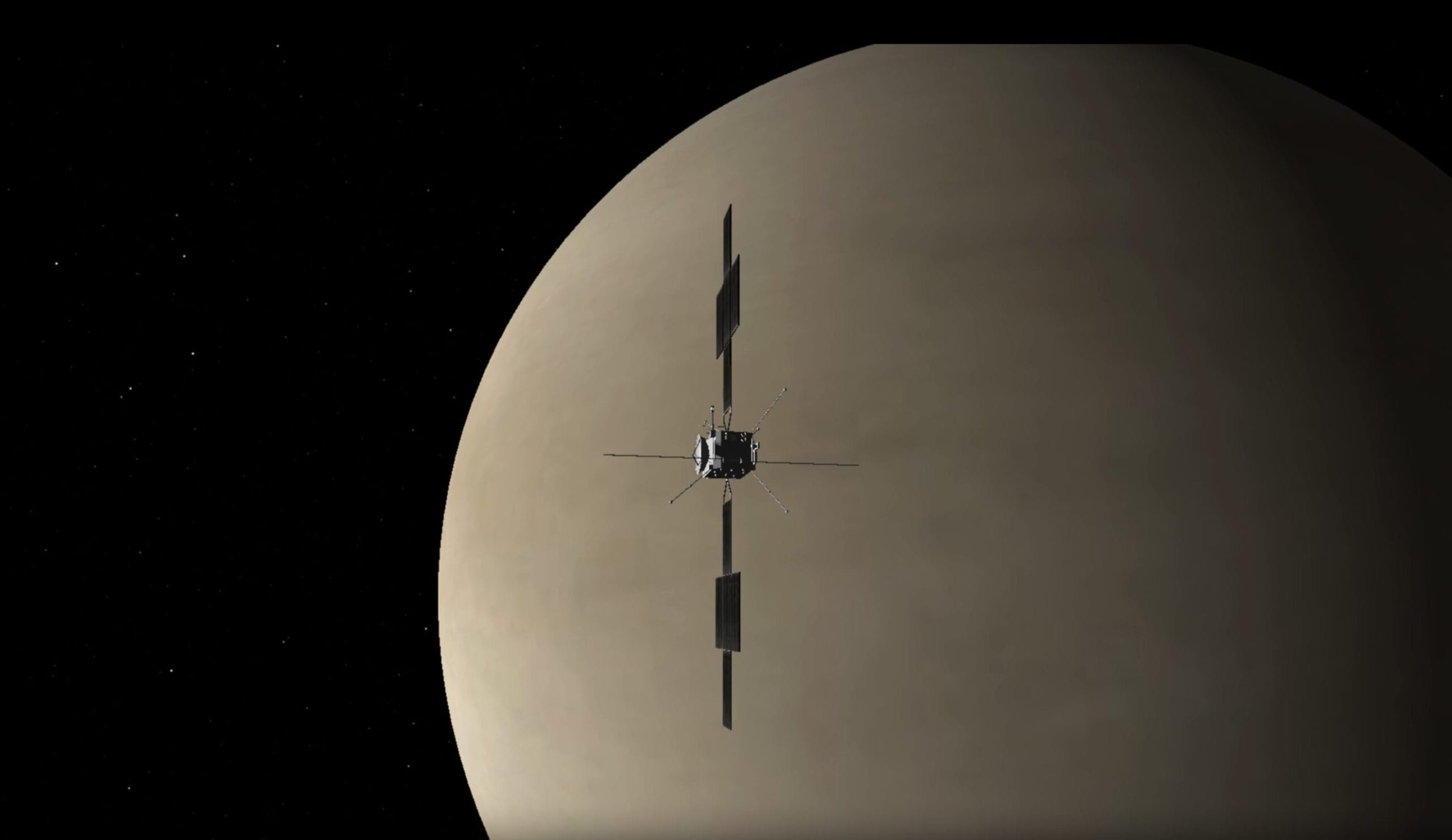
The probe Juice (Jupiter Icy Moons Explorer) of the European Space Agency (ESA) carried out the close overin jargon fly-byof the planet Venus as part of his route to the Jupiter’s system. It is the third fly-by of the mission, which took place on the morning of August 31, 2025 at 7:28 Italian time, after the first two who saw Terra and Luna protagonists last year, including the first double Fly-by in history last August. The maneuver is necessary to exploit what is defined “gravitational slingshot effect”an orbital maneuver that helps probes a gain speed exploiting the gravity of the planets, leading to a fuel savings. In addition to accelerating the probe, Venus’s fly-by has allowed scientists of test and calibrate the tools on -board. Juice will carry out Two other Fly-by with the earth in 2026 and 2029 To then reach the John System and its frozen moons in the 2031. The purpose of the mission is precisely theexploration of the Medici moonswhose oceans buried by Coltri di ice represent the most promising places where to find extra-terrestrial life within the sun system.
The Juice probe and the close overlooking of Venus towards Jupiter
The mission Juice has as its objectiveexploration of Jupiter and his satellite court, in particular the frozen moons Ganimede, Callisto and Europe. Over the years, scientists have accumulated several tests that these natural satellites have immense salted water oceans under theirs icy surfacesthus making it the most promising places of the sun system (together with Mars) on which to find extra-terrestrial life.
The probe was launched the April 14, 2023 on a route that uses different fly-by To reach Jupiter by saving fuel on board. These fly-by They are also called “gravitational slingshots” and are orbital maneuvers that exploit the gravity of a planet to increase speed of a probe, just like a slingshot would do.
Juice has already made two fly-by in 2024 exploiting the gravitational effect of the earth and the moon. The third fly-by It happened at 7:28 Italian time of Sunday 31 August 2025this time, however, taking advantage of the gravity of the planet Venus. Landing the surface a a few thousand kmthe orbital maneuver accelerated the probe, entering it on an orbit that will bring it to the last two fly-byplanned for September 2026 and January 2029. The probe will have the right orbital configuration at that point to reach Jupiter in the July 2031 and then use fuel on board for get into orbit around Ganimede in 2034First time a probe is put in orbit around a natural satellite of another planet.
The problems (resolved) to the on -board tools of the Juice probe
Although Juice has not yet reached their destination, they have already been there Two episodes who have held With suspended breath the scientists of the mission. The first took place practically Shortly after the launchwhen theRime tool antenna had not initially managed to unfold. Rhyme is the radar that the probe will use to disdain the oceans under the ice of the moons, for which it represents the fundamental tool of the probe. Fortunately, shortly after the scientists managed to reactivate it, bringing the alarm back.
Alarm that took place again on the morning of the July 16, 2025. The Easa Terra di Easse station in Spain it has not succeeded in fact On that day a Contact the probe to receive the telemetry data and monitor the state. Scientists initially suspected that the probe had entered a sort of configuration of “survival”a way in which the probes enter when there are on -board problems, thus turning off the medium -profit antenna. Waiting for the automatic reset of the probe after 14 days was not a practicable option, given that the result of the reset would have been able to be too close to the fly-by. After more than 20 hours of worka command sent by the engineers managed to reach the low profit antenna and reactivate the signal amplifierthus fully restoring the telemetry of the probe.
The problem was in a bug of the on -board software that has a function that activates or deactivates the signal amplifier that relies on an internal timer that resets every 16 months. Bad luck wanted the function to be recalled just at the exact moment in which the on -board timer reset, making the amplifier remain off, thus making the Juice signal too weak to be detected.
