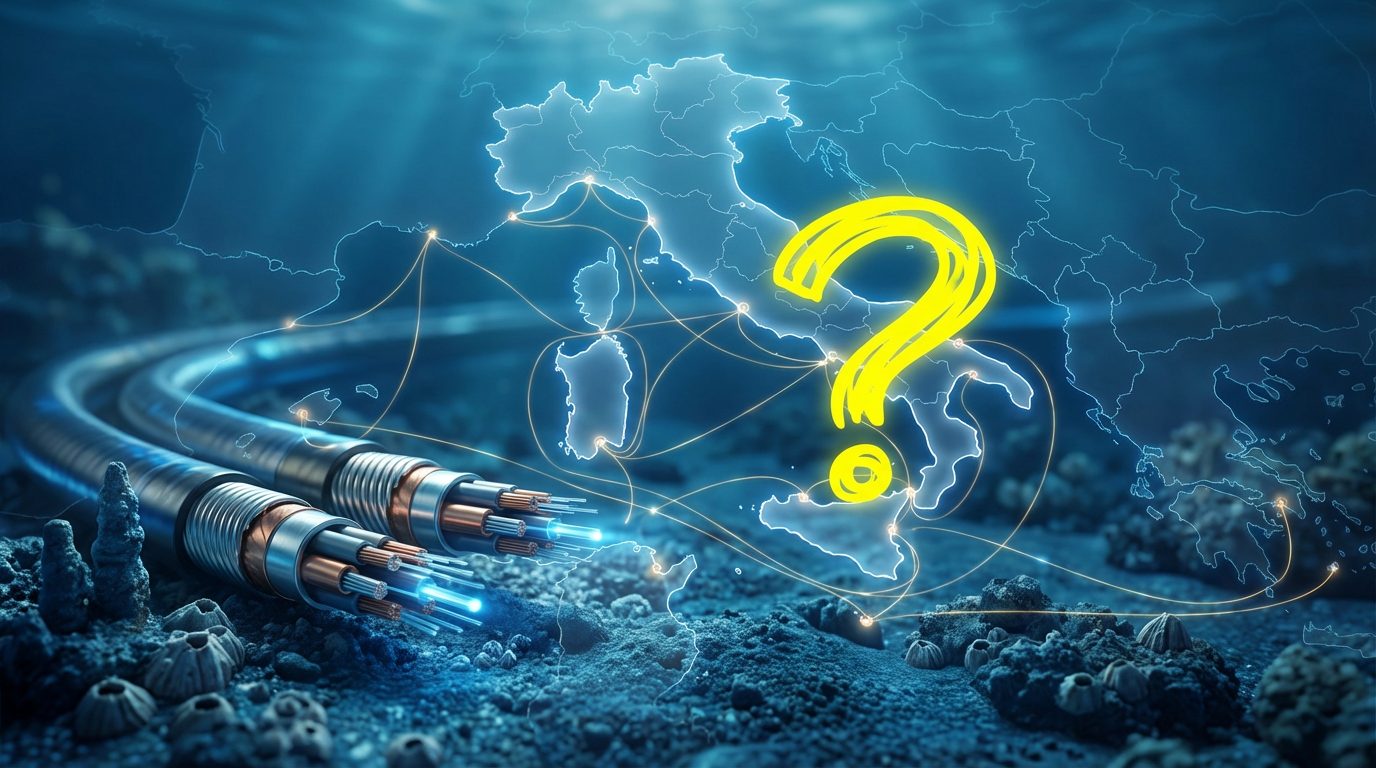
The theme of submarine cables returned to prominence after the island of Lampedusa it remained without internet or telephone connection, with a blackout that began on November 24th and ended only yesterday, December 2nd. The cause is attributable to the damage to a submarine telecommunications cable between Licata, Linosa and Lampedusa which, according to the manager FiberCop, was caused by «non-compliant behaviorssuch as trawling or anchoring in prohibited areas.” At the same time, the increase in tensions between NATO and Russia has once again ignited the fears of sabotage, an episode already occurred in November 2024.
But have you ever wondered How many submarine cables are there in Italy and where are they located? According to TeleGeography estimates, in our country there are approximately 25 submarine cablespositioned in strategic areas, including Sicily, from which cables reach as far as Greece and Malta, but also Egypt, Israel and Libya.
What are submarine cables and where are they located in Italy
Unlike what we might think, the Internet mostly works thanks to cables laid on the ocean floor. These are special cables that contain thousands of optical fibers and which allow the passage of information. In our country there are approximately 25installed to connect Italy with other states (Albania, France, Tunisia, Libya etc.), but also for unite the Peninsula with the islandsas visible in the map below.

In general, our country is mainly crossed by two types of submarine cables: firstly there are telecommunications cables, such as the one damaged in Lampedusa (highlighted in yellow in the image below), which extends for 240km and is called “Lic-Lin-Lamp”, as it connects the islands of Lampedusa, Licata and Linosa.

But there are also submarine cables for the transport of electricity: among the most important is the one that connects the Lazio to Sardiniaoperational since March 2011 with 435 km of length. As reported by Terna, this cable ensures a capacity of 1,000 megawatts and represents one of the deepest in the world, reaching 1,640 meters below sea level.
It must be said, however, that with the development of projects such as Starlink, SpaceX’s constellation of satellites designed to provide broadband Internet connections in the most remote areas of the world, the laying of submarine cables could decrease: at the moment, however, satellites cover less than 1% of data transmission globally.
In the specific case of Lampedusa, however, the Starlink alternative made it possible to guarantee some connections, even if to a minimal extent.
Undersea cables in the world: the global map
As confirmed by ISPRA (Higher Institute for Environmental Protection and Research), the global network of submarine cables for telecommunications extends for over a million kilometres and transports 99% of intercontinental Internet traffic, as visible in the map below. The total number of these cables is unclear: according to estimates by TeleGeographywe would be talking about over 600. The laying of the first telegraph cables began around 1850, and then continued in the first half of the 1900s with the development of analogue coaxial cables, up to the current optical fiber cables, laid starting from from the 1988.

At European level, in recent years the EU has been strengthening its connectivity infrastructure through 51 new projects, under the Connecting Europe Facility Digital (CEF Digital), for a total of 420 million euros invested. The aim of the program is to support the creation of secure cables, reducing dependencies on non-EU infrastructure and strengthening Europe’s position as a global connectivity hub.
But, in the end, who owns these undersea cables? It must be specified that submarine cables have a extremely high cost: those in fiber they can be expensive up to 90,000 euros per kmwhile those for energy can easily reach i €100,000/km for low voltage ei €500,000/km for high voltage.
Precisely for this reason, the main investors in this field are telecommunications companies, together with large ones companies – mainly Americans – who base their business on the Internet, including Amazon, Meta or Google.
