
Among those who play at roulette There is a method circulating that seems to offer a mathematical guarantee for winning: the martingalealso known as “doubling methodThis strategy consists of betting on a color (red or black) and, in case of loss, trying again doubling the bet. In theory, thanks to this strategy you have the mathematical certainty of ending your games with a positive balance. In reality, this strategy only works if you have an infinite bank account and if there are no limits on the maximum bet.
The martingale belongs to a family of strategies popular among French bettors in the 18th century. The origin of the name is not entirely certain, but one of the hypotheses connects it to the expression “jouga a la martegalo” used to indicate a Absurd and irrational way to play. Over time, these strategies have been formalized and studied, until they became actual mathematical objects, which still keep the same name.
Let’s see how this strategy works in detail, why it seems to guarantee success in ideal conditions and why, in reality, it quickly leads to failure.
What is the Martingale and how does it work
The martingale strategy works like this: let’s imagine we are at the table French roulettecomposed of 37 numbers, 18 black, 18 red and 1 green zero. In color bets, the dealer pays double the stake if he wins.
We therefore bet €1 on black. At this point three cases can occur:
- we win €1if a number comes up black. In this case, in fact, we collect €2, but €1 was the initial bet, so we actually “won” only 1;
- we lose €1if a number comes up red;
- we lose half the bet or we get it back on the next turn, if it comes out zero. These rules, however, are not valid in all casinos, in most cases you simply lose your bet.
If we losethe martingale suggests double your betthen bet €2 again on black. If we won now, the bank would return double what we bet, i.e. €4. At this point we have spent €3 in total (€1 on the first spin and €2 on the second), and a €4 win would leave us with a net profit of €1.
What if we lost? We should double again by betting €4. In this way we would have spent a total of €7 (€1 in the first round, €2 in the second, €4 in the third) and in case of victory we would collect €8, with a positive balance of €1.
Even if we didn’t win now, we should continue to double the stakeplaying €8, then 16, then 32, 64,128… and so on, until a black number comes out, which allows you to recover all the previous losses and still close with a profit of €1.
Seen like this, this strategy seems infallible: sooner or later black will come out and allow you to recover everything. In fact, this strategy hides pitfalls.
If we have infinite money, the martingale strategy works
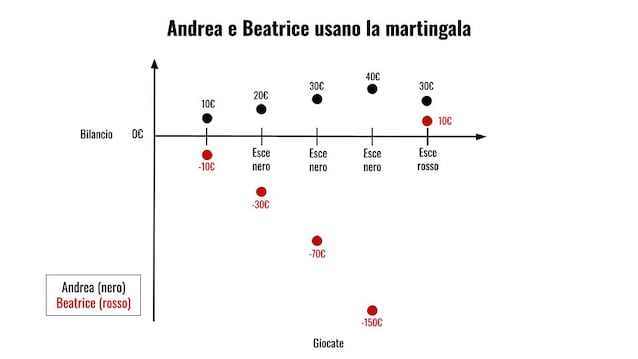
Let’s consider two players: Andrea and Beatrice. Andrew always bet on black, Beatrice always on red. Both follow the martingale strategy and start with a bet of €10.
On the first spin of roulette comes out black: Andrea earns €10, Beatrice loses €10.
On the second spin, Andrea continues to bet €10, while Beatrice, who lost, must double the stakebetting €20. It comes out black again: Andrea earns another €10, Beatrice loses €20 and her negative balance rises to €30.
On the third round, Andrea remains at €10, Beatrice doubles to €40. He still goes out black: Andrea wins, Beatrice loses and reaches -70€.
On the fourth spin, Andrea bets €10 again, while Beatrice has to go up to €80. He still goes out black: Beatrice loses another €80 and reaches a total loss of €150 in just 4 plays.
On the fifth lap, Andrea continues with €10, while Beatrice must bet €160. This time, however, it comes out red: Beatrice recover all losses previous ones and closes with a positive balance of €10.
This is the mechanism behind the martingale: even after a long sequence of losses, a single win is enough to recover everything and go positive.
But what if the two players could continue playing without any money or bet limits?
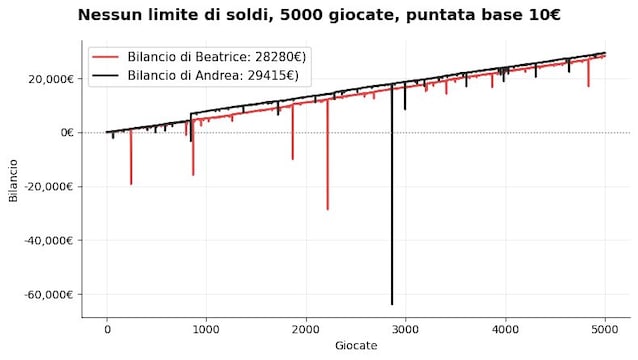
As can be seen from the graph, in these conditions both Andrea and Beatrice would end up, sooner or later, with more money than they had at the beginning (Andrea +28280€, Beatrice +29415€). Both go through phases of strong loss, the so-called moments of “ruin of the player”, but they always manage to get out by continuing to double their bet.
The problem is that this situation only exists on paper. In reality, the money into our current account it is not infinite and casinos (both physical and online) impose a maximum bet limit. And it is precisely here that the martingale stops working: not being able to continue to double the stake indefinitely, it is not possible to escape from the “players’ ruins”.
In reality this strategy doesn’t work: the mathematical flaw
As we have seen, the martingale strategy it only works if we can continue to double your bet every time we lose. The problem is that this requires sums of money that grow very quickly.
In the previous example, in just five unlucky spins Beatrice found herself betting €160. If the negative streak had continued for another four rounds, he would have had to bet €2560 to recover his losses. It might seem unlikely to get that many blacks in a row, but it’s actually not uncommon at all. On 18 August 1913 in Monte Carlo, for example, there were 26 consecutive ones.
But let’s see how the situation changes when we make it more realistic. Let’s imagine that Andrea and Beatrice have €5,000 in their account, they start from a base bet of €10 and that the casino has a maximum bet limit of €10,000. Under these conditions, the result changes completely.
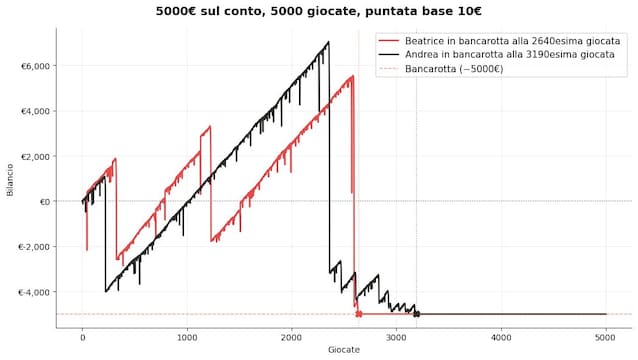
By continuing to play for a long time, both inevitably end up in bankruptcy. In this case, both Andrea and Beatrice reach the “player’s ruin”, respectively in 3190 and 2640 plays (which correspond to a few hours of play), draining their bank account.
