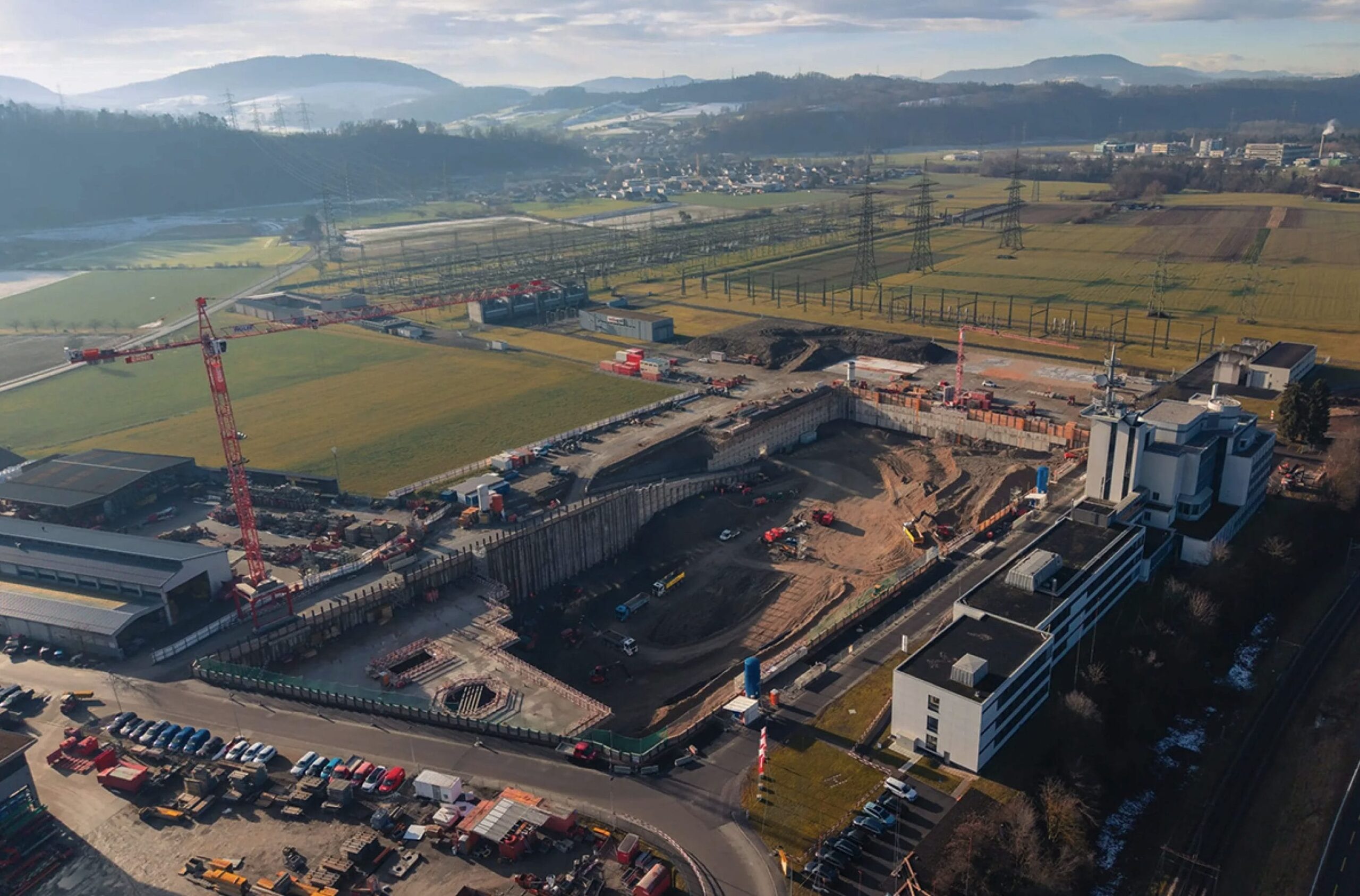
In the Swiss canton of Aargau, almost on the border with Germany, a deep trench is being dug 27 meters and almost 200 meters wide. It is there, at the Laufenburg Technology Center, that the most powerful redox flow battery ever built in the worldwith a capacity of 2.1 GWh (the energy demand of 210,000 homes for 24 hours) and a maximum expected output of 1.2 GW in a few milliseconds. It is being created by FlexBase, a Swiss energy company that aims to complete the work by 2029. The use of this enormous storage system will be to store energy produced through renewable sources to be released during peaks in demand, especially to power the data center for artificial intelligence under construction right in the Swiss technology center. The project will also serve for stabilize the European electricity gridgiven the strategic position of Laufenbug in the heart of the continent.
Why the redox flow battery in Switzerland will be so big: how it works
Redox flow batteries are interesting from the point of view of energy transition because they represent aalternative to lithiuma strategic resource underlying traditional batteries which however has a very high environmental cost.
In flow batteries energy is stored and released via ion exchanges between two liquid solutions containing electrolytes. These two solutions are conveyed via pumps into one electrochemical cell composed of two compartments separated by a membrane. They happen in the cell oxidation-reduction reactions (or redox) which result in the passage of ions (i.e. electrically charged atoms) across the membrane.
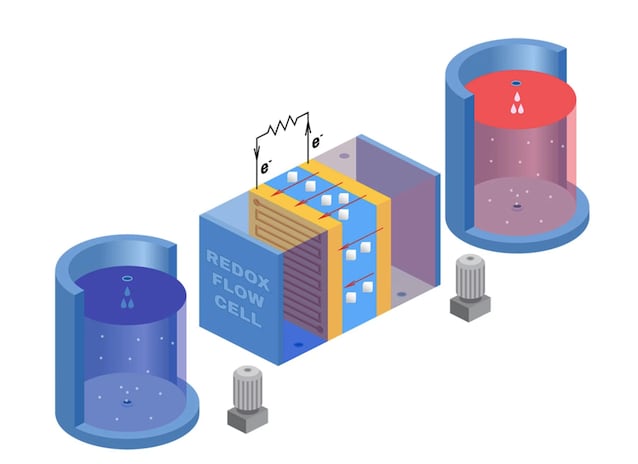
In fact, what happens is a flow of electric charges from the cathode to the anode and vice versa, thus transforming the chemical energy contained in the electrolytic solutions into electrical energy. In the phase of battery chargethe electric current transforms the chemical compounds present in the electrolytes, bringing them into an oxidation state which “stores” energy. In the phase of downloadthe reactions are reversed and the ions return to their original state, releasing the accumulated electrical energy.
The practical consequence of this mechanism is that there capacity of accumulation depends solely on the volume of the tanks. To increase the energy that the battery can accumulate, therefore, it is necessary to build larger tanks. This is why the Swiss plant is so large: to have a very large system it must be, literally, enormous.
The advantages over lithium
The electrolyte solutions of the plant under construction in Switzerland will be composed for 75% waterwhich makes them non-flammable and non-explosive. This is a key safety feature for systems of this scale, while lithium batteries can catch fire or even explode.
Furthermore, the structure of the system involves a reduced maintenance and above all a minimal degradation over timebecause the effectiveness of the return to initial conditions through oxidation-reduction reactions is almost total. Unlike lithium batteries, which deteriorate cycle after cycle, a well-designed redox flow battery is therefore theoretically capable of operate for very long times.
The problem with these storage systems is the cost, which is very high: the Swiss system, for example, costs over a billion dollars. This is also why we aim to create systems that are as large and powerful as possible: in fact, these systems, given a significant initial investment, could become competitive if built on a large scale in order to amortize their cost over a long operating life.
