
The Øresund Bridgeinaugurated in 2000, is the longest cable-stayed bridge in Europe and connects the Denmark at the Sweden with one length of 7.8 kmeven if the infrastructure as a whole includes, in addition to the bridge, an artificial island and an underwater tunnel for a total length of 16km across the Øresund Strait. It represents one of the most interesting infrastructural works ever conceived, merging rubber and rail into a single infrastructure. If we consider every possible type of bridge, the longest in Europe is the Vasco de Gama Bridge in Lisbon.
The characteristics of the Øresund Bridge
The Øresund Bridge it is one of the largest infrastructures in Europe for road and rail transport and is made up, in total, of three main sections. The first section, formed by a long cable-stayed bridge 7.8 kman artificial island, called Peberholm, 4 km long, where the bridge joins the third section, formed by an underwater tunnel, the Drogden tunnel.
The first section we said is the one formed by the cable-stayed bridge. This bridge starts from the city of Malmo, Sweden, and it is, in fact, the longest cable-stayed bridge in Europe with its 7.8 km. The most interesting part is the central span, which is very long 490 meters. The main pylon that supports the structure is tall 208 meters.
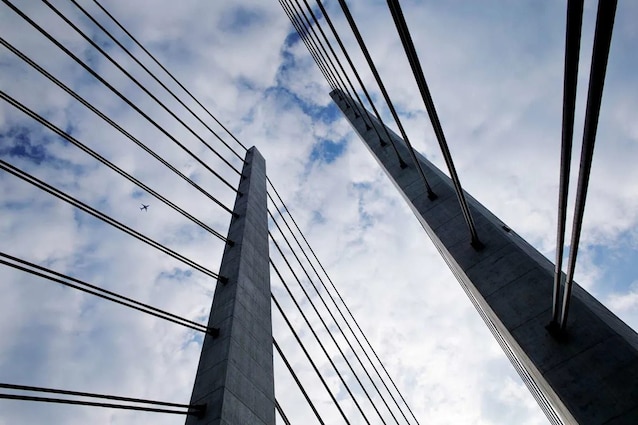
The interesting part about this bridge is that it is structured up two levels. The upper level houses the four-lane highway, the European Route E20, and, in the lower part, railway tracks have been built connecting the Danish and Swedish railways. The bridge ends on Peberholm Island, to enter the Drogden Tunnel. This underwater tunnel extends for a total length of 4.1 km, ending on the Danish island of Amager, not far from the city of Copenhagen. From an engineering point of view, it was built by putting together 20 enormous pre-stressed reinforced concrete elements and then resting them in a trench dug into the seabed. The depth is 11 meters below the water surface. The transition point, where the cable-stayed bridge connects to the tunnel, is depicted from the artificial island of Peberholm, made entirely using material dredged from the seabed for the construction of the underwater tunnel.
The island is located in the Øresund Strait, slightly south of the natural island of Saltholm.

The reasons for the construction in three sections of the engineering work
The need to create aartificial island as a transition point between a bridge and an underwater tunnel was dictated by two sets of reasons. The first is that relating to costs, in fact the construction of a single large tunnel would have created an excessively expensive solution. Even the construction of a huge bridge, capable of covering the entire Øresund Strait, would have been an impractical option, especially because the pylons would have reached prohibitive heights, also given the proximity to Kastrup airport.
The island also represented a sort of interesting biological experiment, as it was deliberately left uncontaminated and not colonized by man. This has allowed many species of animals to colonize it, thus developing a rich and very varied ecosystem.

Criticisms of the project
The Øresund Bridge has been subject to heavy criticism. One of the largest is that relating to toll costsgiven that the crossing can in fact also cost money more than 60 euros if you cross it by car. The need to impose such a high toll, which certainly impacts the pockets of occasional customers more than anything else (those who cross the bridge frequently can get a season ticket), was dictated by the huge debts incurred by the infrastructure management body, the Øresund Consortium.
Another reason why we chose to keep the tolls so high is to avoid the infrastructure being unnecessarily crossed by tourist traffic. Therefore, leaving the toll so high, people often adopt alternative systems (flight or ferries on other routes), thus leaving passage on the bridge always, substantially, free.
Another harsh criticism leveled at the project was certainly that relating tosignificant environmental impact under construction. While on the one hand the creation of an artificial island on which a new ecosystem has developed was guaranteed, on the other the need to dredge, dig and pour concrete still had a significant impact on the ecosystem, including underwater ones.
