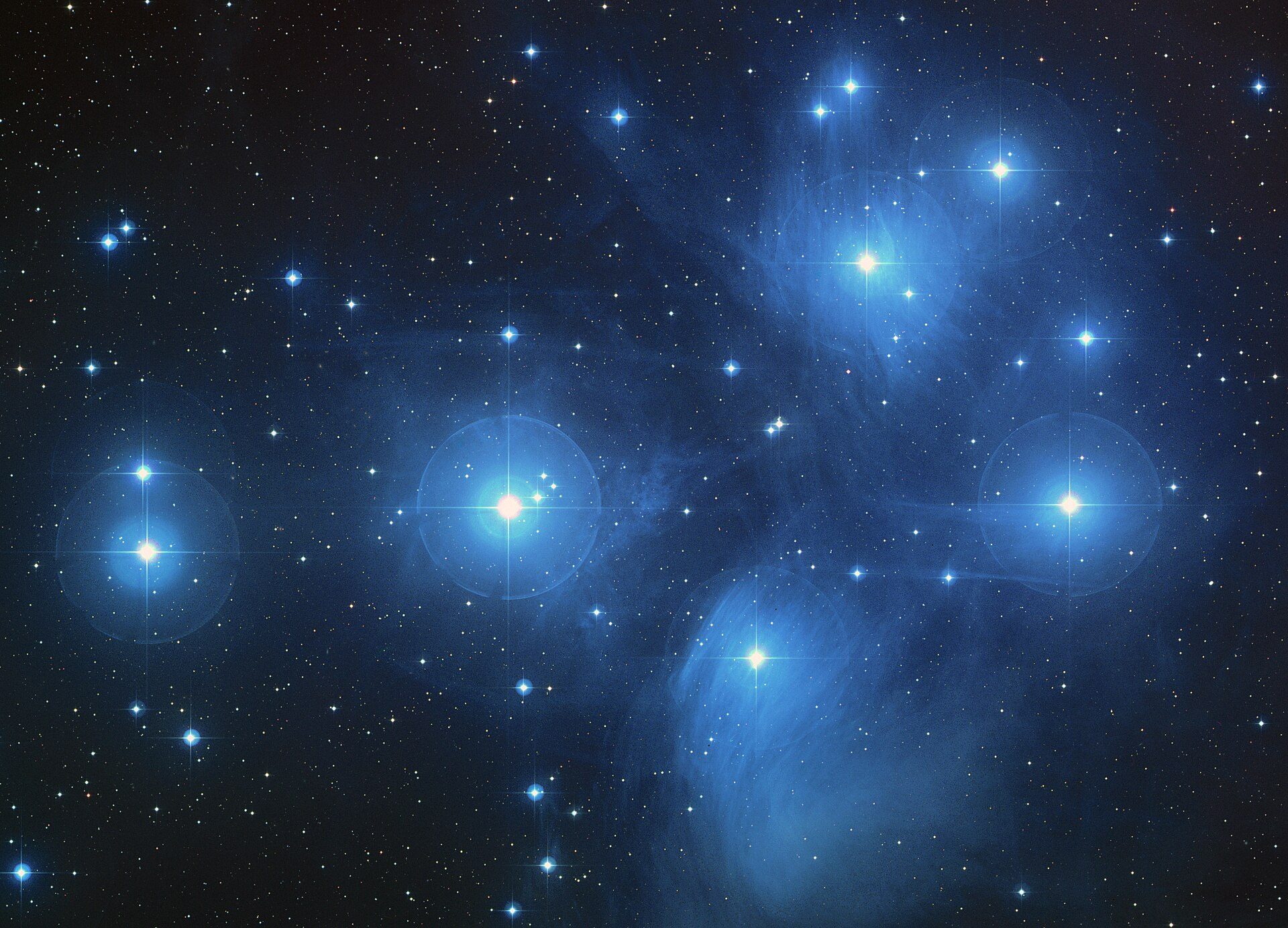
The famous Pleiades star cluster in the constellation of Taurus, cited in Greek mythology as the seven sistersit could be what remains of the nucleus of a largest complex of stars known as Major Complex of the Pleiades (Greater Pleiades Complex). According to a recent study appearing in the Astrophysical Journal, this vast system of stars visible to the naked eye would be made up of thousands of objects born together from the same cloud of gas hundreds of millions of years ago that have since dispersed over time within the Milky Way, leaving the brilliant Pleiades as a reminder of the core of this structure. The research represents a first step in the development of a new methodology that will also be applied to other star systems around the Sun, with the aim of understanding whether our star is also belonged in the past to a larger complex of stars.
What it means for the Pleiades: Study details
The discovery of the nature of the Pleiades as the nucleus of a larger complex of stars occurred thanks to the help of satellite data Gaia of the European Space Agency and the satellite TESS (Transiting Exoplanet Survey Satellite) from NASA. These two tools are indeed able to provide position and speed of billions of stars in the Milky Way, in the case of Gaia, and precise measurements of the variation in brightness of a star in the case of TESS.
Precisely these physical properties were crucial for the study in question. In fact, astronomers started fromhypothesis that all stars that were once close to the Pleiades must have similar ages and chemical compositionsand probably still almost there same speed of movement through the galaxy. The astronomers therefore first looked for all stars moving through the Milky Way at a speed that differs from that of the Pleiades. just five kilometers per second. They then further skimmed these objects looking for those whose age is similar to that of the Pleiades (about 125 million years). This is where the Tess satellite comes into play, estimating the age of the stars based on their age rotation speedsince Young stars tend to rotate faster than older ones.
By combining these features, scientists have compiled a catalog of more than 10,000 possible members of what they renamed as Major Complex of the Pleiades (Greater Pleiades Complex), of which the famous open cluster represents the surviving nucleus. Using the current estimate of the speed of motion of the stars, astronomers have estimated that they are they were all about 200 light-years from the center of the Pleiades 75 million years agowhich is consistent with the fact that all these stars are part of a larger structure that is now fully “evaporating” in the galaxy.
What are the Pleiades mentioned in Greek mythology
Being visible to the naked eye, the Pleiades are among the oldest celestial objects known to mankind. They are mentioned in Greek mythology as the seven sisters (Asterope, Merope, Electra, Maia, Taygete, Celaeno and Alcyone), although to naked eye only six stars of the cluster are visible in the direction of the constellation of Taurus (it is possible that two stars have moved closer in the sky over time, making it difficult to separate them). Using binoculars you can observe dozens of stars in the Pleiades, and hundreds of them if you use a telescope and long exposure images. The number observed therefore changes depending on the quality of the sky and the instrument used to observe them.
Physically, the Pleiades are a young open clusterwith an estimated age of 100 million yearslocated approximately 440 light-years from the Earth, enclosed in a volume with a diameter equal to 40 light-years. The brightest stars are blue stars of spectral type Bthat is, objects more massive and hotter than the Sun, responsible for the typical blue light of the cluster and destined to live only a few hundred million years. The blue nebulosity that envelops the cluster, visible only through long exposure images, is a so-called reflection nebulathat is, clouds of gas and interstellar dust that scatter the light of the hot stars in the cluster. Contrary to what was initially thought, these nebulae are not the residual gas from the formation of the Pleiades, but rather a region of interstellar medium that it is only momentarily crossed by the Pleiades.
The fact that today we know that the Pleiades represents only one small part of a much larger structure it makes them even more interesting because we are actually watching the remnants of a massive star formation eventwhich occurred more than 100 million years ago.
