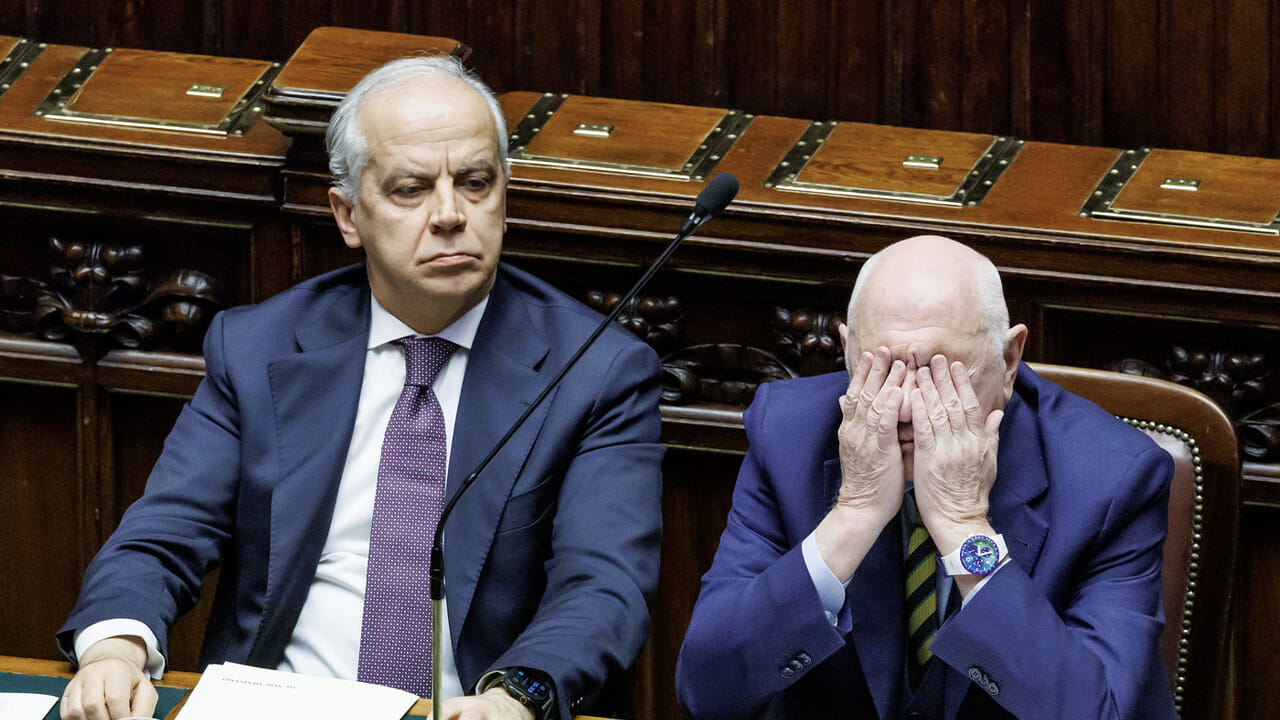
The Republic of Underpants: the scandals of the Meloni government
If it really were just a matter of private life, the latest scandal that is characterizing Giorgia Meloni’s government in recent days would be very little. A liaison between an ambitious communications expert and an elderly Interior Minister. The stuff of a romance novel, except that this latest tasty and – it must be admitted – hilarious expression of human misery – understood as weakness of the senses and the flesh, let it be clear – is piled up with the other scandals, more or less serious, of the third year of the government ofunderdog of Garbatella.
From 2022 to today, Giorgia Meloni’s government has churned out scandals with the regularity of a series streamed on one of the now many platforms, offering, episode after episode and season after season, an almost uninterrupted anthology of gaffes, dossiers, inadequacies and mostly fake romantic relationships. A series of human sketches worthy of the Italian sheep comedy of the mid-70s up to the 80s with Lino Banfi, Gloria Guida, Edwige Fenech and Renzo Montagnani. When it went well, it involved unfaithful husbands, ambitious and young all-round lovers – waiting for institutional positions or some radio broadcast–television ambushed in the crevices of the public TV schedule – and betrayed wives. When things went badly, the program featured dirty stories about journalists being spied on, dossiers on bank accounts, condescending repatriations to executioners with an arrest warrant from the International Criminal Court for crimes against humanity and torture on the back, revelations of state secrets made in shared apartments, New Year’s Eve shootings, gossiped partners and possible crimes such as false accounting and aggravated fraud against the State, with the addition of fraudulent bankruptcy, which in our country is now a proven title of merit.
2024: Sgarbi, Sangiuliano and the South American telenovela revival
In the beginning it was the Ministry of Culture that put on the show. And how could it be otherwise, both for the vocation of the Ministry itself – this, as we should all know, “protects and enhances the cultural and artistic heritage, including the performing arts” – and for the caliber of its characters? That is, the former “former minister” Gennaro Sangiuliano – the man who wrote the biographies of the powerful people of the Earth (from Hillary Clinton to Vladimir Putin, passing through Donald Trump and Tayyip Erdogan) – and the undersecretary Vittorio Sgarbi – creature of Maurizio Costanzo, who later ended up as a newsboy attacks–judges on the Mediaset networks for Silvio Berlusconi, ending up being elevated to the rank of dominus of the figurative arts and of the authentication of works of art and political party–time, divided between the union of small municipalities and a position as undersecretary. It was 2022, with the then undersecretary of Culture Sgarbi forced to resign from his position – after months of exhausting pressure inside and outside the government – because the Antitrust had established that his multiple activities as an art critic, lecturer, public appearances and professional roles were incompatible with the institutional position, identifying a conflict of interest with respect to the law on public offices. Then, once the Sgarbi case was closed, between August and September 2024 the Sangiuliano case took center stage–Boccia, a sort of South American soap opera with bright and sanguine tones – in the true sense of the word, complete with a deep scratch on the forehead of the former Minister of Culture – which ended with the resignation in favor of the lunar and dandy Alessandro Giuli, lover of pagan rites and lover of black leather overcoats and Attila Melanchini-style boots – character played by Donald Sutherland in “Novecento” by Bernardo Bertolucci. In the end, after a painful interview with Sangiuliano in prime time on Tg1, collected by the director Gian Marco Chiocci – who, among other things, is about to be the next spokesperson for the Prime Minister at Palazzo Chigi, perhaps because of the services rendered to Meloni – he resigns, amidst the mockery of half of Italy. Already then, Italians began to ask themselves some questions about the caliber of the ruling class of this government.
But they hadn’t seen anything yet. 2024 then ends with the scandal of the dossiing of the bank accounts of illustrious politicians and their families, including Giorgia Meloni herself, by a former Intesa Sanpaolo employee who – it was never clear why – had improvised himself as a “secret agent”. Despite the inconvenience of having her bank account under observation, Meloni herself took the opportunity to reiterate how she, a daughter of the people, was the subject of dossiers precisely because she was free and independent and, even more importantly, untouchable. From then on, the Melonian catchphrase “I am not blackmailable”. But if you think about it, it would have been more convenient for her to be a little more blackmailable, but to have friends in the government who were a little more moderate and sober.
2025: the twist Almasri and the Paragon case, from legal drama and to spy fiction
2025 is the year of twist – in the writing of a screenplay it represents a sudden and unexpected turning point in the plot that overturns the viewer’s certainties – in the TV series of the Meloni Government, which goes from a romantic drama to legal dramawith a splash of thrilling and a splash of secret service: the Almasri case. Libyan general Najim Osema Almasri, accused of serious crimes against humanity, was arrested in Turin in January 2025 on a warrant from the International Criminal Court, but was then immediately released due to a formal flaw, being repatriated on a state flight. The International Criminal Court subsequently ruled that Italy violated its cooperation obligations. The result was the inclusion in the register of suspects by the Rome Prosecutor’s Office of the main exponents of the executive – the Prime Minister Giorgia Meloni, the ministers Carlo Nordio and Matteo Piantedosi and the Undersecretary of the Presidency of the Council with responsibility for the secret services Alfredo Mantovano – with the hypotheses of aiding and abetting and embezzlement. All then archived by the Court of Ministers in October of the same year. The only one to be sent to trial was Giusi Bartolozzi – yes, the one who had declared that with the Yes to the referendum on justice we would get rid of the firing squad represented by the judiciary – who at the time of the events was deputy head (later, in the meantime, head) of Minister Nordio’s cabinet. The investigations against her were closed at the end of February 2026. Recently, on 2 April 2026, an indictment was requested for her, although the Chamber of Deputies is oriented towards raising the “shield” of parliamentary prerogatives (having been a deputy for Forza Italia) to protect her from the trial. Bartolozzi herself will then be forced to resign, the first victim of the Melonian purges, after the defeat in the referendum. Parallel to the Almasri scandal, the so-called “Paragon/Graphite” case broke out and so, from legal drama we moved on to gender spy fictionexcept that there isn’t much of it here fiction and a lot real. In summary, it turns out that a group of Italian journalists were intercepted and spied on for months through sophisticated surveillance software – called “Graphite” – produced and sold by the Israeli company Paragon. Even today we wonder who gave the mandate and order to the secret services to intercept these journalists and many suspicions weigh on the government team. The case created so much embarrassment that Paragon itself terminated the contract with Italy for alleged improper use. Further embarrassment was added to the embarrassment.
2026: the year of the Melonian justicialist purges
2026 marks, perhaps – and hopefully – the final season of this TV series that is at times compelling, but at times also very depressing. It’s the year of resignation. From the Undersecretary of Justice Andrea Delmastro to the Minister of Tourism Daniela Santanchè, forced to resign in the storm caused by the defeat in the referendum on justice. It’s not that before the referendum vote there weren’t all the conditions to force them to resign. But the defeat in the referendum advised Meloni to open the stage for a series of symbolic purges with the aim of revitalizing the image of the government entirely inspired by the principles of hyper–justicialism, a rule according to which if you are investigated and, even more so, sent to trial, you must resign. The undisputed champion of government embarrassment is certainly Andrea Delmastro Delle Vedove, protagonist in spite of himself of three masterpieces, in ascending order of seriousness: the Pozzolo case of January 2024, which sees our man involved as a witness in the investigation into the gunshot (it will later be learned that it was a woman’s pistol, elegant and small) fired at the New Year’s party in the municipality of Rosazza – starring the former FdI parliamentarian and now Roberto Vannacci, Emanuele Pozzolo; the Cospito case of February 2025, in which Delmastro was sentenced in first instance to eight months for revealing official secrecy on information linked to the anarchist Alfredo Cospito in relation to the 41 regime–encore; the Caroccia/Senese case of this last month, in which Dalmastro’s participation in a catering company with Miriam Caroccia, eighteen-year-old daughter of Mauro Caroccia, indicated by the prosecutors as close to the Senese clan and money launderer, emerges. In short, from the gunshot, through an anarchist in prison, to ending with steaks smelling of the Camorra. A sort of scandal star. Not at the first, not at the second, but at the third, he had to resign. One step below – but also two – there is Daniela Santanchè, priestess of the revanche of the Piedmontese provincial culture of Billionairea worthy representative of that part of the enriched country that sees all those who criticize them as poor – in the sense of incompetent – envious. In the end, she too, after a series of investigations, was forced to leave the ministry after months of investigations into her publishing company Visibilia, the funds received for the Covid emergency and a suspected fraudulent bankruptcy. Too much for neo fury–Meloni’s executioner.
The grand finale (hopefully): the Piantedosi case–Count. The Italian comedy of the Meloni government
To close – at least for now – the 2026 season, the Piantedosi case–Count. There love story revealed by Claudia Conte herself on a podcast hosted by social media strategist of Brothers of Italy in the Chamber. We return to the genre of Italian comedy à la Lino Banfi and, to be honest, it seems like a bad copy of the Sangiuliano affair–Bowl. Not really a great idea – to be honest – to hopefully close this TV series of the Meloni Government. In short, something already seen which makes it clear that this government team is at the lowest levels, compared to other governments, in terms of sobriety, sense of institutions and awareness of the gravity of its role. The clear feeling is that this government can go down in history only for the endless series of scandals and scandals, for the terrible gallery of human types it has proposed to the public and for the disarming sloppiness in representing the institutions. More than a “Banana Republic”, we are preparing to embody a “Republic of underpants and cash”. A sad slope to which we are getting used to a government without any political horizon and with too many scandals on its back. Looking forward to a new series to watch.
