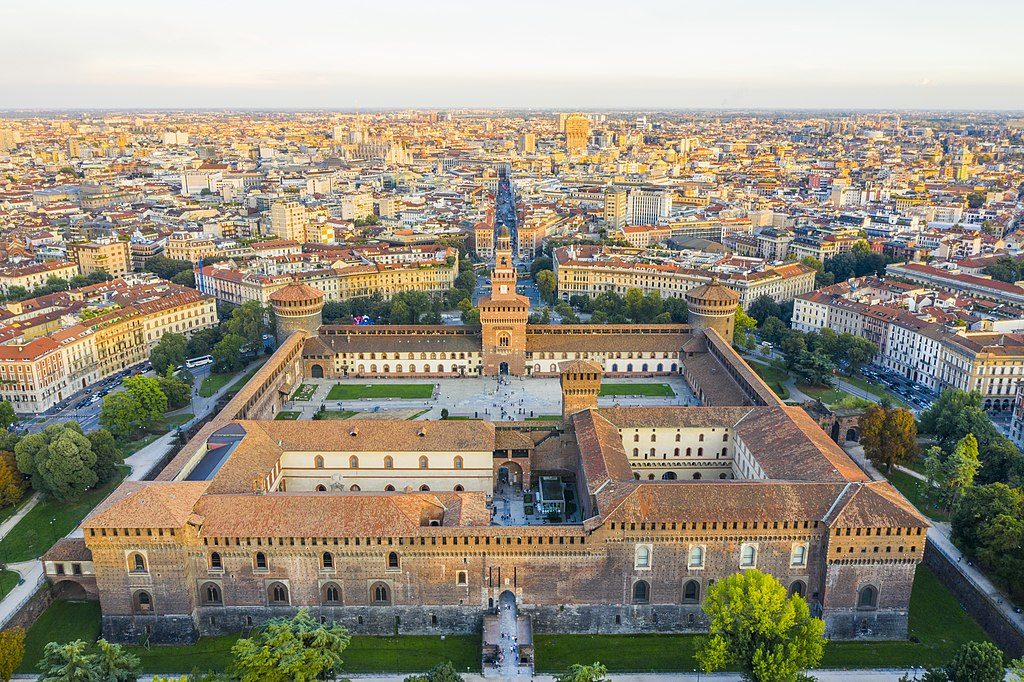
Located just outside the historic center of Milan, the Castello Sforzesco It is a large fortified complex, among the largest in Europe. His current Renaissance guise was wanted in the fifteenth century by the Duke Francesco Sforzawhich rebuilt it on the remains of a previous medieval fortress. In addition to being a symbol of Milanese history, since 1896 the castle has also been a first -rate cultural center, as the headquarters of the civic museums and custodians of one of the largest artistic collections of the city.
The architectural style of the Sforzesco Castle in Milan and the Filerete tower
The Sforzesco Castle represents one of the major externalizations of the architectural and military engineering functionality and, at the same time, residential. Its current conformation is the result of continuous changes that have determined destruction and reconstructions and that have given the castle the aspect it has today.
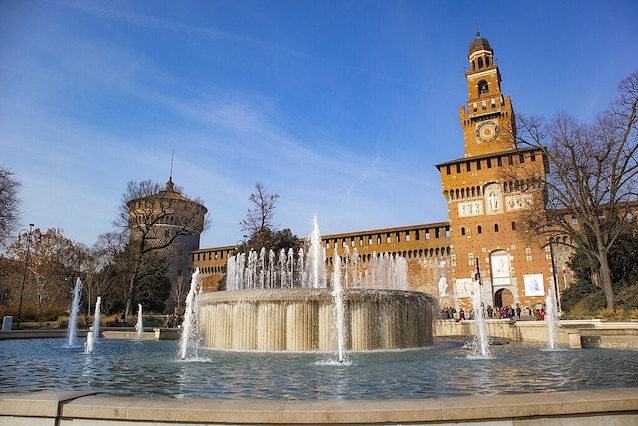
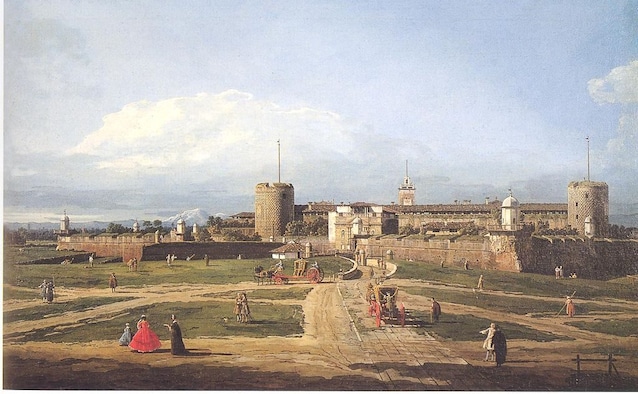
The castle presents itself with one square plant of about 200 meters per side, surrounded by a vast moat. The imposing perimeter walls, made mainly in red bricksdefine the defensive structure. The use of the moat, a flooded time, was a fundamental defensive strategy to prevent direct assaults and the use of siege machines.
The entire perimeter of the castle is marked by towers, each with a specific and well determined function. We have, first of all, the Torre del Filaretecertainly the most symbolic of the entire structure. In fact, it is the central tower. Collapsed in 1521, it was faithfully reconstructed by the architect Luca Beltrami At the beginning of the 1900s, becoming the symbol of the castle. It is the main access and has a bas -relief with the Sforzesco coat of arms. At the four corners of the perimeter of the castle, as many four towers made of stone are placed. Their circular shape made them much more resistant to cannon strokes during sieges.
The interior de Castello is divided into three main courtyards. First of all we have the Court of arms, which consists of the large internal courtyard, which was dedicated to military exercises and the parking of troops. Then we have the Ducal courtconsisting of the representative and residential area, where the Duke and his Court resided. Characterized by elegant arcades and frescoed salt, such as the Axis room decorated by Leonardo da Vinci. La Rocchetta represents the last defensive bulwark of the entire castle, consisting of a small fortified courtyard where the ducal family could take refuge in case of danger.
The walls of the castle are dotted with numerous holes who, although today they often offer shelter to the pigeons, their origin is purely functional: these cavities, in fact, served to support the scaffolding necessary for the construction and maintenance of the imposing fortress.
The Sforzesco Castle and the military engineering of Leonardo da Vinci
The figure of Leonardo da Vinci played a crucial role in the construction of the castle, in particular as a military engineer. In his manuscripts, such as the Trivulzian code preserved in the castle, there are sketches and drawings of war machines and engineering solutions for the defense of fortresses. He analyzed the weak points of the walls and designed innovative systems to resist sieges and artillery, which at the time was revolutionizing the war. Leonardo created complex systems of ditches and canals, not only for the defense, but also to manage the flow of water, fundamental for the castle and the city.
Its masterpiece at the castle is the pictorial decoration of this room. Leonardo transformed the environment into a natural pergola with a trompe-eeil of branches and mulberry leaves, intertwined to form a decorative motif that celebrated the link between the Duke (the “Moro”, a name linked to the mulberry) and nature. He was also responsible for the conception of scenographic set -ups and machinery for court festivals, demonstrating his exceptional talent in the creation of ephemeral visual and theatrical experiences, essential for the celebration of ducal power.
