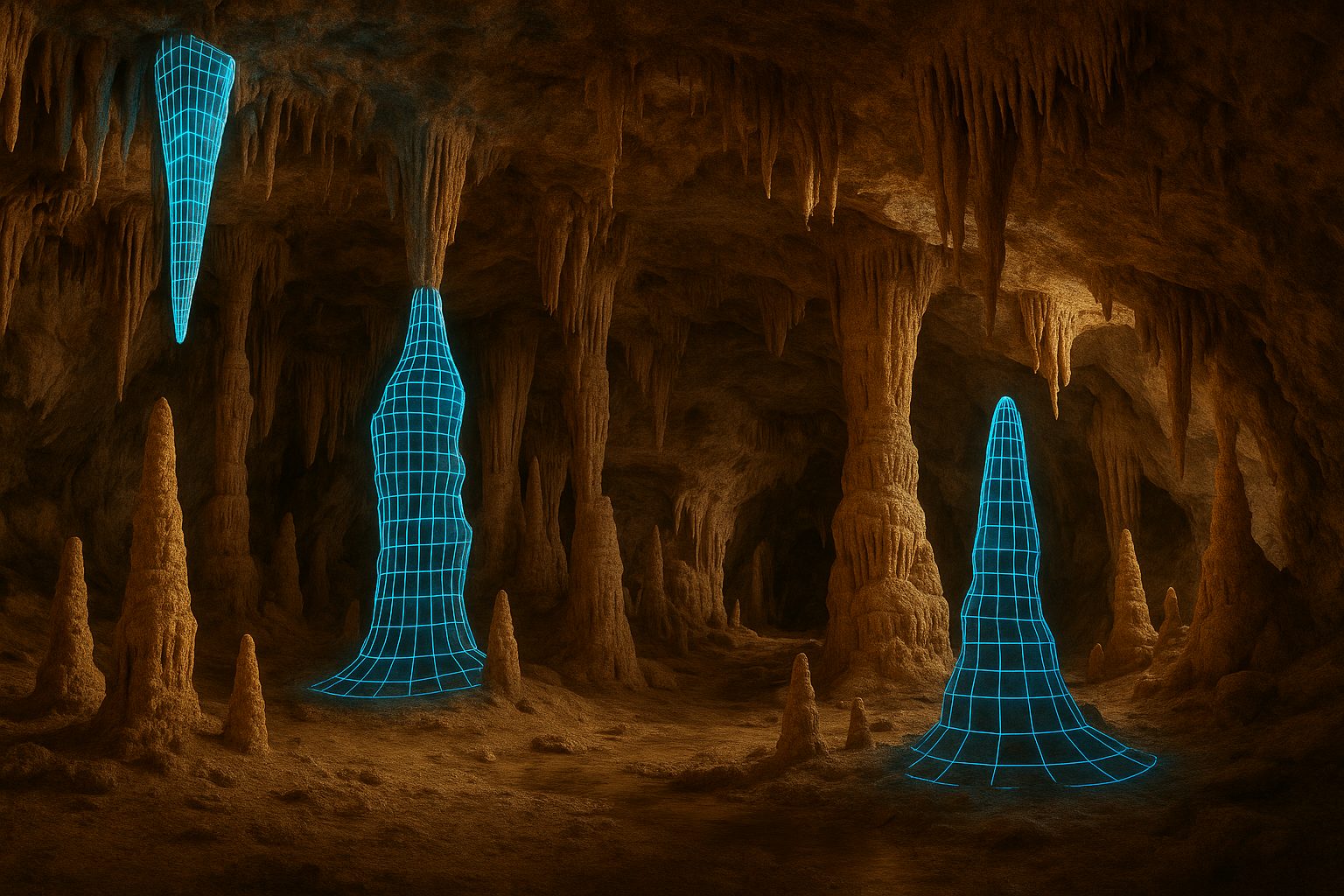
The shape of the stalagmites is not random, but can be explained with mathematics. Researchers P. Szymczak, AJC Ladd, M. and D. Pekarovič recently published a joint study between Poland, USA and Slovenia published in Pnas, which shows that the stalagmite shape can be described on the basis of a single parameter called Damköhler number. The researchers have in fact shown how different shapes of the stalagmites correspond to certain values of the Damköhler number, for example conical or column-shaped.
Thanks to this recent discovery we can make predictions about the shape of the stalagmites that we can expect to find depending on the conformation of the specific cave and some other physical and chemical characteristics of the environment.
The Damköhler number is not a mathematical constant with a fixed value but can vary, therefore each stalagmite has its own Damköhler number which is calculated with a specific formula in which they appear different variables.
Each of the variables in the formula describes a measurable characteristic of the stalagmite, such aswidth of the baseThe water flow that falls on the stalagmite, or the speed with which a certain chemical reaction occurs, i.e. the calcite precipitation. Each of these characteristics affects the shape of the stalagmite, for example a very wide base favors the formation of a flat top, while a high flow of water favors the formation of pointed stalagmites. The way in which these characteristics combine to give rise to the shape of the stalagmite depends on the different values that the Damköhler number can take on, let’s see how.
Once the values of all the variables involved in the formation of a stalagmite are known, it is in fact possible to calculate the Damköhler number, which is abbreviated to From, and which broadly reflects the characteristics of the stalagmite as follows:
- the larger the base of a stalagmite and the greater its Da
- the greater the speed of the chemical reaction involved and older is Da
- the greater the flow of water and the smaller the Da.
In general, it may turn out that the Damköhler number is smaller than 1 (Da<1), equal to 1 (Da=1), or larger than 1 (Da>1) and, according to the study by Szymczak and his colleagues, each of these three cases corresponds to a specific type of stalagmite:
- if From<1 the stalagmite has a shape conicalwith the pointed top
- if From=1 the stalagmite has an a shape column with the rounded top
- if From>1 the stalagmite has the flat topas if it had been cut with a knife
For example, if we are in a cave with a very high ceiling, we can expect to find many stalagmites with flat tops: the drops falling from a high height can deviate and wet a large area of the ground overall, resulting in a wide base for a possible stalagmite which will therefore have a Growing uppossibly greater than 1. For the same reason, in a cave with a low ceiling we can expect few flat-topped stalagmites and perhaps more columnar or conical stalagmites.
In reality there can be many factors that influence the shape of the stalagmite, but the fact that there is a number capable of describing the shape of a stalagmite is yet another example of how mathematics can help us understand the world around us in an eternal intertwining of abstraction and reality.
