;)
The Beijing Daxing International Airport (PKX) It is not only a new hub for air traffic, but aims to become a real icon of modernity that reflects China’s ambition. The event project bears the signature of Zaha Hadid And it was inaugurated in 2019. With a great ability to manage an important passenger flow, this airport was immediately nicknamed the “starfish“For its particular form.
The characteristics of the Beijing Daxing International Airport of Beijing
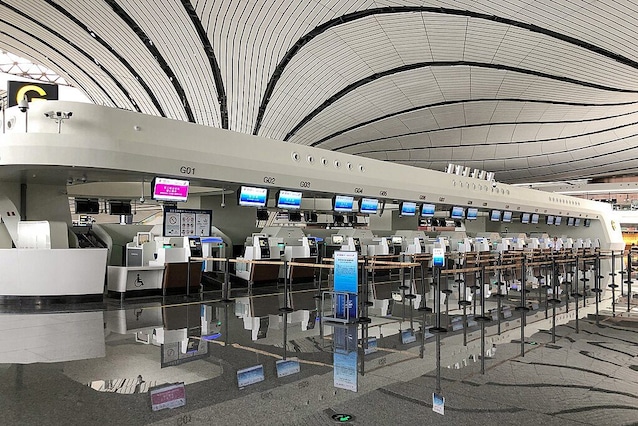
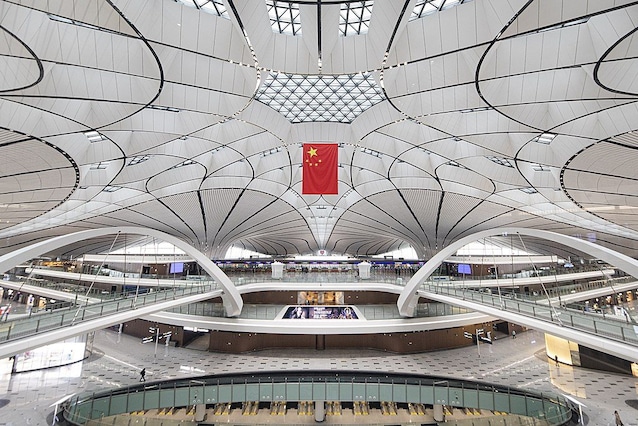
Located to about 46 km From Beijing, this airport was conceived in order to lighten the load of passengers of the airport of Beijing Capital, And to create a strategic hub to face the increasing request and demand for travel to Asia. The terminal of this airport is one of the largest in the world And, thanks to its modern design, it is able to drastically reduce the distances to walk inside the airport. The terminal design bears the signature of Zaha Hadid Architects and Adp Ingenieriè, and, to inspire its form, it was the traditional Chinese architecture. The star shape also involves several advantages: first of all there is a central hub from which five terminals branch off. This particular form allows optimized management of passenger and planes flows, avoiding congestion.
The distance between the center of the terminal and the farthest gate is only 600 meterswhich can be traveled in less than 8 minutes. This is a remarkable engineering result, considering that the terminal is almost as much as 100 soccer fields.
The engineering details of the star airport
The main structure is in steel, whose construction was a certainly remarkable engineering company, completed in less than 5 years. The project has certainly integrated multiple solutions in order to optimize sustainability, minimizing what is the environmental impact. In fact, in addition to an optimal use and use of natural light, rainwater collection and reuse have been installed. In addition, a large amount of solar panels are installed. To further facilitate the movements, efficient mobile catwalks and quick transport systems have been integrated.
The construction of the airport itself cost about 17 billion US dollars (about 120 billion yuan), with an overall cost for the surrounding infrastructures (roads, railways) which brought the total investment to approx 63 billion US dollars. The airport was designed to manage 45 million passengers per year, to arrive, in the not too distant future, to 100 million passengers per year by 2040. In 2023, the airport managed beyond 39.4 million passengers.
