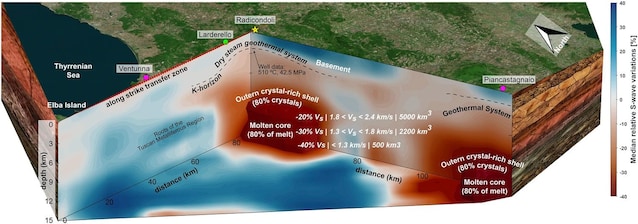
In Tuscanyunderground Larderello and of Mount Amiatahave been identified huge magma reservoirsmuch broader and deeper than previously thought. They are found between 8 and 15 km deep and they might have a volume of thousands of cubic kilometers. Magma chambers of this size are comparable to those of so-called “supervolcanoes”, such as Yellowstone. This large amount of magma, however, does not constitute an immediate danger. This is an incredible discovery in an area that, despite being geothermal, has not been affected by actual volcanic activity for hundreds of thousands of years. This was done by researchers from the University of Geneva, the Institute of Geosciences and Georesources of the National Research Council (Cnr-Igg) and the National Institute of Geophysics and Volcanology (INGV), whose study was published in the journal Communications Earth & Environment.
The discovery of the enormous magma reservoir in Tuscany
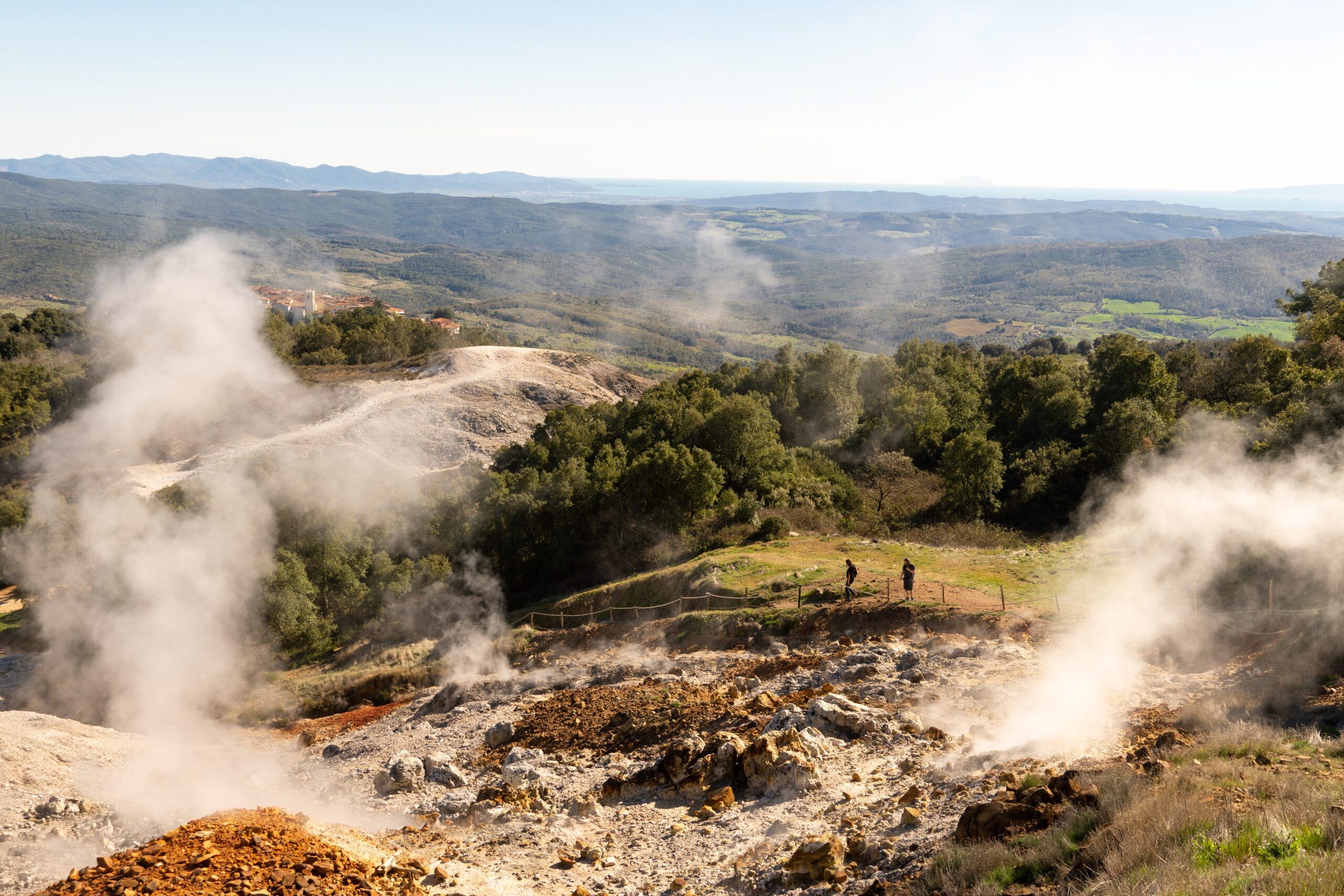
The areas of the planet in which there are “supervolcanoes”, which in the past have given rise to very violent eruptions with the emission of enormous quantities of materials, present a surface morphology and volcanic deposits which make them well recognisable. This is the case of Yellowstone in the United States, Toba in Indonesia and Taupo in New Zealand. However, large volumes of magma can also be found at great depths in unexpected areas, such as that of the so-called Tuscany Magmatic Province (TMP). Here the presence of magma underground is demonstrated by secondary volcanic phenomena, such as the famous ones boraciferous blowholes of Larderelloexploited to produce geothermal energy. However, the presence of magma reservoirs of this size was not known. The most recent eruptions we know of are those of Mount Amiataan extinct volcano located between Grosseto and Siena, occurred around 300,000-200,000 years ago.
“We knew that this region, which extends from north to south across Tuscany, is geothermally active, but such large magma reservoirs were difficult to imagine. This find is extraordinary,”
Explains Matteo Lupione of the authors of the study.
The “X-ray” of the subsoil: how they did it
To reconstruct the subsurface structure of the area, the researchers used the environmental noise tomography. This is a technique that allows you to obtain an “X-ray” of the Earth’s crust using the vibrations that are continuously produced by the wind, ocean waves and human activities. The waves that are generated propagate inside the Earth at different speeds depending on the materials they encounter. THE seismometers they record the times of arrival on the surface and therefore the speed of propagation. In this case one network of 60 broadband seismometers detected a slowing of the waves about 10 km deep in the crust. This type of behavior revealed areas of accumulation of partially molten rockscorresponding to magmatic reservoirs. It was so possible reconstruct a three-dimensional image of the subsoil structure.
The discovery first of all demonstrates theeffectiveness of this type of tomography to explore the subsoil without environmental impacts and with low costs. Furthermore, the discovery of deep magmatic systems may be important for the energy transition, since these are associated with critical raw materials such as lithium and rare earths. Finally, the identification of these reservoirs allows us to better quantify the potential of the area from the point of view of geothermal energy production.