
In Italian, when we use the way of saying “let’s do the proof of the nine”we mean that verify that will surely tell us if something is right or wrong. As if it were the latest confirmation we needed. This way of saying, however, was born from a False myth! In mathematics, The proof of the nine does not always tell us “the truth”. To understand what we mean, let’s see what the nine test consists of.
The proof of the nine allows you to control the correctness of an operationeven with many figures, reducing it to the same operation but carried out with two numbers of a figure. It works with all four operations (+, ×, ÷, -) and the procedure is basically the same. Let’s see it in the case of the multiplication which is the one in which it is most commonly used.
Suppose we have calculated 21 × 47 = 985to verify the correctness of the result we proceed in this way:
- A cross table is prepared
- The figures of the first factor are added, until a number of a figure is obtained (in this case 2+1 = 3) which we report in the first box of the table
- The figures of the second factor are added, in this case 4+7 = 11 which is not yet a number of a single figure so I addor 1+1 = 2, we report 2 in the box at the top right
- The figures of the result are added, in this case 9+8+5 = 22 from which 2+2 = 4 that we report at the bottom left
- Finally we multiply the numbers of the two boxes at the top and report the result in the box at the bottom right: in this case 2 × 3 = 6.
- We compare the numbers of the two boxes below: if they are different, as in our case then the result of the operation is wrong (see figure below).
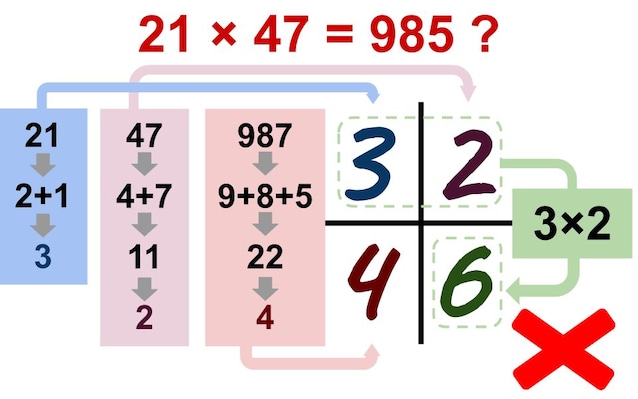
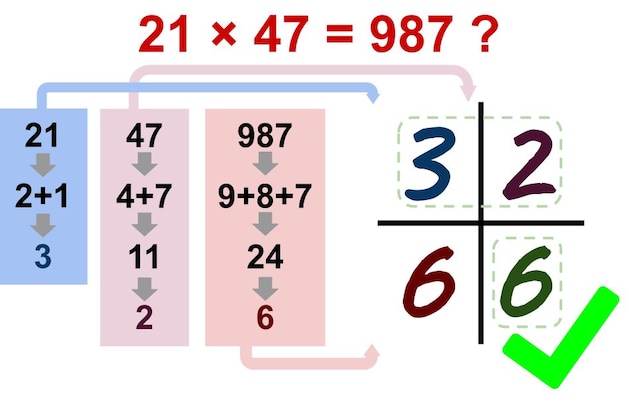
But what happens if the numbers of the two boxes below are the same? There are two possibilities, the first, as in the figure below, is the case in which there are no errors in the calculation, and the proof of nine confirms it to us.
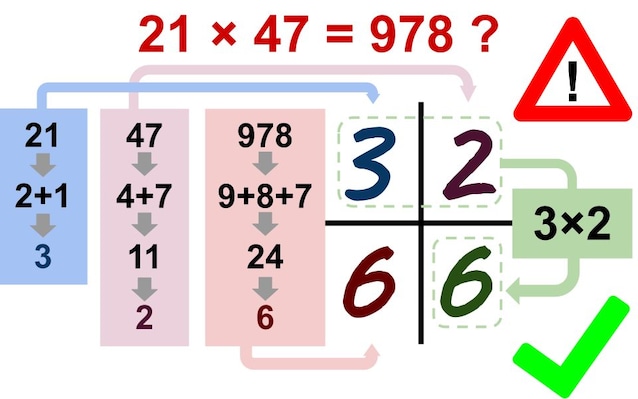
However, there is also another case, the one in which The calculated result is wrong but differs from the correct result exactly 9 (or a multiple of 9) as in the figure below: Also this time the proof of the nine does not detect errors, yet there is an error, so you have to pay close attention!
In this case the expression is used false positiveto indicate a correct result only apparently. Making a very approximate estimate, the probability of embarking on a false positive is about 11%, given that it concerns 1 wrong result every 9a decidedly not negligible probability.
And therefore How do we trust the nine test? No problem, just know how to use it and remember that this test is not able to always tell us if the calculation is right or wrong, but every time it identifies an error then the error is for sure. In practice It is legitimate to trust of the nine test only and exclusively when he tells us that we were wrong the calculationsbut when it does not point out errors, it is good not to trust too much.
But why does the nine test works and why isn’t it called the 7th of the 7th, or 2? It is a question remains of divisions, in short, if we multiply two numbers, for example 13 and 21 which divided by 9 give remaining 4 and 3, then their product divided by 9 will have to give the same rest as the 4 × 3 product: The proof of the nine in practice checks that these two remains are the same.
The same could be done with the remains of the divisions for any other number, like 7 or 2, but the 9 enjoys a feature that makes everything simpler. When we divide by 9, in fact, the rest of the division coincides with the sum of the figures that make up the number, for example by adding the figures of the number 985 we obtained 4 which is precisely the rest of the division for 9, since 985 = 9 × 101+4.
In essence, when we add the figures to apply the proof of the nine we are actually calculating the rest of the division for 9, and this is the reason why this test is called the 9th test and does not try 7 or 2.
