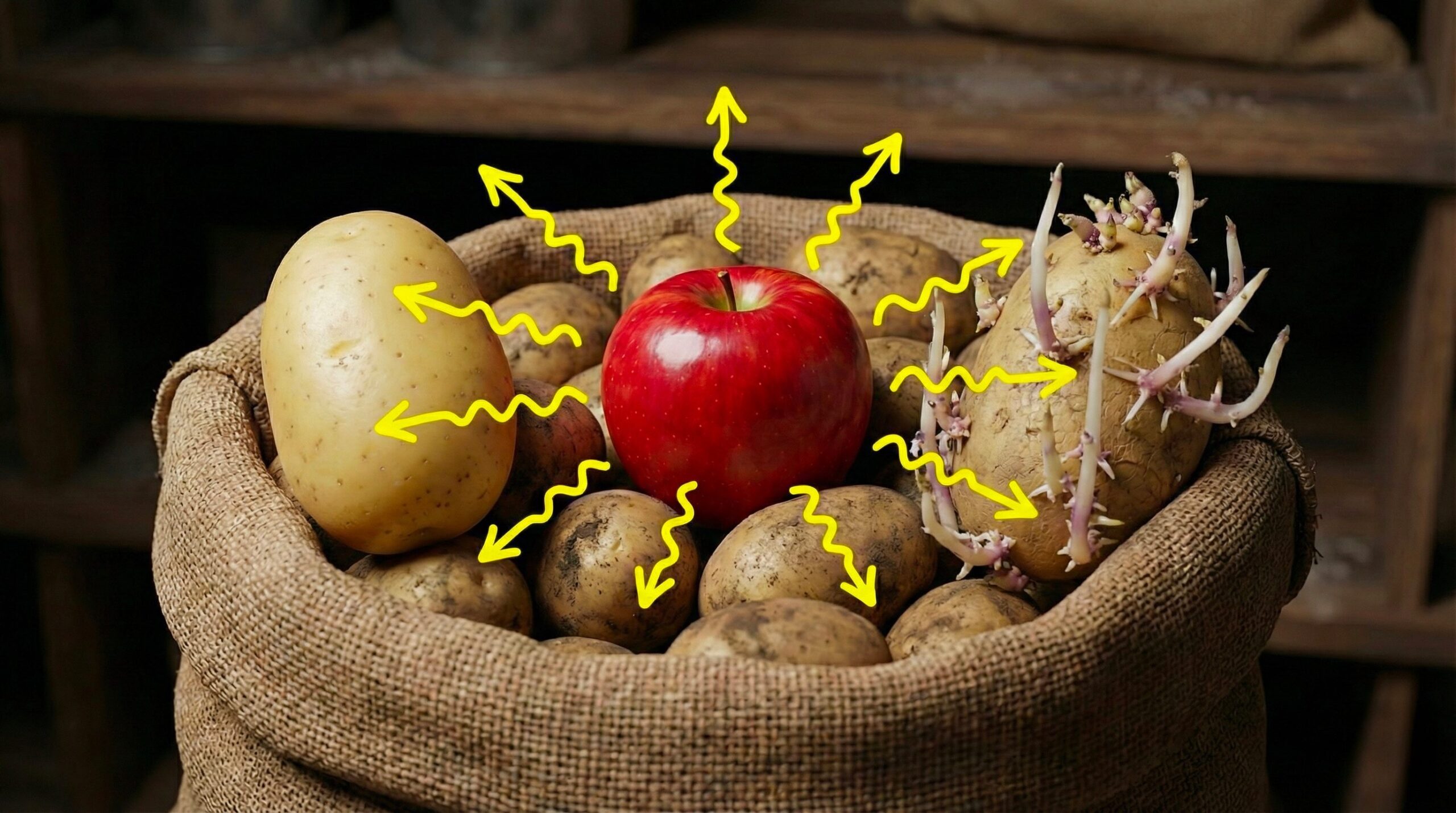
Have you ever heard of the “trick” of putting a apple in the bag of potatoes to keep them from sprouting? In fact, theethylene emitted by climacteric fruits (such as apples or tomatoes) is known for its ability to inhibit bud development. However, chemistry hides a pitfall, some studies reveal that the effect of ethylene is not unique. If the exposure conditions change, the gas stops acting as a ‘brake’ and presses on the accelerator, causing rapid sprouting which makes the tuber no longer edible.
Let’s take a step back, potatoes are gods tubers rich in starch (complex carbohydrates) and nutrients such as Vitamin C, B5 and potassium which are divided into precise categories based on consistency and use in cooking. The potatoes after harvesting and when we buy them are in a state of “dormancy“, or a temporary arrest of growth. Recent studies cited by Agripat confirm that during “dormancy” the potato’s metabolism works constantly, modifying the levels of starch and proteins. Some varieties are programmed to accumulate starch and resist for a long time (long dormancy), others to germinate immediately (short dormancy).
It is known that ethylene, a gaseous plant hormoneacts as the molecular switch of the ripening of some fruits, called climacteric, such as apples, bananaspeaches, pears, kiwis and tomatoes. By binding to specific receptors, ethylene activates a cascade of genetic processes that alter the organoleptic properties of the fruit, making it colourful, sweet or fragrant.
This molecule can also have effects on products not climacteric (which do not ripen after harvesting) like the potatoes or onions. In industrial processes, in fact, potatoes are continuously exposed to ethylene through chemical processes (although this can affect the quality of processing and the sugar content) which, as scientific studies have shown, inhibits the elongation of the shoots, keeping the potato marketable. This is where the custom of recommending putting an apple in the bag of potatoes comes from.
Ethylene, however, can have a double effect. If the exposure is short, periodic or interruptingethylene can act as a “wake-up” signal by breaking tuber dormancy (Terry et al., 2015).
So, summing up, Does the trick work or not? A slow and continuous release of ethylene – for example by placing one or more apples in the bag where we store the tubers – can inhibit the development of shoots, while a rapid accumulation of this gas – caused for example by the proximity of a tomato or a banana – can act as a stimulant. Yes, apples can be useful but the advice to prevent growth from restarting is always to conserve them in the dark (light stimulates the production of solaninea potentially toxic substance), in a dry place to avoid the growth of mold or bacteria e coolaround 10 °C.
Sources
Ifl Science Maltsev, SV “Efficiency of ethylene application on seed potato tubers.” Sel’skokhozyaistvennaya Biol 56 (2021): 44-53. Tipu MMH, Sherif SM. Ethylene and its crosstalk with hormonal pathways in fruit ripening: mechanisms, modulation, and commercial exploitation. Front Plant Sci. 2024 Nov 7;15:1475496.
Terry, L. A., Cools, K. and Foukaraki, S. (2015). UNDERSTANDING THE UNDERLYING MECHANISMS BY WHICH ETHYLENE SUPPLEMENTATION EXTENDS STORAGE LIFE OF ONIONS AND POTATOES. Acta Hortic. 1071, 181-186
Rylski, Irena & Rappaport, Lawrence & Pratt, Harlan. (1974). Dual Effects of Ethylene on Potato Dormancy and Sprout Growth. Plant physiology.
Bopape L, Satekge T, Mafeo P, Lekganyane M. Apple fruit as a biological suppressant for potato tuber sprouting during ambient storage. Heliyon. 2024 Sep 18;10(18):e38055. doi: 10.1016/j.heliyon.2024.e38055. PMID: 39328529; PMCID: PMC11425168.
