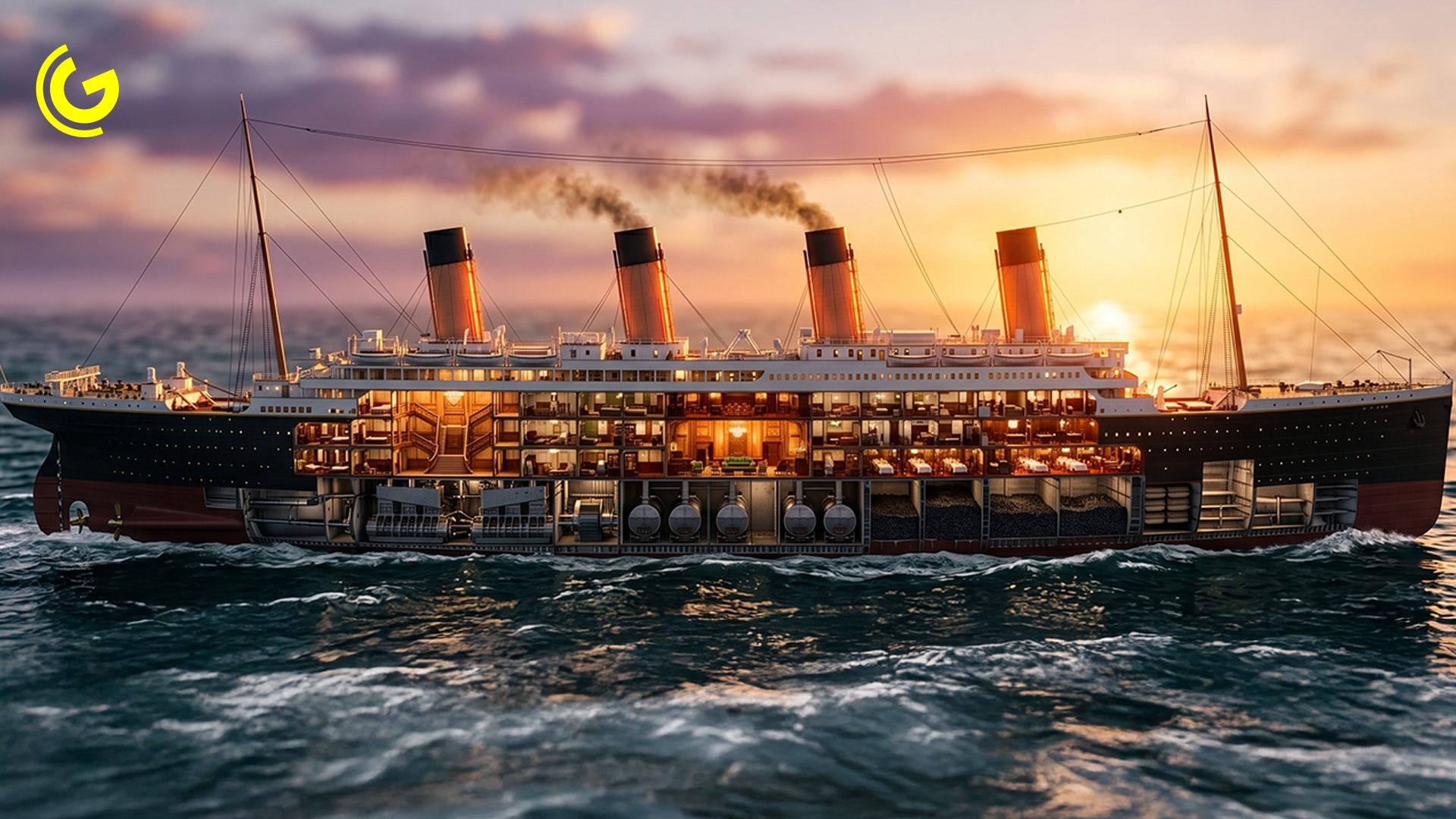
We made one Unpublished 3D reconstruction of the interiors of the Titanicso you can take a “virtual tour” of the various parts that made up the British White Star Line liner that sank on April 15, 1912 after colliding with an iceberg. We will see the Bridge of Lances, the internal structure, the engine room, the bulkheads, and we will explain the phases of the construction of the ocean liner, its first and only maiden voyage and the tragic sinking.
Construction, characteristics and shipwreck: the brief history of the Titanic
The Titanic is built in Belfastin Ireland, as of 1909. It was not a single ship but was part of a family of three “sister ships”, which in addition to the Titanic included the British (sunk during the First World War after hitting a mine) and the Olympicwho instead had a career of about 24 years.
The three ships were practically twins, with only small internal differences. When the Titanic was completed, it became the largest ship in the world at the timeslightly larger even than the Olympic, with 269 meters long.
After 3 years of work the ship is ready for its maiden voyage: the first crossing of the Atlantic. Most passengers board at Southamptonin England; then the ship stops in France and Ireland, and finally heads for New York.
That first trip will also be the last. Four days after departure, in the middle of the ocean, the Titanic hits an iceberg. From that moment it took just over two and a half hours for the ship to sink completely. The lifeboats turn out to be completely insufficient: there are only enough for about half of the people on board, and what’s more, they are not even filled completely. Finally, on the night between 14 and 15 April 1912, About 700 people survive out of over 2,200.
The exterior of the ship: the funnels, the shafts and the propellers
The Titanic had 4 smokestacksone of the most iconic aesthetic features of the ship. In reality only 3 were actually connected to the boilers and worked to expel the smoke. The fourth was added mainly for aesthetic reasons, to make the ship more imposing. However, it had a secondary function: it served to ventilate the rooms below.
The two large poles visible on the ship are the treesused to support radio antennas and flags. Towards the bow there is the crow’s nest: the elevated point from which the lookout spotted the iceberg on the night of the shipwreck, unfortunately with very little advance notice. The front raised area is the forecastlewhere you can also see the huge chains connected to the anchors. At the stern, however, there is the stern castlewith the command bridge for docking used when the ship entered the port.
Below the waterline are the 3 propellersmoved by the ship’s engines. And then there’s the rudderwhich allows you to govern the direction.
The decks of the transatlantic
The highest deck on the Titanic was the Bridge of Lancesfollowed by the others identified with the letters A to G.
The Bridge of Lances it was divided into areas for the different classes: second class passengers often had their view of the ocean partially blocked by the lifeboats, while for the first class a large part of the deck was free and unobstructed (other lifeboats were not added which instead could have saved many lives during the shipwreck). Each lifeboat was suspended from a system of winches: when needed, the winch was rotated outwards, the passengers climbed aboard and the lifeboat was slowly lowered into the sea.
The Bridge Asaid Promenade Bridgewas dominated by first-class spaces: large covered areas, separate bathrooms for men and women, lounges, reading room, smoking room. Aft were the Veranda Café and Palm Court, designed for relaxation and refreshments.
Going down to the Bridge B (Promenade Bridge) the height of luxury was reached. Here were concentrated the first class cabins with private bathroom, the lounge suites with private promenade, the first class boarding entrance, the elevators, the kitchens, the à la Carte Restaurant and the Café Parisien. The second class spaces were located in the stern, and the aft deck served as a promenade for the third class. This way each class had their own walk on the upper decks.
The Bridge Csaid Shelter Bridgeis the tallest to extend without interruption from bow to stern. It housed first class cabins, crew areas, a barber shop, spaces for passengers’ servants, the second class library and, towards the stern, the third class common areas. The rudder gear and steering motors were also located at the rear end.
The D BridgeThe Hall Bridgewas the level at which life on board became more communal. Here was located the large first class dining salon, food preparation areas, the on-board hospital and the second class dining salon. Toward the bow were the firemen’s rooms and a staircase that led directly down to the boilers.
The E Bridgecalled Upper blanketwas mainly dedicated to the crew and third class cabins. It was also the lowest level reachable from the Grand Staircase and elevators. On this deck was the so-called Scotland Road, the main corridor used by the crew to move from bow to stern without interfering with passengers.
The F BridgeThe Middle Bridgeheld some surprises: here was one of the first swimming pools ever installed on an ocean liner, the Turkish bath reserved for first class, the third class dining room with kitchens and pantries, and other second class cabins.
The G BridgeThe Lower deckwas the last one above the waterline to have habitable spaces. It housed crew and third class cabins, the post office — remember? The Titanic was first and foremost a royal mail ship — luxury baggage storage, and even a squash court. A squash court, on a 1912 ship. It is not a trivial detail: it gives the idea of how much emphasis was placed on the experience of first class passengers.
The Orlop Bridgepresent only at the bow and stern, was dedicated to cargo, baggage, mail and machinery.
The boilers, engine room and engines of the Titanic
Under Bridge G you enter the technical areas. And then we go down to the hold, the lowest level of the Titanic, where the ship reveals its true nature as an extraordinary industrial machine.
The Titanic had 6 boiler roomsnumbered from one to six, for a total of 29 boilers. The first boiler room had five single-ended boilers, fired from one side only. Halls two through six had double-ended boilers, fired from both sides. Between one room and another there were bunkers, filled with coal before departure. Working here was very hard: extreme heat, humidity, constant fatigue. The stokers had the task of keeping the boilers constantly fueled, shoveling coal without stopping. The mechanism is simple in principle: the coal burned in the boilers, the fire heated the water and produced steam. The smoke passed through the pipes and then rose into the ducts leading to the first three smokestacks. It took up to 24 hours to start steam production, so preparation began well before departure.
The steam produced by the boilers reached the engine roomwhere there were two enormous steam engines three stories tall. Each engine had 4 cylinders with pistons that moved up and down thanks to the thrust of the steam. This movement turned the drive shaft, which came out of the back of the ship and drove the two side propellers.
The third, central propeller was instead driven by a low pressure turbine enginewhich used residual steam already used by reciprocating engines. An intelligent system to exploit every bit of energy available. After doing its job, the steam moved to the condensers, where it was cooled and turned back into water, ready to be used again in the boilers. A closed cycle, efficient by the standards of the time.
Fresh water was stored in large tanks and distributed throughout the ship as drinking water. There was also the electrical machine roomwith 4 generators which produced electricity for the entire ship, and two backup engines. During the night of the shipwreck, this area was among the last to flood: the electricians remained in place until the end to keep the ship’s lights on, with a courage that has remained in history.
The watertight bulkheads
The Titanic was equipped with 15 watertight bulkheadswhich divided the ship into 16 watertight compartments. The principle was simple and, on paper, ingenious: if one of these compartments flooded, the water would not pass to the others, and the ship would remain afloat. Between one compartment and another there were watertight doors, normally open but quickly closed in case of emergency, operated from the command bridge.
It was these compartments that made people believe the Titanic unsinkable. The ship was designed to float even with four compartments flooded at the same time. The problem is that when the ship hit the iceberg, on the night between 14 and 15 April 1912, the forward compartments that began to flood were five, not four. One more than the system could handle. This circumstance, along with many others, caused the sinking of the ship.
