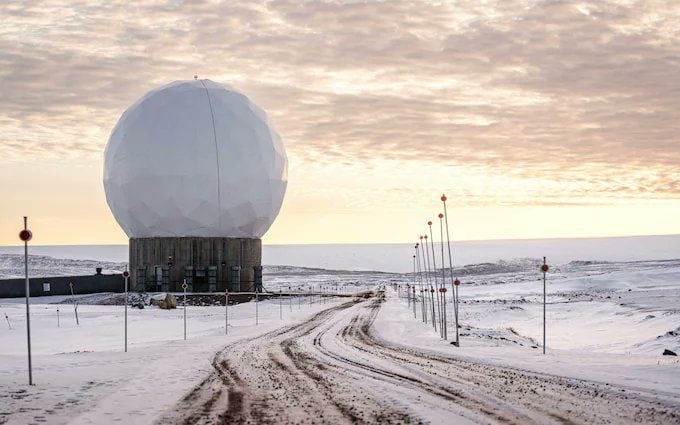
There Greenland returned to the center of public attention after the President of the United States Donald Trump he reiterated his intention to annex this territory – now under the control of Denmark – to the USA, considered “indispensable for American national security”. But while on the one hand it is clear that Trump’s real interest is the mineral resources present on the island, on the other hand not everyone knows that the United States already has an important military base in Greenland: it is the Pituffik Space Basealso known as Thule Air Basewhich houses within it the Bmews radar system, capable of promptly identifying any missile attacks directed against the United States.
So let’s see them characteristics of this US military base and other military outposts on the largest island in the world.
The characteristics of the Pituffik Space Base military base
There Pituffik Space Base is a US military base located in northwestern Greenland: it’s about thesingle basis that the United States owns inArcticas well as the northernmost one among those operated by the United States Air Force, being approximately 1,100 km north of Arctic Circle. Its construction was legitimized by an agreement signed between Washington and Denmark in 1951, according to which both countries would collaborate to militarily defend the NATO member island (being part of Denmark). Until 2023, the military base was known as “Thule Air Base”: in that year, the administration Biden he decided to rename it “Pituffik” in honor of Greenland’s cultural heritage.
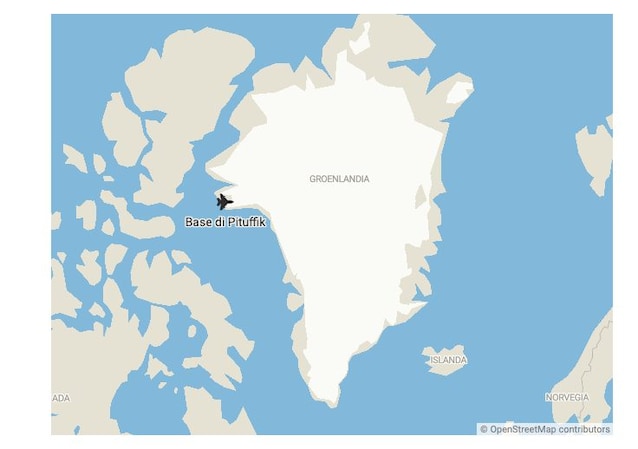
Pituffik military base, Greenland. Credit: OpenStreet Map
Operational since 1952, in the early years the military base served as intermediate port on the air route between North America and northern Europe, especially for B-36 aircraft, capable of carrying nuclear and thermonuclear bombs. With the development of a new generation of aircraft, capable of traveling longer distances, the base was reconverted and became part of the Ballistic Missile Early Warning System (Bmews), capable of providing 15 minutes warning in the event of a Soviet missile attack against American soil. At the end of the Cold War, a plan was initiated modernization of the Pituffik Space Base.
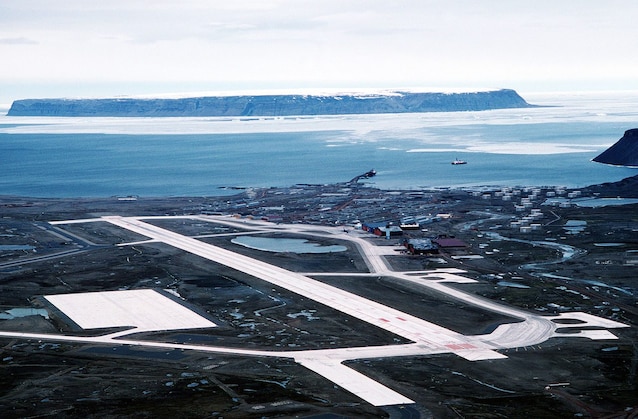
Currently, they are present in the base 150 US military personnel: It consists of an airstrip 3,000 meters and still houses within it the Bmews radar system, capable of promptly tracking the launch of intercontinental missiles towards North America, calculating their route and impact time and starting the various alert phases for the defense of the continent. In this case, geographical location plays a fundamental role: at latitudes such as the Arctic, in fact, the curvature of the Earth means that the warning can be greater than at other sites located at more southern latitudes, which means an important advantage of several minutes to activate procedures or countermeasures.
Pituffik Space Base is also home to the 23rd Space Operations Squadronwhich deals with the control of satellites for intelligence operations, for communication and warnings in the event of an attack against US soil
The secret military base of Camp Century
An honorable mention goes to Camp Century secret base, buried approximately 30 meters deep under the ice of Greenland. Camp Century was conceived by the US government in 1959 as a top-secret project (dubbed “Project Iceworm”) to test the feasibility of deploying nuclear missiles from the Arctic to the Soviet Union. When active, the military base hosted between 85 and 200 soldiers and was powered by a small nuclear reactor: the initial project also included the creation of a 4 km long tunnel system, capable of containing over 600 nuclear missiles.
In 1967, however, the project was abandoned and the military base was completely decommissioned: today Camp Century has transformed into a toxic and radioactive waste landfill, buried under a blanket of ice: as confirmed by a 2016 study, inside there are approximately 9,000 tons of physical wasteincluding remains of buildings and rails, over 200,000 liters of diesel and 24 million liters of waste water. Added to this are also the radioactive waste – the quantity of which is not certain – deriving from the regenerating fluid of the reactor.
Finally, there are also the two former air bases that the United States planned to consider Kangerlussuaq ea Narsarsuaq, respectively active until 1992 et al 1958. Today both bases have been converted into airports.
What about Denmark’s military bases in Greenland?
At this point it is natural to ask: does Denmark, which controls Greenland, have military bases on the island? Not exactly: the Danish army, in fact, has military outposts, such as Mestersvig Airfield or North Station, that actually demonstrate Denmark’s presence on the island (and therefore its control). In reality, these military outposts are mostly used as bases for scientific research and host several teams of scientists for 26-month expeditions.
In short, There is no well-structured Danish military base in Greenlandor at least comparable to that of Pituffik Space Base: nevertheless, Denmark is responsible for the security and foreign policy of this island, which has around 57,000 inhabitants and independently manages its own economic and internal policy. However, according to the Danish government, military spending on Arctic security has been increased by 2025. 13.7 billion dollars.
