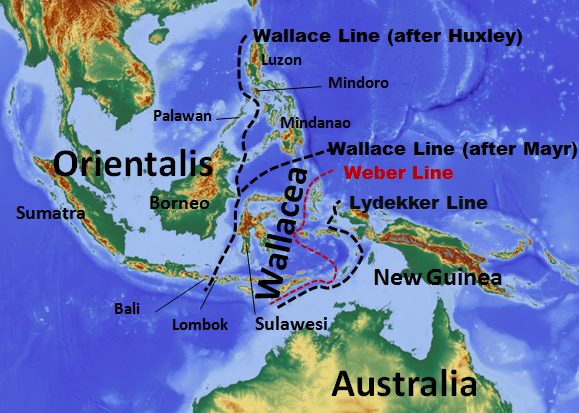
The Indonesian archipelago is crossed by an invisible border, a line that is not found on any map, but which is practically impassable for nature. Is called Wallace Line and separates the Asian and Australian regions from an ecological and faunal point of view. The line owes its name to Alfred Russell Wallacea nineteenth-century British naturalist and explorer of the same age as Charles Darwin who arrived at his own conclusions on evolution almost anticipating him. During his travels in the Malay archipelago (told in the famous book “The Malay Archipelago”), in which he studied over 125,000 specimens, he noticed that the fauna suddenly changed from island to island. To the west of the line he found typically Asian animals: tigers, rhinos, elephants And monkeys. In the east these disappeared to make way for a world populated by marsupial mammals (such as kangaroos), come on koala and birds typical of Oceania, such as cockatoo.
The striking example of this phenomenon are the islands of Bali and of Lombok which are only 35 km away from each other, about the same as Naples and Ischia. Yet, their fauna – the set of animal species – is completely different as if they belonged to two very distant continents.
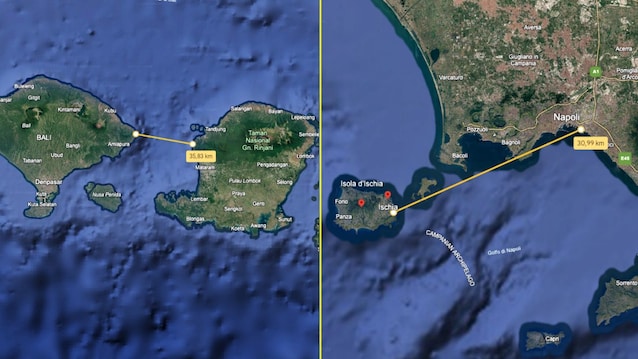
How is it possible that there is such a clear difference in such a small space? The answer is to be found in geology of these places. Despite the theory of plate tectonics was hypothesized in the 1930s, Wallace understood that the cause was linked to the ancient history of the emerged lands. In fact, the two islands rest on different continental platforms: ù
- To the west is the platform of Probeconnected to Asia (Java, Sumatra, Bali and part of Borneo)
- To the east is the platform of Sahulwhich united Australia, New June and Tasmania
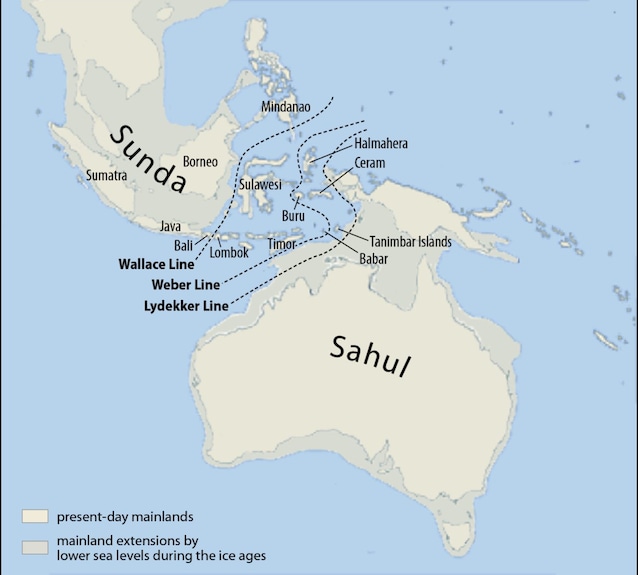
In the Pleistocene, the lowering of sea levels during the glaciations allowed terrestrial fauna to migrate across the platforms, connecting the islands separated by shallow waters. However, the depth of the strait between Bali and Lombok, around 250 metersprevented the formation of land bridges. In addition to the physical barrier of water, the strait is characterized by the strong passage of ocean currents and from strong winds which also limit the spread of birds. For his observations and studies, Wallace is considered the father of biogeographythe science that studies the distribution of life on Earth in space and time.
The biologist Thomas Henry Huxley – the person who named the Wallace line in 1868 – modified the northern part of the border based on a more in-depth study of birds. He then traced the Huxley Line, since according to his theories, the fauna of the Philippines presented marked differences compared to that of Asia. He then traced the so-called Huxley line moving the border further west.
Another line was also suggested, called Weber linebetween the Moluccas and Sulawesi and between the Kei Islands and Timor, which the German zoologist Max Weber thought divided the fauna of the two regions even better. The area between Weber’s and Wallace’s lines is called Wallacea.
THE’Indian Administrative Service Zoology reports some tangible examples of the distribution of different species among these areas. Almost all of the mammals eastern ones stop in Borneo and Java, very few reach Sulawesi and Bali and none cross the Moluccas and the Lesser Sunda Islands. Australian mammals stop in New Guinea, in practice, the overlap between the Australian and eastern fauna in Wallacea is minimal. As for the reptilesmost of the eastern ones do not cross the Wallace Line, and none extend beyond the Weber Line. While some birds eastern ones extend up to New Guinea and some Australian species go beyond the Wallace Line. Specifically, 75% of the birds in Lumbok are of Asian origin but in Bali only 14.5% are Australian birds.
This area of the world was also important for human evolution, here they experienced theHomo floresiensis el’Homo luzonensis – characterized by their short stature – and the Asian Denisovans who arrived around 400,000 years ago demonstrating that for humans the Wallace Line was not an insurmountable border.
