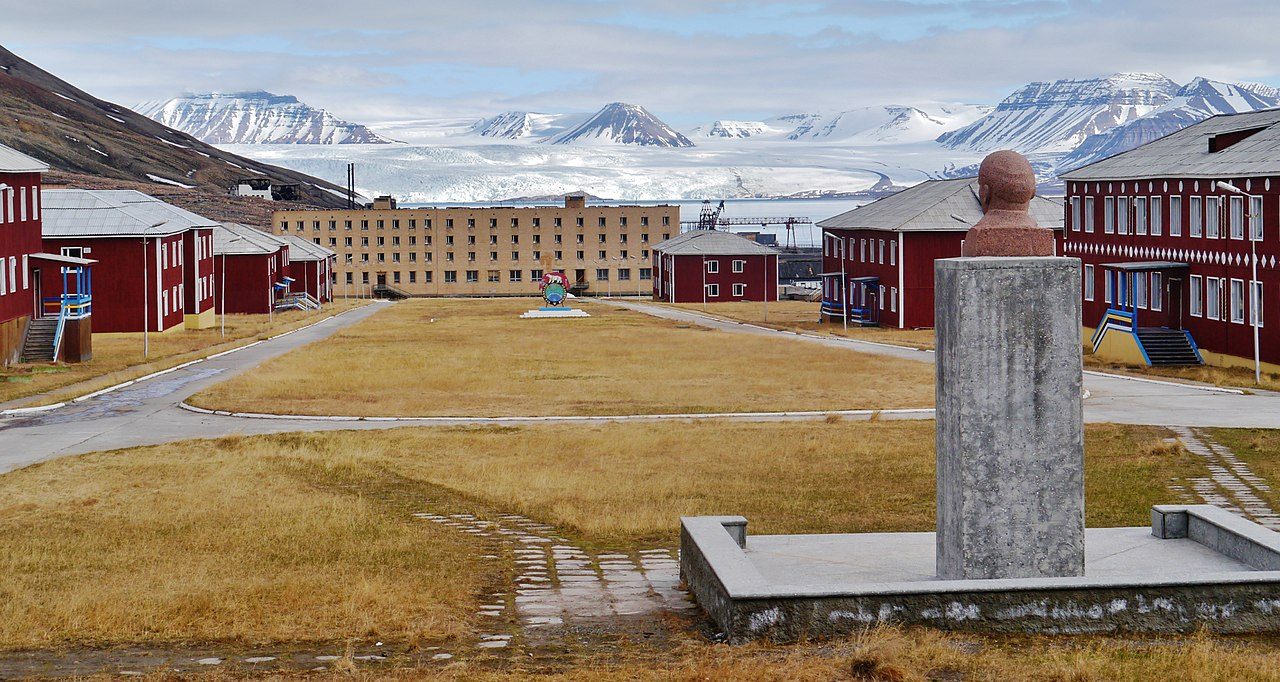
Pyramiden is a former mining settlement dating back to the Soviet era, today considered one of the ghost town best preserved in the world. Located on the island of Spitsbergen, the only inhabited island of the Svalbard islands, about 1000 km from the North Pole, it is a place suspended in time that recounts the years of the Cold War, when the world was divided into two enormous factions and the fear of a nuclear conflict hovered.
Between Norway and the North Pole: the settlement at the edge of the world
The name of the city, Pyramiden, derives from the mountain that dominates it and overlooks the Adolfbukta bay, to the east of the island, in correspondence with the Nordenskjøldbree glacier: its silhouette recalls that of a pyramid. Built by Sweden in 1910, and then ceded to the Soviet Union in 1927, this settlement was born as a population center intended for workers coal mines neighboring. During the Second World War it suffered serious damage by the German forces but, starting from the 1960s, it was rebuilt and transformed into a model village: flagship of the USSR in the Arctic.

Source:By Prillen – Own work, CC BY–SA 3.0, https://commons.wikimedia.org/w/index.php?curid=11302041
According to the data, in fact, towards the mid-1970s the local population had reached 1,500 individuals: families of miners who enjoyed free room and board and received salaries up to five times higher than the average. Among the most interesting aspects was the quality of life: in addition to the guaranteed hospital and school services, the city was equipped with numerous community facilities, including a cinema, a theatre, a library and a municipal swimming pool with heated sea water. In the main square of Pyramiden there is also a statue of Lenin, and it is the most northerly in the world.
The inexorable decline and abandonment of the city
After the fall of the Soviet Union, problems began to emerge forcefully. The lack of funds and the poor quality of the little coal left in the mines pushed the population to abandon the city close to the North Pole. A tragic event accelerated the crisis: in 1996, an Arktikugol charter flight crashed, killing 141 people, including many residents of Pyramiden and nearby Barentsburg. The last residents thus left the settlement just two years later: on October 10, 1998.

Source By Hylgeriak / Wikipedia – Own work, CC BY–SA 3.0, https://commons.wikimedia.org/w/index.php?curid=15834221
The “Pompeii Arctic”: chat Pyramiden is today
One might imagine that the city is left with a pile of ruins and dilapidated buildings in a complete state of abandonment, but surprisingly this is not the case. The Russian government has in fact chosen to enhance what remained of Pyramiden by investing in hotel and tourist facilities, so as to make it attractive precisely as a ghost town and authentic time capsule. Run by a group of custodians from the Arktikugol company, the city is today known as the “Arctic Pompeii”, since the sudden abandonment by the inhabitants left homes and public spaces largely intact and still full of everyday objects, even the most personal.
As a backdrop and to further increase the charm of the place is the legend according to which, inside the House of Culture – the building that housed the library and theater – there is still a grand piano perfectly tuned. The harsh climate would have kept the strings in constant tension, surprisingly preserving their sound performance.

Source:By Zairon – Own work, CC BY–SA 4.0, https://commons.wikimedia.org/w/index.php?curid=52466484
The visits in Pyramiden they take place mainly in summer – approximately from June to September, when there is light and the sea is not frozen – and are only possible if accompanied by an expert local guide. The reasons are related to safety: on the one hand the risk of building collapses, on the other to the high presence of polar bears in the area. The more intrepid can stay at theHotel Pyramiden (formerly known as Tulpan or Tulip): large residential building, once inhabited by miners, converted into a hotel in the late 1980s. Closed after the city was abandoned in 1998, the hotel was renovated and reopened in 2013.
