
There are tricks to do it multiplication in mindquickly, without resorting to column multiplication. In general it involves replacing a multiplication with simpler operations that give the same result, but some of them seem like magic tricks. Let’s see some of them, those that exploit simpler operations, the magic trick of multiplication by 11 and that of the product of numbers close to 100.
How to solve multiplication problems quickly
Transform it into simpler operations
The level of difficulty of an operation is subjective, but they are there some operations that are easier and we can exploit them to do certain types of multiplications on the fly. For example, multiplying by 10, by 100 or by 1000 is very easy, just add 1, 2 or 3 zeros, but doubling or halving is also quite easy: by combining these operations we can easily multiply by 5, 4 and by 25.
- To multiply by 5 simply multiply by 10 and then halve: to calculate 23 × 5, we multiply by 10, that is, we add a zero to 23 to obtain 230, and then we halve: 230 : 2 = 115 which is precisely the result of 23 × 5. This trick works because 10 is double 5.
- To multiply by 25 just multiply by 100 and then halve twice: to calculate 23 × 25, we multiply by 100, that is, we add two zeros to obtain 2300 and then we halve the obtained number twice: we first calculate 2300 : 2 = 1150 and then 1150 : 2 = 575 which is precisely the result of 23 × 25. This trick works because 100 is quadruple 25 and halving twice is the same what you divide by 4.
- To multiply by 9 just add a zero and then remove the number we are multiplying= 180 – 18 = 162.
- To multiply a number by 11 just add a zero and then add the number we are multiplying= 188.
The trick we just saw can be used, by analogy, to multiply numbers close to powers of 10. For example, to multiply by 99 just multiply by 100, adding two zeros, and then subtract the number we are multiplying, for example to calculate 45 × 99 just take 4500 and subtract 45 obtaining 4455 without actually carrying out any multiplication. Similarly, to multiply by 57 × 1001 just add 3 zeros and then add 57, 57 × 1001 = 57000 + 57 = 57057.
The multiplication by 11 trick
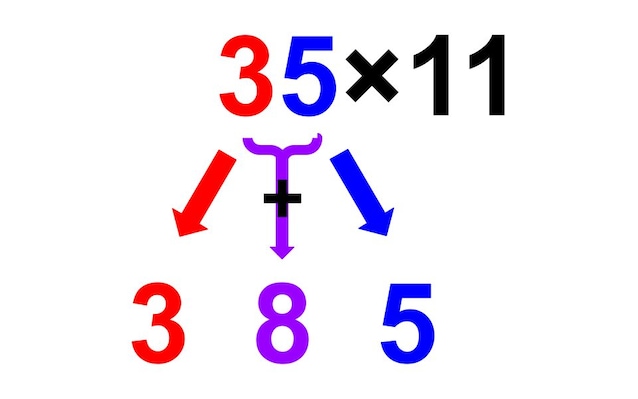
Multiplication by 11 they are magical, in fact there is a super fast way to calculate them without even carrying out multiplication. Let’s see it with an example: to calculate 35 × 11 we take 3 and 5 as the first and last digits respectively, and put their sum, 8, in the middle, the result will therefore be 385, as illustrated in the figure below.
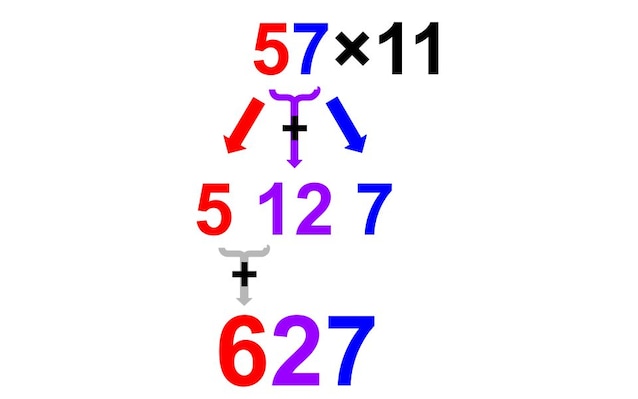
Things get slightly complicated, but not too much, if the sum of the numbers is greater than 9, for example to calculate 57 × 11, we take 5 and 7 as the first and last digit and in the middle we should write the result of 5 + 7 except that this equals 12: there is no problem, just take 2 as the central digit and do the carry by adding 1 to the first digit, so the searched result will be 627 (see figure below).
It all seems easy if the digits of the number we want to multiply by 11 are only 2, but what if there are more? This trick works anyway, just follow this procedure:
to multiply a number by 11, the first and last digits of the number are taken as the first and last digits of the result, while to determine the intermediate digits, the sums of the digits of the starting number are taken, taken two by two, starting from the first two up to the last two, taking care to consider all possible carryovers.
It seems like magic, but in reality it is just mathematics, let’s try to see it with the calculation of 35×11: the number 35 is made up of 3 tens and 5 units, therefore 35 = 3 × 10 + 5and in the same way 11 = 10 + 1then we can write:
35 × 11 = (3 × 10 + 5) × (10 + 1) = 3 × 10 × 10 + 3 × 10 + 5 × 10 + 5 = 3 × 100 + (3 + 5) × 10 + 5 = 3 × 100 + 8 × 10 + 5.
The final passage shows us that they are there in the end 3 hundreds, 3+5=8 tens and 5 unit, that is 385.
The base complement method for numbers close to 100
Now suppose we want to multiply between them two numbers both close to 100for example 94 × 97, is not an easy calculation to do in mind, but we can do it like this:
- is found how far is each number from 100in our case 100-94=6 and 100-97=3 (6 and 3 are the 100’s complements of 94 and 97)
- you subtract the complement of one number from the other number for example 94 – 4 = 91 (it doesn’t matter which number you choose, the result will be the same in fact 97-6=91, in general 91=100-6-3)
- the number you getin our case 91, constitutes the first two digits of the result of multiplication.
- the two complements are multiplied togetherin our case 6×3=18, thus finding the last two digits of the product.
- Put the numbers togetherin this case 9118.
But why does this trick work? The fact is that 94 = 100 – 6 and 97 = 100 – 3 so calculating 94 × 97 is the same thing as calculating (100 – 6) × (100 – 3) and this calculation, thanks to the distributive property (which says that a×(b+c)=a×b+a×c and the sign rule, can be rewritten:
(100 – 6) × (100 – 3) = 100 × 100 – 100 × 3 – 100 × 6 + 6 ×. 3 = 100 × (100 – 3 – 6) + 6 × 3 = 100 × 91 + 18 = 9100 + 18 = 9118.
In the calculation you can see how subtracting the two complements, 6 and 3, from 100 you get exactly that first two digits of the final resultWhile multiplying them gives the last two. In short, even in this case it is not about magic but about mathematics.
This trick, with some small precautions, can be adapted to numbers slightly larger than 100, for example to calculate 105 × 107 we will write 1 followed by the sum of the two complements of 100, 5 and 7, then we write 112 and add the product between 5 and 7 as final digits obtaining 11235 which is precisely the result of 105 × 107.
