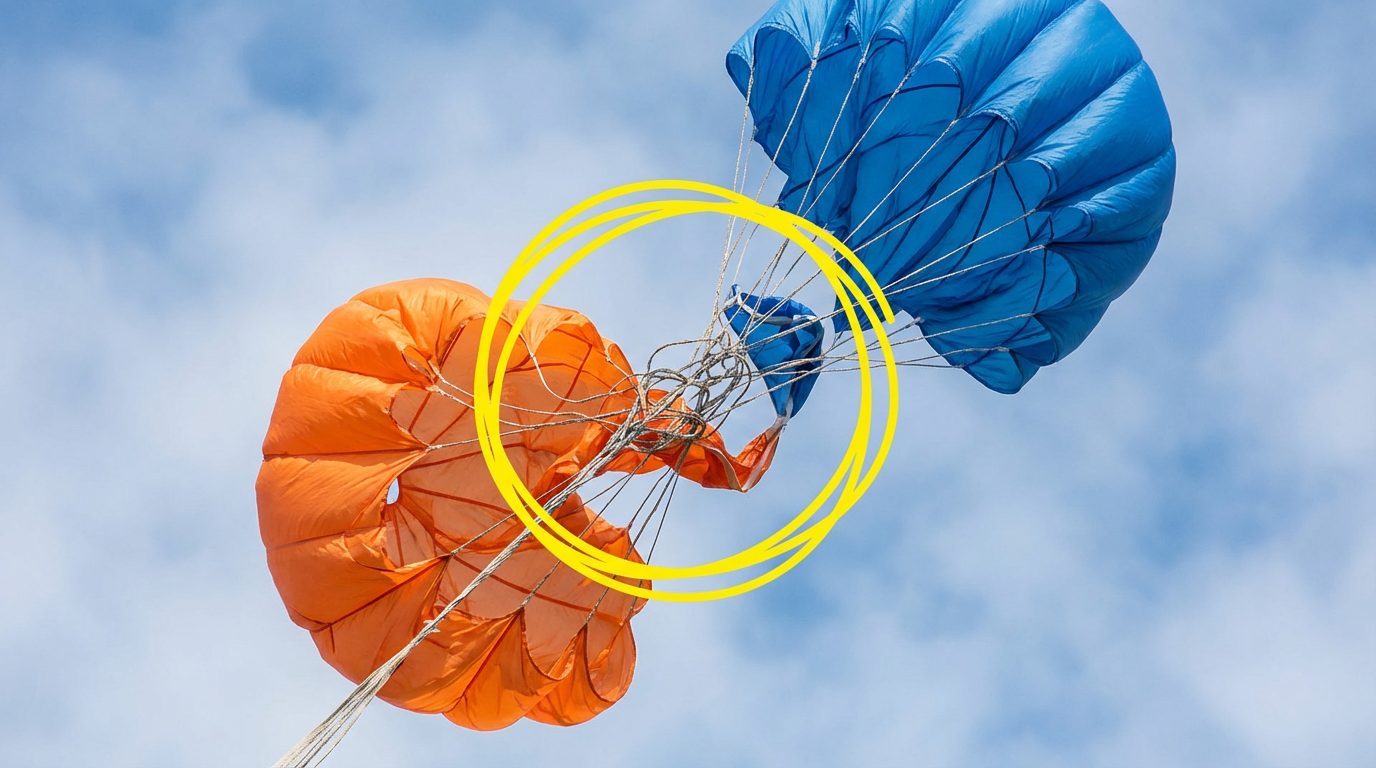
The two expert parachutists Ermes Zampa (70 years old) e Violetta Laiketsion (63 years old) died in a dramatic accident during a launch in Fanoin the Marche region, on Sunday 14 December 2025. According to the testimonies of those present, in particular of Roberto Masciodirector of the local parachuting school, the caps of the two parachutes collided at approximately 40-50 meters from the ground, causing thecable entanglement with the consequent collapse of the caps, without the two expert paratroopers having time to intervene in any way. At the moment they seem so hypotheses of technical malfunction excluded or of illnessbut the exact dynamics of the accident will be reconstructed only at the end of the investigations which have already been started by the Carabinieri.
We therefore do not intend to explain how the tragic accident occurred but simply explain from a scientific point of view why the collision of two parachutes can be so dangerous even for experienced skydivers and cause an almost total loss of control.
Conceptually, a parachute works increasing air resistance to falling thanks to its surface. In fact, while a body falls in the air, two main forces act on it: the weight force which pushes it downwards, and the friction with the air which acts in the opposite direction to the motion and therefore slows down the fall. In this tug-of-war between gravity and friction, the parachute gives a huge assist to friction. In fact, by opening it, the surface exposed to the air drastically increases, e.g aerodynamic friction increases as the surface area increases. This is enough to bring the speed of a parachutist from approx 200 km/h to 15-20 km/h.
To function, a parachute therefore needs a large surface area. But what keeps the canopy of a parachute deployed? There rope tension which anchor it to the parachutist. This is why it is very dangerous if two parachutes get their cables tangled: intertwining, prevent the sail from unfolding and this compromises its ability to offer surface to the air. As he explained to us Emanuele Bielliparachuting instructor and secretary of the AIP (Association of Parachuting Instructors), «the parachute fabric is made of nylon soaked in silicone and, therefore, has zero porosity. However, this fabric works when it is there tension on the ropes and, therefore, when the sail is taut. The moment the ropes lose this tension – when there is, for example, a collision, a collision with another paratrooper – then the fabric deflates and therefore no longer has that characteristic of a brake, of a static anchor that manages to slow the downward fall”.
In short, if the ropes lose their tension, the sail deflates and the parachute is no longer able to generate aerodynamic friction: the skydiver accelerates downward substantially in free fall. One of the main safety rules for those who dive with a parachute is to keep a safe distance from other parachutists, precisely to avoid this type of accident. In fact the launches take place a few seconds apart from each other so as to keep everyone at different quotas. Unfortunately, it can sometimes happen that different canopy release times can “align” two paratroopers, as happened yesterday in Fano.
When the ropes of a parachute are intertwined, there are some emergency procedures that can be adopted; however, as long as they work they must be applied between 1000 and 500 meters of height so that we have the material time to avoid the worst. When their ropes became intertwined, Zampa and Laiketsion were instead at 40-50 meters above the ground. Considering their initial velocity and acceleration due to gravity, this means they had just over 3 seconds to crash to the ground at tens of km/h.
«In this type of accident, the first rule is understand how the collision occurred and how the parachutes were intertwined,” the instructor explained to us. «In the event that one of the two parachutists is free from any entanglement with the ropes or fabric, then one can unhook from the main parachute harness and then open the emergency parachute. The other parachutist, obviously, must also free himself and in this case he can use abladeinserted into the harness specifically to cut parts of ropes if necessary. On the contrary, in the event that the two parachutes become intertwined with each other and therefore do not provide the possibility of supporting the people attached, then it is necessary to immediately open the emergency parachute. Because, actually, the only thing that saves lives is having an open parachute – totally or partially – which slows down the descent towards the ground.”
With the tragic accident that occurred in Fano, the number of fatal parachute accidents occurred in Italy suffers a increase: «In the last 4 years in Italy there has been an average of 1 fatal accident per year. In September 2025 there had already been a fatal accident on the outskirts of Rome, during which a 49-year-old man lost his life. And statistics show that the greatest number of accidents happen to experienced parachutists, thanks to one underestimation of risk – linked to experience – but also an overestimation of one’s ability to react in the face of emergency situations.”
Looking instead at the statistics of larger countries, in United States in all of 2024, 9 fatal accidents occurred, a historic low for the last decade.
In short, the parachuting remains an extreme sport and dangerous: however, also thanks to the continuous updating of emergency procedures and to new training methods, the number of accidents And drastically decreased compared to the past.
