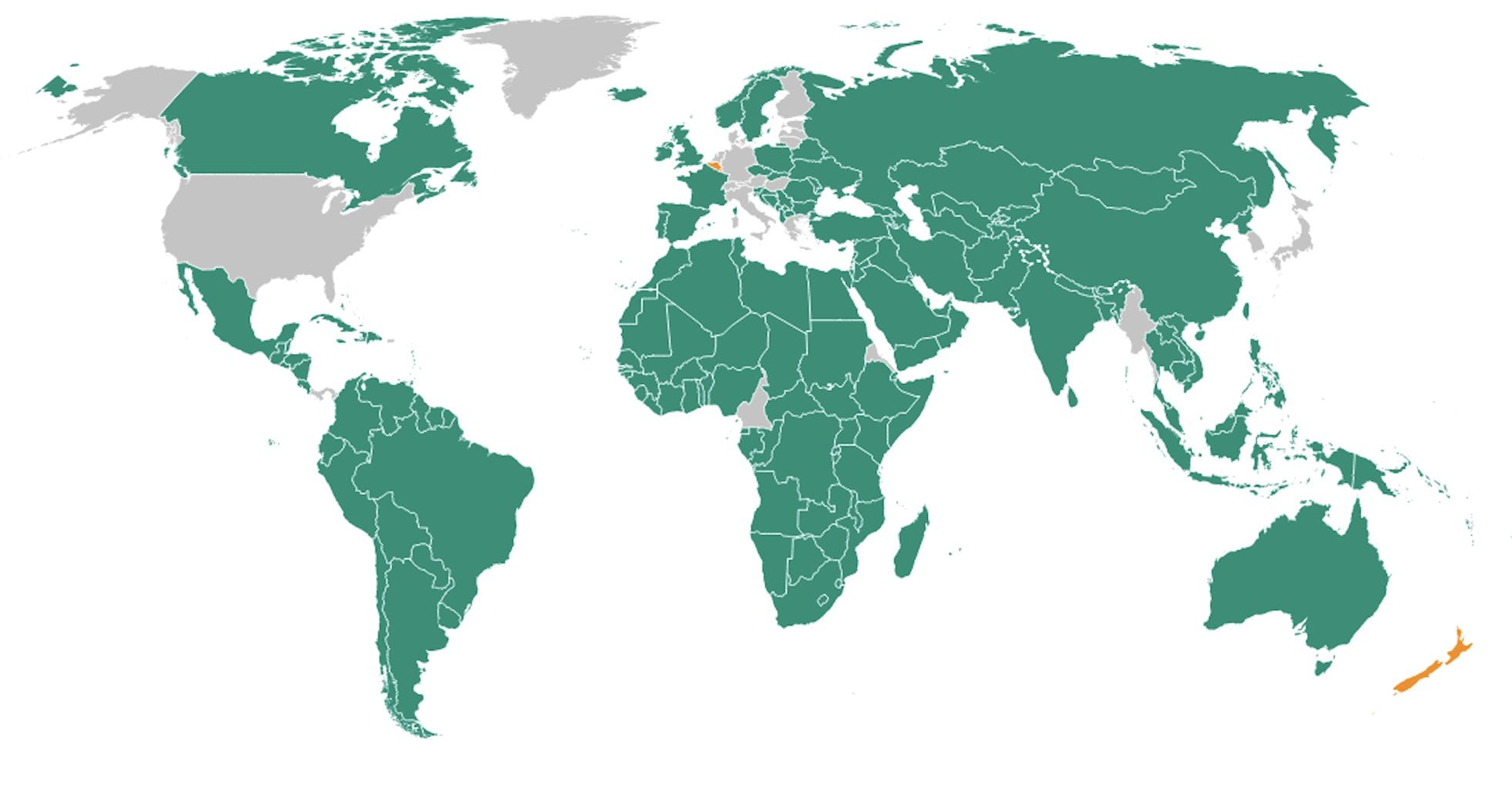
There France has formally recognized it Palestine state During the United Nations Assembly held every year in New York, in the wake of what they had already done, last Sunday, Portugal, United Kingdom, Canada And Australia. In the meantime, other countries such as Belgium, Luxembourg, Malta, Lichtenstein And New Zealand They announced that their intention to present this recognition in the next few days.
In this way, the countries that in the world recognize Palestine as a state in the world: the goal is to create political pressure on Israeli Prime Minister Benjamin Netanyahu, pushing him to stop the serious crimes That the Israeli army is committing in the Gaza strip and to accept an agreement that takes into account the solution of the “two peoples – two states”.
In practice, therefore, this recognition mostly has a symbolic value And aims to isolate the Israeli government internationally, which has repeatedly repeated how the creation of a Palestinian state is not “absolutely an option”.
The map of the countries that recognize Palestine
Between July and September 2025, the number of UN Member States that recognized Palestine went from 142 to 152: At the moment, however, Palestine has not yet become an official member of the United Nations, but maintains its status as a permanent observer.
As visible also from the map, theItaly He has not yet presented his formal recognition: the Italian government, however, has expressed itself several times in favor of the solution of “two states“, But he defined the current recognition of Palestine as” counterproductive “and” premature “until a war is underway. Of the same position, in Europe, there are countries such as Germany, Austria, Greece, Hungary and the Netherlands.
To recognize Palestine, however, are all Arab countriesthe Russiaalmost all states Africans and of theLatin America and most countries Asianincluding China and India.
What is the recognition of Palestine for
But, in practice, what is the recognition of Palestine for? Over the past two years, 14 western countries have recognized the state of Palestine and 5 others are preparing to do so: this recognition, however, has a value purely symbolic and aims to increase the international pressure on the prime minister Benjamin Netanyahu so that it puts an end to what has been defined by the UN as a genocide.
It should be remembered, in fact, that one of the essential requirements for the existence of a state is to have a territory On which to exercise its sovereignty: Palestine, however, does not have full control of its territory, which is partly occupied by Israel and partly under the control of Hamas. Also for this reason, recognition aims to guarantee the right to self -determination of the Palestinian people.
There sovereignty State, then, must be exercised by a government: also in this case, in Palestine, at the moment, there is no solid and unitary government. In West Boardin fact, the Palestine National Authority (ANP) exerts only limited functions, also due to the Israeli employment of some territories from 1967while from 2007 there Gaza Strip It is under the administration of Hamas.
In short, the recognition of the existence of a Palestinian state is in all respects a strategy to isolate the government of Netanyahu internationally, an isolation that has also been applied to other countries (as in the case of Russia after the invasion of Ukraine), but which towards Israel has been late to arrive. The answer of NetanyahuHowever, it was not long in coming, with the Israeli Prime Minister who repeatedly repeated that the creation of a Palestinian state “It’s absolutely not an option” and threatening to annex further territories of the West Bank.
Several experts, however, highlighted how the wave of awards by Western countries had the aim of appealing public opinions: in fact, for the moment, the recognition of the state of Palestine did not mean the interruption of the commercial relations With Israel (with the exception of Spain), thus making it only partial Israel’s international insulation.
