
They afflict us throughout the summer and, even with the arrival of autumn, some specimens remain at home taking advantage of the warmth of the apartments to survive; We are talking about the mosquitoise. About the world have currently been classified about 3,700 species of this annoying insect, of which Over 60 are present in Italybut fortunately, only a few of them are of interest like possible carriers of some diseases. The best known and most frequent in the urban environment are the common mosquito (Culex Pipiens) and the tiger mosquito (Aedes Albopictus). When they disturb us, the action is immediate to crush them or “electrocute” them with the now widespread electric rackets. We hardly stop to observe them, but know distinguish the two species And knowing their habits can help us fight them. For example, the common mosquito of brown color mainly stings at night and in closed places and goes in diapause as an adult, looking for shelter in cracks and ravines. The tiger mosquito, black with white streaks, “hits” even during the day mostly outdoors and lays the eggs in autumn before dying. Both are vectors of viral diseases: Culex Pipiens He is the main vector of the West Nile virus in Europe. The tiger mosquito of Dengue, Chikungunya and Zika.
Appearance of mosquitoes and mosquito tigers: the differences
The common mosquito and the tiger mosquito are Dittors of the Culicidi family, like all the other species of mosquitoes, but they belong to two different genres: Culex and Aedes. There tiger mosquitooriginally from Southeast Asia, is one allochthonous species Accidentally arrived in Italy together with goods contaminated by its eggs (probably supplies of used tires). There common mosquito instead it is widespread in the temperate regions practically all over the world (Europe, Asia, Africa, Australia, North and South America).
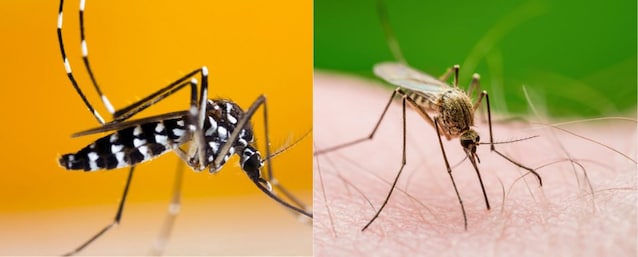
On the right, a common mosquito (Culex pipiens), brown in color and with the most rounded abdomen
They can be easily distinguished by the appearance of the adult stadium: black with evident white streaks On the legs and body the tiger mosquito; brownish color with transversal bandwids on the body brown and beige color the common mosquito. The first, almost “zebra”, is 4 to 10 mm long and has a tapered abdomen, the second inconspicuous, is also smaller (5 – 7 mm), with a rather rounded abdomen.
Lay eggs in water, but in different ways and times
In both species, the hatching of the eggs takes place in presence of waterbut while the female of the common mosquito lays the eggs directly in pools, ponds and large tanks, grouping them in aggregates in the shape of “raft”Able to float, The tiger mosquito lays the eggs individually Taking advantage of small collections of water such as sauces or bowls, or inside used tires or in the drainage of road manholes. The eggs come laid immediately above the water hair On the walls of the container where they look forward to being submerged to hatch. They resist dry even for long periods.
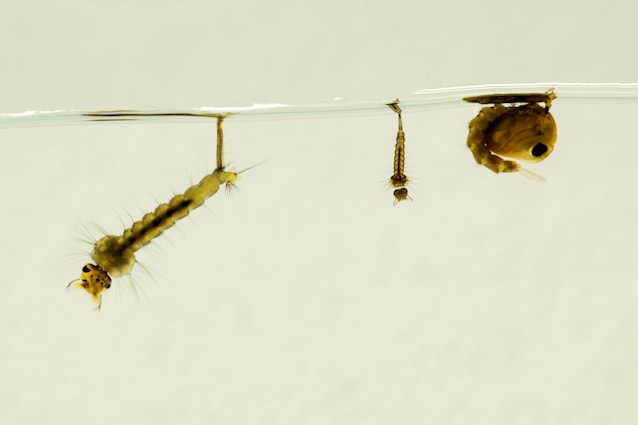
With the arrival of winter penalties, the common mosquito goes into diapause As an adult and look for shelter in cracks and ravines also in the houses. The tiger mosquito, active in our latitudes from April to October, not resisting the winter temperatures, ensures the survival of the species laying in autumn, in repaired places, thousands of eggs who will hatch with the first hot ones.
They punish us in different places and moments of the day
Quite different is the attack strategy adopted by the females of the two species to perform the blood meal:
- The common mosquito is active above all at night and to twilight, It is well adapted to closed environments and restricted spaces and manages to perform the first cycle of deposition without blood meal. Fly by emitting the Classic and annoying buzzdue to the high frequency of the beat of its wings. So, in summary, it strikes us at home, at night and buzzing.
- The tiger mosquito is also active during the day and prefers open spaces and the presence of grass Where often hides. It emits a humous or not audible to be hearing from the human ear because Fly more slowly and with a tiny wings at less frequency. This makes it more effective in hitting its target in broad daylight and mainly outdoors.
The two species can compete
When the tiger mosquito arrived in the United States, a decline in the abundance of the Culex Pipiens, As a result of a competition resources between species at the Larvale stadium. Research was conducted to measure the survival rate, the development time and the longevity of the adult stadium of the two species, breeding the same number of specimens both alone and in the presence of the competing specieswith five types of ration of the same food resources: the competition was in favor of the tiger mosquito larvae.
Laboratory studies have then shown that, at a temperature of 25 ° C, The tiger mosquito larva is more efficient In transforming body mass food than that of the common mosquito and, therefore, it has a greater ability to exploit food and grow faster.
