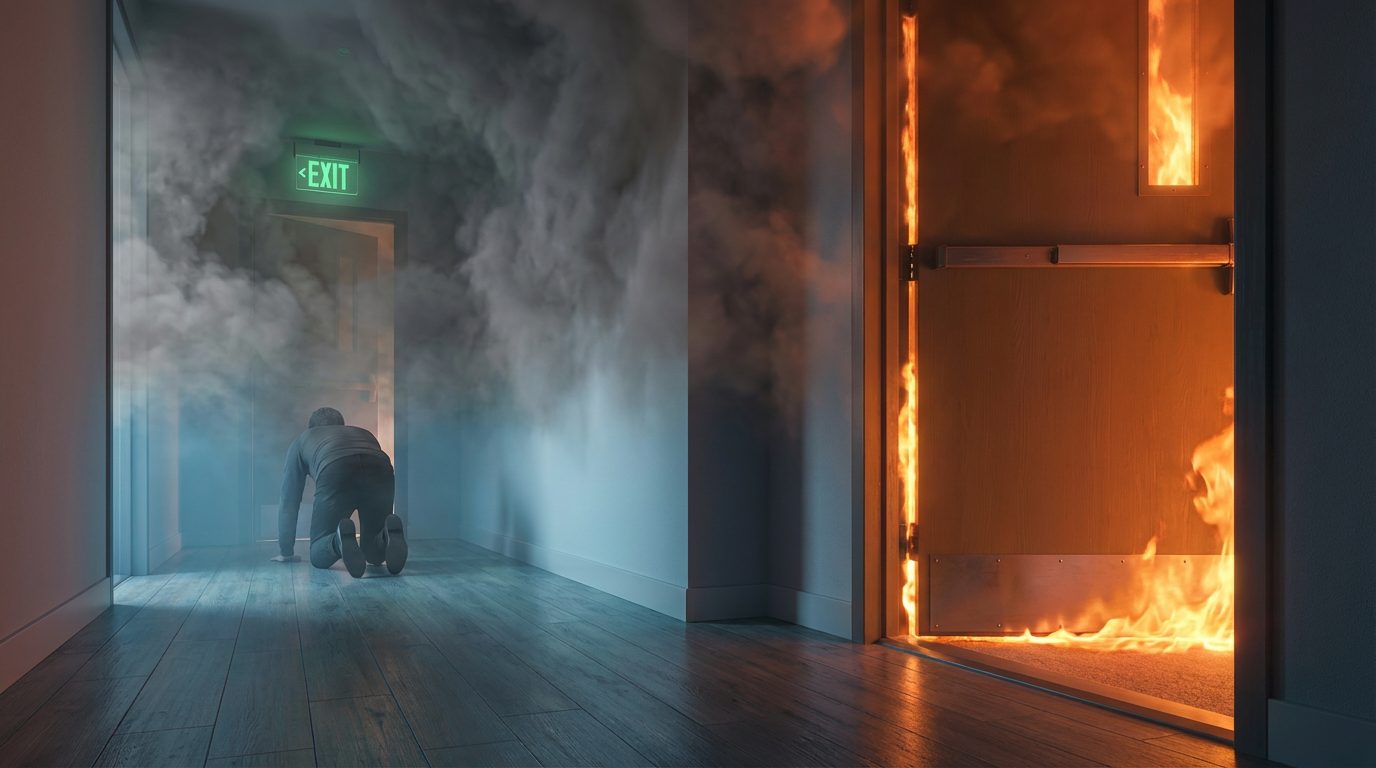
The Crans-Montana tragedy, during which they lost their lives at least 47 people remained trapped in a fire on New Year’s Eve, shone a spotlight on the importance of evacuation plans in case of fire: knowing immediately how to behave in front of flames can prove essential, allowing us to act as quickly as possible, especially in emergency situations where even just 30 seconds can make the difference and save our lives.
So here is a quick guide on Behaviors to adopt in the event of a house fire – developed on the basis of the official guidelines of the Fire Brigade – and on the importance of good practices for prevention.
What to do in case of a house fire
As also highlighted by the guidelines released by the Fire Brigade, the first thing to do in the event of a domestic fire is to try to stay calmas much as possible. In many situations, such as the Crans-Montana case itself, the panic that was generated among people made evacuation even more difficult, already complicated by the existence of only one escape route.
We must then remember that a essential element for the spread of a fire is theoxygen: for this, it is necessary suffocate the flames as soon as possible. If the fire starts from a pan, for example, it will be necessary to place a pan on top cover. Similarly, you could use a cover or a towel for other fire principles, but only in cases where they are of small intensity.
If, however, the fire is already quite developed, the first thing to do is escape, looking for an escape route to leave the building. Among other things, the smoke produced by the flames could make us lose consciousness within a few seconds, due to the substances released during combustion – listed in the image below – which can cause fainting from smoke inhalation. During the evacuation, it is best to close all the doors behind you, so as to place as many barriers as possible between ourselves and the flames.

Also for this reason, in case of large quantities of smoke, it is advisable walk on all fours: during a fire, the smoke is hotter than the surrounding air and, therefore, tends to stratify upwards. By the same principle, if it is impossible to escape from the building, the best thing is to lie down on the ground, with a handkerchief or rag soaked in water to cover your nose and mouth.
Once you reach a safe place, it is crucial contact the emergency services immediatelyby dialing the single emergency number, the 112or the 115number of the Fire Brigade.
What not to do in case of a house fire
At this point we know what to do, but what actions are not recommended in the event of a house fire? First, it absolutely is The use of water to extinguish an electrical fire is prohibited due to the risk of electrocution: tap water, in fact, is a conductor of electricity (as it is rich in mineral salts) and throwing it onto a live system (such as an electrical panel, an appliance or a socket) can create a physical connection between the energy source and ourselves.
During the evacuation, then, absolutely forbidden to use the elevator, but you need to escape via the stairs.
Last but not least, do not open the windowsunless it is to escape out of the building: as we saw before, the flames are fed by oxygen and opening the windows wide could only favor the spread of the fire.
Good practices for preventing a fire
As in all risk situations, prevention plays a fundamental role in fires too. In this case, good practices include:
- equip yourself with one or more fire extinguishers inside the houselocated in places at greatest risk (such as the kitchen);
- create an evacuation plan personalized based on escape routes, of which all family members, including children, are aware;
- do not use lighters or matches inappropriately;
- arrange the furnishings away from heat sources – such as fireplaces –, trying not to accumulate materials in a disorderly manner, especially the most vulnerable ones such as curtains or carpets.
