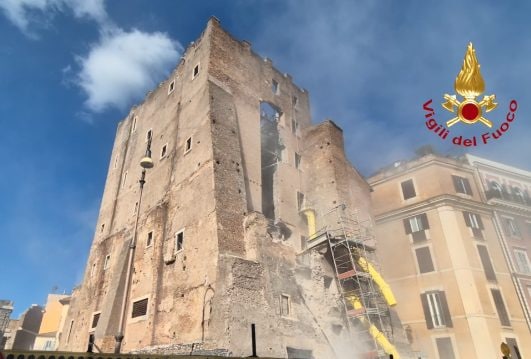
After the partial collapse of the Torre dei Conti in Rome – which caused the death of a 66-year-old worker, Octay Stroici, who was buried for 11 hours under the rubble – the future of this monument is still uncertain. In fact, restoration and redevelopment works were already underway at the Tower, which had become necessary given that the buildinglocated near the Imperial Forums, it was in a state of abandonment and “general dilapidation” since 2006.
We then interviewed the structural engineer Gaetano Cantisanito better understand what the possible structural interventions are to preserve the Torre dei Conti and secure this medieval building, symbol of the Counts of Segni family. After the two collapses, which occurred respectively at 11.30 and 12.50 last November 3, it will be necessary make safe the building, and then evaluate the static consolidation of the Tower.
What are the intervention scenarios that open up after the partial collapse of the Torre dei Conti?
«Since there has been a collapse, the first intervention necessarily concerns the made safe, starting from the outside. This is usually done with temporary structures such as pipe-joints or – in more severe cases – with real support structures designed ad-hoc. These structures serve to give support to the load-bearing perimeter walls, we can say they act a bit like buttresses, but in steel. After the provisional securitywe can start internally investigate the state of the places: since the floors collapsed, it is in fact probable that there was also damage to other walls and – in any case – a significant change occurred in the structural organism as it was known before. In general, then, the inspection should define the state of conservation of the building, regardless of the damage caused by this collapse.
Following this, you can lean towards a safety assessment carried out with numerical models and technical analyzes accompanied by calculationswhich also recall the investigations already carried out previously and possibly carry out further ones: the objective is to understand the current state of health of the Torre dei Conti. In practice, it means understanding whether there is static safety of the building or not: in technical jargon we speak of the so-called static suitability!
The first case is the simplest one: if the engineer evaluates that the state of the places is not that much compromised, then it can be the restructuring project already started has been adapted (and which should have been completed by 2026, ed.). If, however, the statics are compromised, then everything must be remodulated: in this case, depending on the severity of what was observed/calculated, it may not even be possible to guarantee the safety of the building due to its own weight. Let’s say that this is the extreme case!
From a technical point of view, what are the investigative tools that could be used to carry out the inspection of the Torre dei Conti?
«In these cases, we can distinguish between two types of investigation tools: the first type is used to understand if there is any problem in the current state of progress of the phenomenon and the damage. Much is done by the visual analysis of the technician who, with the necessary experience, is able to immediately understand the severity of the problem. The first thing what must be ascertained is whether it is balance is somehow guaranteed of the acting loads (mainly the own weight).
Downstream from this, you can move on and evaluate cascading problems: for example, i slides they are placed across the cracks to understand if it is continuing to open, or if the phenomenon has stopped. This tool, for example, requires an observation interval.
Externally, any movements of the walls can then be assessed with sensors as gauges laser (always if it is possible because the external scaffolding must not limit the view of the observation points). Load tests can also be carried out on the remaining floors if necessary understand the movements that the attic undergoes starting from a known applied load, then comparing these results with predictive numerical models.
The second type of tools, however, is used to understand the resistance characteristics of the masonry: in these cases, for example, jacks. In practice, slits are made in the wall with a saw and elements are inserted that can come under pressure through a fluid that circulates inside them: if this object is put under pressure, the masonry begins to crush locally and the maximum resistance can be deduced at the same time.
As for the Garisenda Tower in Bolognayou can also use accelerometersso as to establish the accelerations from white noise that the building suffers (due to the effect of the wind, the traffic around it, etc.). These results are exploited to calibrate ad-hoc mechanical models to predict the future behavior of the building with less uncertainty. This, however, takes a long time.
At this point, all the investigations are grouped together, interpreted and a solution is constructed analytical modelwhich indicates how the forces are distributed internally to the elements starting from the applied loads, so as to understand if those acting on the load-bearing walls are sufficient to ensure the safety and stability of the building».
From a structural point of view, what are the interventions that could be done to preserve the stability of the building?
«There are many interventions that can be carried out, depending on the problems that are detected: theuse of internal chains it is a recurring type of static consolidation, which serves to guarantee a box connection between all the walls present. In ancient times, in fact, there was no connection between the orthogonal walls and this means that the wall is free and has no effective constraints in height: these chains placed internally join the wall to the one on the other side: they are an internal equivalent of the external buttresses and they constitute an intervention that is often used, also because they have little impact on a visual level.
Subsequently, we will have to think about renovating the floors, and if there are minor problems such as detachments or localized cracks, we could think about “injections” of material such as mortar, to fill the void created by the crack. If the crack is important, you can think of doing an armed injection, that is, I also insert metal bars inside, simulating a seam..
So, overall, the main interventions they should concern the atticsthe compensation for all cracks and it will be understood if the wall structure And capable of carrying loads which derive from its dimensions and what is placed on it. It must be said that these would probably still be limited interventions, due to the fact that it is a historic building, for which it is not always possible to use all the materials (for example, in many cases the use of modern resins or even reinforced concrete elements is not permitted)”.
Are these types of collapses and, more generally, structural weakening of historical monuments rare in Italy or are they more common than you think?
«In reality these types of collapse – fortunately – are quite rare: if there are structural weakenings, especially if we are talking about cultural heritage, there are always bodies responsible for monitoring and intervening as soon as possible. I would say, though, that the advanced extent of degradation of the Italian historical heritage is commonwhich is very dated. This exposes him to increasingly higher risks. So, perhaps, if we hear about it more often than in the past it’s because we are in an increasingly growing phase of the problem».
