We talk about sustainable mobility indicating a transport organization system aimed at minimizing their environmental, social and economic impact. Cross-cutting examples of sustainable mobility policies are the promotion of the use of bicycles and public transport, but also car sharing and sometimes the use of electric vehicles. The concept of sustainable mobility, however, is not a monolith: his practical implementation within a specific social fabric varies from country to country. Let’s see how this concept is interpreted in the case of Italy and other European countries such as Norway, Germany, France, Spain and the United Kingdom.
From paper to reality: how sustainable mobility takes shape in Europe
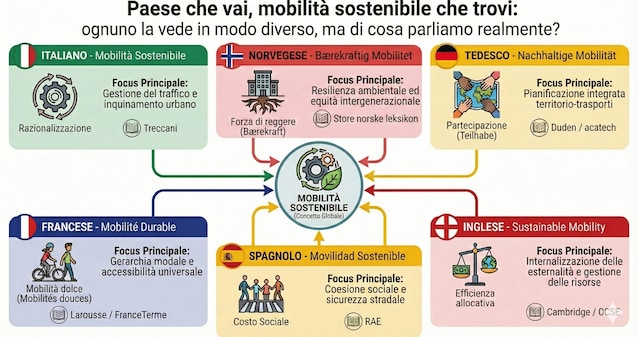
Within the European Union sustainable mobility (Sustainable and Smart Mobility Strategy) is one of the fundamental pillars of Green Dealthe plan desired and signed by the Member States to combat climate change through initiatives which, on the one hand, drastically cut the current CO emissions₂ and other climate-altering gases and, on the other, lead the EU to reach net zero. This same guideline is also taken up by Norway and Great Britain, two nations that do not belong to the European Community: for Oslo we talk about Bærekraftig mobilitetwith the adjective “Bærekraftig” composed of the verb bære (support/carry) and from the noun kraft (strength/resistance) to indicate a movement system that can also be adopted in the future without damaging the environment.
What is meant by sustainable mobility in Norway, the United Kingdom and Spain
In concrete terms the Norway is making widespread the habit of moving first of all on foot or by bicycle (the so-called gentle mobility), secondly by public transport and, as a last resort, by private car. Like the European Union, also the United Kingdom aims to quickly reach net zero (the deadline has been set for 2050) and to do so it is necessary to rethink citizen travel from a smart and green perspective. London is the British city that is setting a good example, investing massively in improving and making the public transportmaking the use of private cars superfluous and encouraging travel by bicycle or e-bike, especially for “last mile” deliveries by e-commerce companies, such as Amazon. For the Spanish Government the concept of sustainable movement translates into a movement system (for people and goods) using means of low social, environmental and energy cost, in perfect compliance with law 2/2011:
Within their competences, Public Administrations will promote sustainable mobility policies that respect the following principles: a) The right of citizens to access goods and services in adequate, accessible and safe mobility conditions, and with the minimum possible environmental and social impact.
Premier Sánchez’s initiative relating to a single subscription for public transport on road and rail a 60 euros per month, halved for users under 26, fully applies what is established by the law on sustainable mobility.
The meaning of sustainable mode in Italy, France and Germany
France, Germany and Italy present similar paths or, to be more precise, share some critical issues. For France we are talking about durable mobilityunderstood as an ecosystem in which movements generate the lowest possible environmental impactfor Germany, however, the nachhaltige mobilität it is framed as the reconversion of traffic with an ecological focus, with the aim of reducing fuel consumption and emissions to regenerate the ecosystem. For theItalyfinally, sustainable mobility materializes, theoretically, in rationalization of vehicular traffic with incentives for public transport to safeguard the urban environment, but the data on the efficiency of LPT (Local Public Transport) and on the preferences of Italians show a reality that is very far from what the environmental objectives pursued by governments in office (both the current one and the previous one) should be.
On paper, the definition of sustainable mobility therefore still appears rather nebulous and open to discussion different interpretationsappearing distant from the expository clarity with which other countries have been able to translate this concept into recognizable guidelines, objectives and policies. However, if the Elysée seems to align itself with a strategy that places public transport and soft mobility at the centre, for Berlin and Italy the paradigm shift from private cars to public transport still remains uncommon.
Sustainable mobility within the European Union
situation in Italy – Clean Cities and Istituto Piepoli
Sustainable mobility in Europe
