
It can happen, ed It’s more common than it seems: maybe we are still inexperienced, or we are simply lost in thought while we are at the petrol station, and we happen to make a mistake, putting diesel in our petrol car, or vice versa. Inserting the wrong fuel can cause serious damage to the engine, but the severity depends above all on one thing: whether the car is started or not. If you notice the error immediately, do not start the vehicle and call a repair shop for empty the tank. If we put petrol in a diesel engine, poor lubrication of petrol can ruin pumps and injectorscausing noise, vibration and shutdown. If instead you put it diesel in a petrol enginethe fuel, denser and less volatile, tends to clog the fuel system and makes ignition difficult. Fortunately, today it is easier to avoid these errors: they have been introduced throughout the European Union standardized labels. Petrol is indicated by a circle with the letter E (ethanol) followed by a number, such as E5 or E10, while the Diesel is marked with a square with the letter B (biodiesel) also followed by a number, such as B7 or B10.
What happens if we get the wrong fuel
Getting the wrong type of fuel can have very different consequences, depending on the quantity inserted and, above all, whether we start the engine or not. By starting the car after the wrong fuel, we are literally using an engine on one fuel it was not designed for. In the most common case – petrol in a diesel engine – the risks are only high: petrol has a much lower lubricating power and, instead of igniting spontaneously like diesel, requires the spark from the spark plug. The result is that the engine loses lubrication and can suffer damage to the pumps and injectors. The symptoms arrive immediately: abnormal noises, vibrations, loss of power and shutdown.
On the contrary, put diesel in a petrol engine makes ignition difficult or impossible: diesel fuel is denser, less volatile, and tends to clog the system causing irregularities in operation. In both cases there is only one rule: do not start the engine. You must stop and immediately contact a workshop or roadside assistance to empty the tank and save the vehicle.
The engine of a car is a internal combustion engine (in English Internal Combustion Engineoften indicated by the acronym ICE), whose operation is directly linked to first law of thermodynamicswhich many of us know as: energy is neither created nor destroyed, but transformed from one form to another. Here, the engine of our vehicle does just this: transforms chemical energy into mechanical energyallowing the wheels to move. But where does this chemical energy come from? From a combustion reaction that takes place inside the engine, where a fueljust like petrol or diesel, reacts with oxygen. This reaction is exothermicMeaning what releases heatalong with other waste compounds (such as carbon dioxide and nitrogen compounds) that are evacuated through the exhaust pipe.
Inside the cylindersthe heat causes theexpansion of the gases, which push the pistons connected to thecrankshaft. The latter transforms this alternating movement (up-down) into rotary movement, which, thanks to the transmission system, sets the wheels in motion. And this is how the chemical energy of the fuel is transformed, step by step, into the movement that moves our car forward.
What causes car damage: the chemical differences between diesel and petrol
To understand what changes between petrol and diesel you must first start from what they have in common: they are the fuel that burns in the engine to make the vehicle move. Both are mixtures of hydrocarbons (organic compounds consisting mainly of carbon and hydrogen) resulting from oil refining. There gas it’s a more blend lightformed by hydrocarbons with shorter chains. The diesel (or Diesel), instead, contains longer and heavier molecules: it is therefore denser, less volatile (it evaporates more difficult) and has a greater lubricating power.
This different composition affects the behavior during combustion. In gasoline engines, the fuel comes mixed with air before entering the cylinder, and combustion begins thanks to the sparkle of candleswhich ignite the mixture at the right time. It is therefore important that the petrol does not ignite on its own, otherwise the so-called “pounding in the head” (i.e. combustion would occur early, damaging the engine). The ability of petrol to resist self-ignition is measured by the octane number: the higher it is, the more the fuel can be compressed without spontaneously igniting, ensuring regular and controlled combustion.
In the diesel engine, however, air comes first heavily compresseduntil reaching very high temperatures. Only afterwards is diesel fuel injected, which ignites spontaneously as a result of the heat: here, unlike petrol, it is important that the fuel ignites easily (this is called SIT, Self Ignition Temperaturei.e. the temperature at which the fuel begins to burn spontaneously).
How to understand which fuel is right and avoid putting petrol in diesel
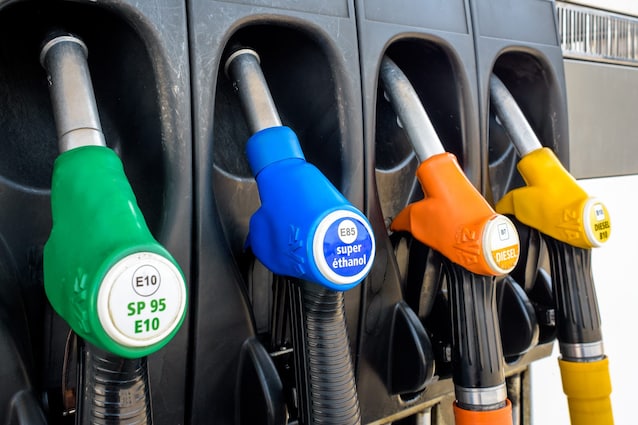
First of all, in addition to checking the registration document or the user manual, prevention is based on nozzles of different sizes and shapes between diesel and petrol pumps. But unfortunately this is not always enough. Fortunately, they have been introduced in all EU member countries (and the UK) for some years standardized labels on the tank doors and on the refueling pumpsprecisely to reduce these errors:
- There gas is identified with a circle with the letter Efollowed by a number (for example E5, E10, E85): the letter indicates the presence of ethanolwhile the number corresponds to the maximum percentage of ethanol contained in the fuel (for example E5 indicates that it contains up to 5% ethanol).
- The diesel it is instead indicated by a square with the letter B followed by a number (such as B7 or B10): in this case the letter refers to the biofuel (biodiesel) and the number indicates the maximum percentage of biocomponent present.
If you notice the error while you are still at the pump, it is important do not start the engine under any circumstances. The damage is limited and can be resolved by emptying and cleaning the tank.
