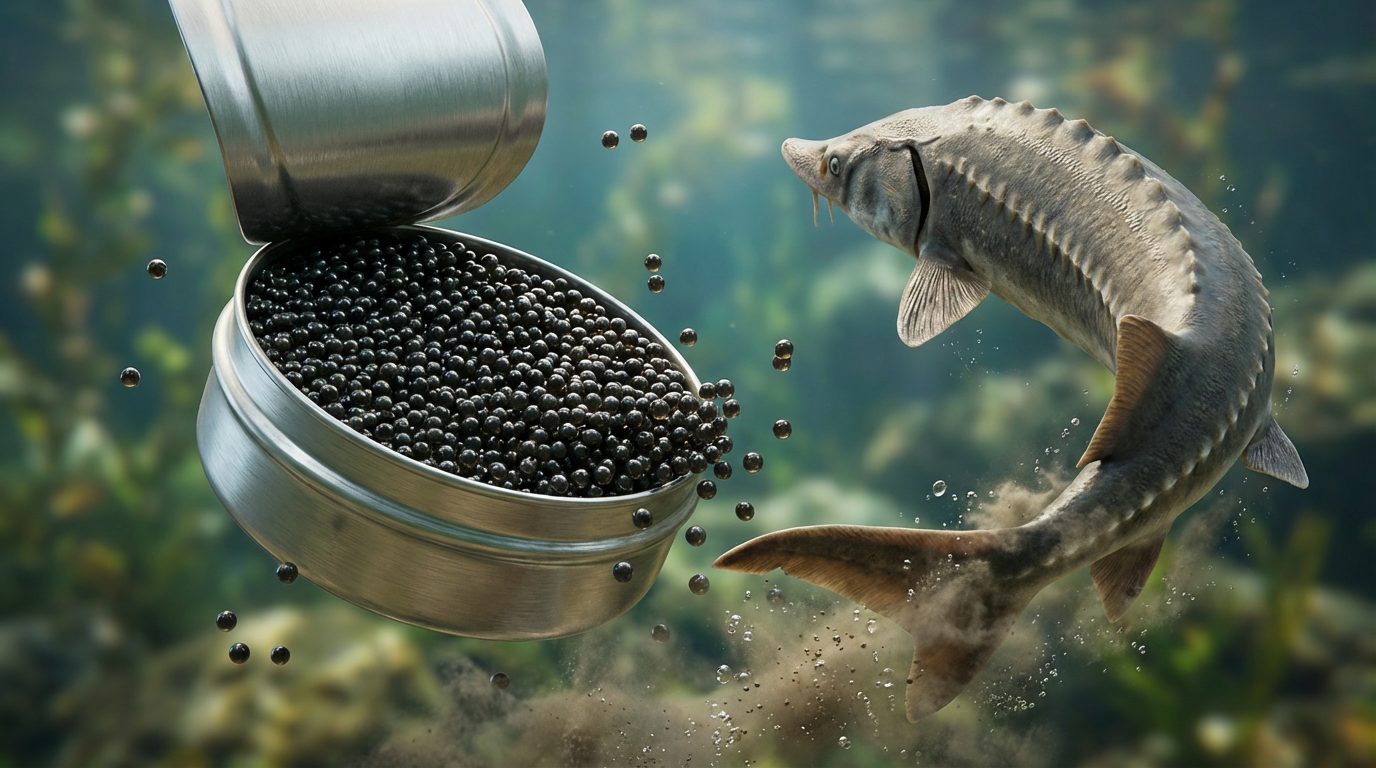
Celebrating with “caviar and champagne” is synonymous with a rich, refined and expensive party, but the origin of this product and the reason for such a high cost of the famous black beads in a jar are not always known. These are exactly the eggs of a fish: lo sturgeona fish that reaches 8 meters, 1500 kg and lives up to 100 years, appropriately salty. They were originally mined from wild specimens caught in the rivers, today caviar is produced by sturgeons bred with rather complex techniques which require experience and scientific skills in aquaculture (i.e. in the controlled breeding of aquatic species).
The use of caviar on the tables of nobles has its roots in Middle Ages and appears to have been first produced in Russia around 1200; in Italy, the first recipe documented in Cristoforo da Messisburgo’s book dates back to 1563. Many times on the refrigerated counters of supermarkets you can find fish eggs used as a “substitute” for caviar, decidedly less expensivebut absolutely less valuable such as lumpfish eggs, black or reddish in color, extracted from Lumpfish (Cyclopterus lumpus) a fish from the Baltic Sea or the eggs of troutof a characteristic bright orange colour, extracted from rainbow trout (Oncorhynchus clarkii). Indeed, the famous Codex Alimentarius of the FAO which establishes international standards for food products, in 2010 established the univocal reference description for caviar: “product obtained from non-ovulated eggs of fish belonging to the Acipenseridae family, having a final salt concentration of 3-5%, with or without the addition of other food additives and intended for direct human consumption”.
What is caviar and how is it produced
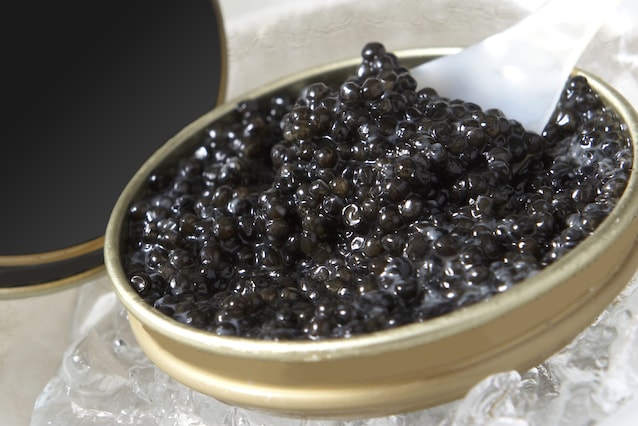
The precious product found in the jar is simply a mixture of sturgeon eggs and saltbut to achieve this result there is a truly complex production technique. The eggs are obtained traditionally extracting the entire ovary from adult femalesimmediately after having suppressed them. The connective tissue of the ovary should be immediately removed and the eggs carefully sieved and washed in cold water several times. Then the product is weighed, selected by caliber and salted. Salting is also a particularly delicate phase; it can take place dry or immersed in a sort of brine and the average percentage of salt varies from 3 to 10%. The caviar is packaged in high-quality boxes tinhermetically sealed to avoid oxidation and deterioration. In unopened packaging it can also last 90 days and, if pasteurized, it can last up to a year as long as the packaging remains intact; the important thing in any case is to maintain the so-called “cold chain”, therefore always keeping it in the refrigerator at temperatures around 4 °C.
Considering that the traditional method involves the killing of adult animals and, therefore, presents critical issues both from a economic is ethicalhave been tested more modern techniques to extract the eggs without killing the fish. The exact moment of maturation of the eggs must be identified and a substance must be administered to the female to encourage the release of the eggs in a natural way or through a simple ventral incision; this allows you to obtain more production cycles. However, this product is classified differently from caviar and is defined, to be precise, as “caviar from ovulated eggs”; the quality is lower because the eggs are more mature, of different consistency and require different treatments to reduce the degree of viscosity.
Originally caviar was extracted from wild sturgeon caught in the wild; fishing pressure combined with other environmental impacts have made sturgeon populations extremely vulnerable and at risk of extinction. In the 90s of the last century the wild caviar market almost completely collapsed. Since then, the breeding of sturgeon for productive use in plants with open-air tank systems for reproduction, growth and fattening of the specimens from which the caviar is extracted has become increasingly popular. The sturgeon, once sacrificed, is also used meatsbut their economic value is significantly lower than caviar.
What species of sturgeon are used to produce caviar
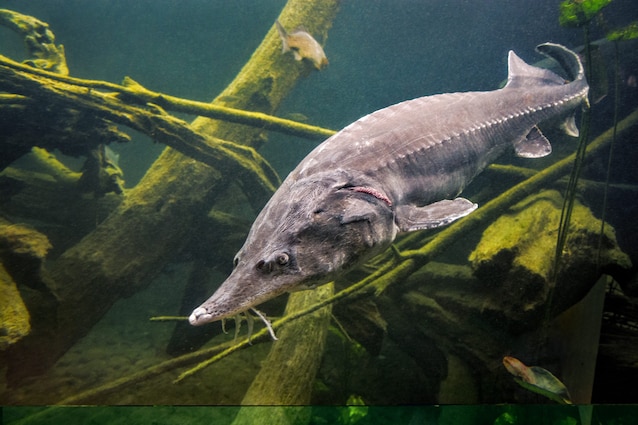
They are known 25 species of Sturgeon, all belonging to the Acipenseridae family and distributed in the northern hemisphere, but only about ten are used for the production of caviar; among these the beluga sturgeon (Huso huso), the Cobian sturgeon (Acipenser naccarii) and the Siberian sturgeon (Acipenser baerii). These are prehistoric fish considering that they evolved about 200 million years ago and they have maintained some primordial characteristics such as the 5 rows of bony shields present on the body. They are long-lived (they can live up to 100 years), have a notable but very slow growth and can reach even 8 meters long hey 1500 kg weight. Most species live most of their lives at sea and migrate to river waters to reproduce (anadromous species). Since 1998 all sturgeon species have been declared at risk of extinction.
Why caviar costs so much: properties and prices
Caviar is “noble” not only from a gastronomic point of view, but also nutritionally; it is very nutritious, highly proteinrich in essential amino acids And source of minerals and vitamins; in particular calcium, phosphorus and vitamin B12. It also contains a significant amount of omega-3 and omega-6 fatty acids. The analysis of caviar in different sturgeon species showed a lipid content of around 10-20% with a prevalence of unsaturated fatty acids compared to saturated fatty acids.
The price of caviar varies greatly depending on various parameters including the species of sturgeon used, the production techniques, the quality of the eggs obtained, but the cost is still very high; the most expensive in the world is theAlmas obtained from beluga sturgeon (Huso huso) albinowith golden-white eggs and can even reach 40,000 euros per kgon par with the average cost of DOP saffronthe so-called red gold.
There are many reasons, but in particular factors such as:
- THE long times to wait for production, considering that female sturgeons become fertile rather late. For example, the female beluga sturgeon ( Huso huso ) reaches adulthood around 18-20 years, while the female White Sturgeon (Acipenser transmontanus) takes on average 13 years old to produce eggs;
- THE breeding costs of specimens in captivity are quite high;
- The production techniques they are complex and delicate.
Caviar producing countries in the world: Italy in second place
Historically, the largest producers of caviar were Russia and Iran, given the abundance of sturgeon in the Caspian Sea and the historical use of their eggs as food. Currently the China is the main producer in the world, but perhaps some will be surprised to discover that the first places in the world production of this delicious food appear preciselyItaly. It is also produced in France, the United States, Russia and Iran. A 2016 European Commission report estimated global caviar production in 340 tons with China as the main producer. China’s leadership at the world level has also been confirmed in 2024 and Italy ranks second with 67 tons of caviar produced in 2024, concentrated in the factories in Lombardy and Veneto. On the other hand, Italian production of farmed sturgeon has been the highest in Europe since 1990.
