
Many know it as oxygenated water, only some as hydrogen peroxide with chemical formula h₂OR₂but surely, we all have it at home. Synthetized in the early 19th century by the French chemist Louis Jacques Thénardit’s called this because simply has an oxygen more than water! Its best known is the Wound disinfection And for the classic white skimmer that forms: thanks to its oxidizing power and the formation of free oxygen radicals (ROS), it can damage bacterial membranes and DNA, fundamental structures for their survival. Oxygenated water is not only useful as a disinfectant, but it can be a valid help in the house: for example, whiten the cotton And other fabrics oxidizing chromophores responsible for the colors of some stains. The same chemical principle allows you to lighten teeth and hair, but here the do-it-yourself is risky: unstressed concentrations or times can ruin nail polish, gums or weaken the hair. For these uses, Better to always rely on expert hands.
What is oxygenated water, between history and chemistry
The history of oxygenated water begins in the first half of the nineteenth century, when in 1818 the French chemist Louis Jacques Thénard He summarized it for the first time inside his laboratory. It was he who called her eau oxygénéefor a fairly simple reason: the chemical formula of water is h2Or, however, if we add an oxygen atom to the structure we get H2OR2which is our oxygenated water. The two oxygen atoms are directly linked to each other, this bond is typical of a class of compounds called peroxides And it is for this reason that it is also called hydrogen peroxide.
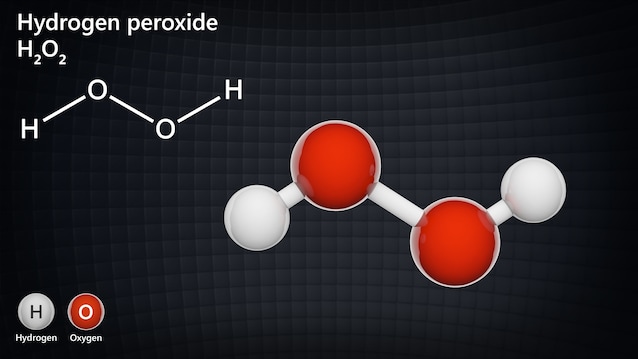
The oxygenated water appears as a colorless liquid with a pungent smell, but what we buy in the pharmacy is not pure oxygenated water, but diluted: It is in fact an aqueous solution of oxygenated water, often at a concentration of 3% (if for example the bottle is 100ml, it means that inside we have 97 ml of H2Or 3 ml of h2OR2).
Use on the wounds of oxygenated water
Why do we use oxygenated water for the treatment of superficial wounds? The reason is his strong oxidizing power. What does it mean? When we pour it for example on a cut, it comes into contact with an enzyme present in our blood, the enzyme Catalasewhich catalyzes (i.e. promotes) the degradation of oxygenated water in water and gaseous molecular oxygen, according to the reaction:
2h2OR2 → 2h2O + o2
By decomposing, the oxygenated water can free the so -called Ros (Reactive oxygen species), which easily interact with biological structures: they attack the membranes and proteins of microorganisms, such as bacteria, damaging them to bring them to death. Precisely for this reason, oxygenated water is a good ally for Reduce the microbial charge at the level of the woundswhich are in all respects of the doors Between the outside and the interior of our body and could become an ideal entry point for pathogenic microorganisms.
And it did not end here: as mentioned a little while ago, the oxygenated water degrades by releasing gaseous molecular oxygen (or2), which appears in the form of foam: it is a real mechanical helpbecause the bubbles raise dirty, thin or contaminating powders and very small particles of asphalt or earth were stuck in the lesion, and which could give life to ainflammation if not carefully eliminated. It is no coincidence that our mothers used it when we peeled their knees as children: very often they were injured outdoors, climbing a tree or falling on the gravel.
What is the hydrogen peroxide in home for: use as bleaching
Oxygenated water in aqueous solution can also be used as bleaching On some types of fabrics, especially cotton: once the ros are produced, these can interact with i chromophores, That is, the chemical compounds responsible for the color of wine, blood, earth or any other machinery substance, oxidizing them and breaking the bonds that absorb visible light. In this way the fabric gradually loses yellowish shades or dark and appears more white and bright.
Oxygenated water and “do it yourself”
Cases are also known in the scientific literature in which the h₂OR₂ (alone or more often in association with other substances) can be used for Defort up the teeth or lighten the hair. In fact, oxygenated water is one of the most used products in hair colors as an initial step to which follows the application of the color and acts with the same mechanism with which she stins the clothes: it breaks the natural pigments of the hair. In these contexts, however, it is not sure to rely on do-it-yourself: in the case of the teeth, concentrations and unstressed exposure times they can damage enamel and gums, while for hair incorrect use can weaken the fiber and in some cases also lead to the formation of burns and vesicles. It is always better then rely on professionalI who know how to modulate the conditions of use safely.
