
There is a particularly interesting phenomenon that shows how the human brain tends to systematically associate sounds and shapes: the Bouba-Kiki effect. This experiment, studied within the psychology of languageinvestigates the link between the acoustic characteristics of sounds and the visual properties of shapes.
The Bouba-Kiki experiment is very simple: it consists of taking two abstract figures, one come on round and soft contourswhile another angular and pointedand then ask participants to choose which of the two they would call “bouba” and which one “kikiThe phenomenon became known in 2001 thanks to neuroscientists VS Ramachandran and Edward Hubbardwho demonstrated how almost 98% of American and Tamil Nadu students performed the exact same name-figure association, attributing the name “bouba” to the round figureWhile “kiki” to the more angular one. This interesting phenomenon was already analyzed in some studies on phonosymbolism which date back to 1929, when the psychologist Wolfgang Köhler he noticed that people of different languages attributed sounds like “maluma” to round figures and “takete” to angular ones.
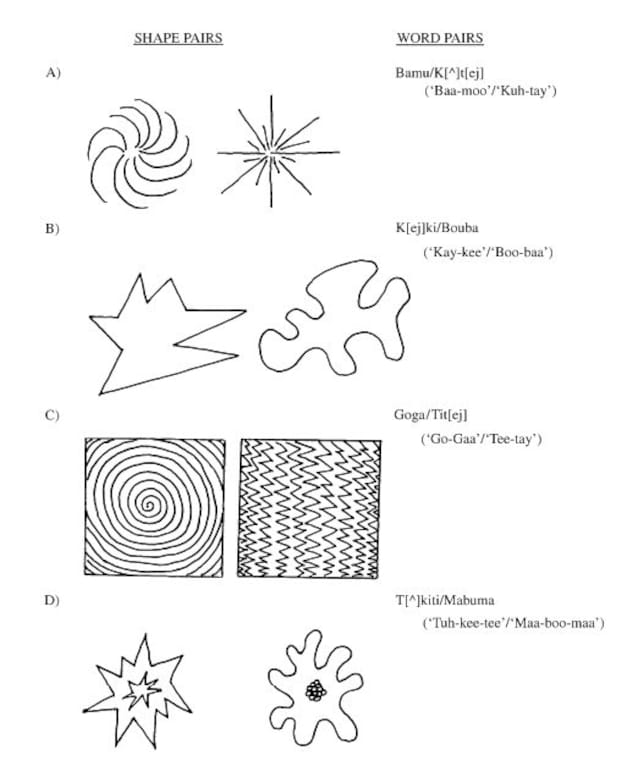
A convincing explanation comes from phonetics. To pronounce “bouba” (/ˈbuːba) the lips are rounded and the resulting sound is perceived as soft and fluid, while “kiki” (ˈkiːkiː) involves the guttural and plosive sound of the “k”, thus making it more “edgy”. In a certain sense, mouth movements seem to implicitly recall the characteristics of the shapes with which the sounds are associated.
Some neuroscientists describe these associations as “cross-modal correspondences“, i.e. spontaneous connections between information coming from different senses. The Bouba-Kiki effect reflects the fact that the brain integrates sounds and shapes already in the early stages of perceptual processing, through neural connections that connect auditory, visual areas and regions of multisensory integration. This suggests that the way a word sounds can influence how it is mentally represented.
These associations are not just about abstract forms. The Bouba-Kiki effect it can also influence how we perceive people’s first names: Without determining anyone’s personality, the sound of a name can evoke different sensations. Names full of rounded vowels can appear softer or welcoming, while those with harder consonants can be more energetic or punchy.
It comes naturally to ask whether the sound of a name really can influence personality of whoever carries it, or at least how that person is perceived. In reality, there is no scientific evidence that connects character traits to the name itself, and therefore we do not become “softer” or more “edgy” depending on whether our name sounds more bouba or more kiki, what weighs much more are the experiences, the people we meet and the memories we build over time.
The Bouba-Kiki effect therefore shows how perception and language emerge from the continuous interaction between different senses, rather than from isolated systems.
