
There Klein bottledescribed for the first time by the German mathematician Felix Klein in 1882, is a surface, that is, a two-dimensional geometric shape relative of the donut, which however is not orientable, in fact it only has one face and although it seems closed to us it doesn’t have an inside and it doesn’t have an outsidejust like the more famous Möbius strip. Let’s see how it is made and explain its strange properties.
The Klein bottle is a surface, as geometric objects such as the (empty) sphere and the plane can be. These are geometric shapes of dimension 2, the abstract versions of concrete objects such as the ball, and sheets of paper. However, the Klein bottle is a bit strange compared to these surfaces. It is a geometric figure that can be seen as a kind of donutin mathematician bull. To build a donut we can take a tube, bend it a little, and join its ends so that they fit together as shown in the figure below.
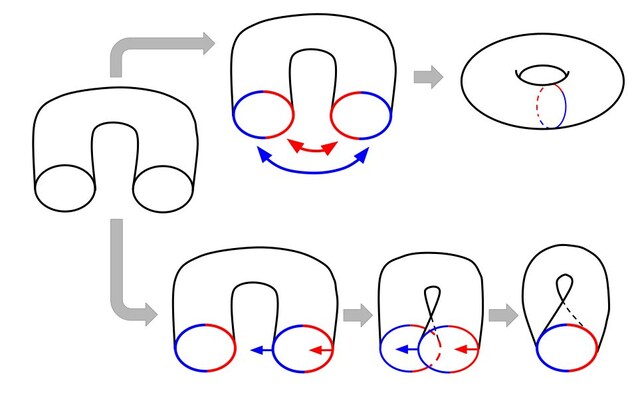
Alternatively we can, as in the lower part of the figure, try to slide the two ends over each other, until they match, creating a Klein bottle. However, to carry out this operation, one piece of tube seems to necessarily have to fit inside the other, and in fact all representations of the Klein bottle involve one part of the tube fitting into the other, as in the figure below.

The fact, however, is that the truth Klein bottledoes not foresee that its parts interpenetrate, unlike what is seen in all its representations: but how is this possible?
The reality to build this surface 3 dimensions are not enough, but 4 are neededbut our graphic (or sculptural) representations cannot go beyond the third dimension: this is something difficult to imagine but which in mathematics is not so unusual. Let’s try to understand the simplest example of a circle and a segment drawn on a sheet of paper as in the figure below. To join the two ends of the segment, remaining on the plane of the sheet, we must necessarily cross the circumference (see the upper part of the figure). If instead (see the lower part of the figure) we allow the ends of the segment to come out of the sheet of paper and go over the circumference by passing over it, then it is possible to join the two ends without any interpenetration. By moving in 3 dimensions instead of two we managed to join the two ends.

A similar thing happens for the Klein bottle, except that instead of from 2 to 3 dimensions we have to go from 3 to 4 dimensions. This is why all the representations of the Klein bottle that we see, images or sculptures, are all wrong, since they always involve interpenetrating parts.
This one though that’s not the only oddity about the Klein bottlegiven that, unlike spheres, cylinders and planes, it is one non-orientable surface. If we take a sheet of paper, in fact, we can always color one side of one color and the other of another color, without the two different colors touching except at the edge of the sheet.
In the same way we can imagine coloring the inside of a ball with one color and the outside with another, without the two colors ever touching. This is not possible with the Klein bottle and that is why mathematicians say that it is not orientable unlike spheres and planes which are instead orientable surfaces.
It is therefore a non-orientable two-dimensional surface just like the Möbius strip, a figure famous precisely because it has no inside and outside and can be seen as a road that never ends. On the Möbius strip it is possible to start from a point and, walking without ever crossing the edges, return to the same point and find yourself on the opposite side of the surface. If you then continue walking, always moving forward, you can return to the starting point, on the same side of the belt. The Möbius stripIndeed, it does not have two sides but only onejust like the Klein Bottle. In the figure below we have traced the path of an ant that, walking, walking, passes by what it looks like the outside of the surface to what it looks like the inside of the surface. In particular, you can see how it passes twice through the same point on the Bottle (top), once on one side of the surface and once on the other.

If the ant walked on a sphere, however, it could not go from the outside to the inside simply by walking on it. In practice in the case of Klein bottle we can’t really talk about external and internalbecause the two sides of the surface are connected: the surface has only one side, not two, that’s why we used the word “it seems” referring to the outside and the inside. It’s a bit as if the Klein Bottle were one borderless version of the Möbius Stripand in a certain sense it is exactly like this because if we cut it into two parts (see figure below), along its symmetry plane, we obtain two Möbius strips which in turn, glued along the edge, give life to a Klein Bottle.

