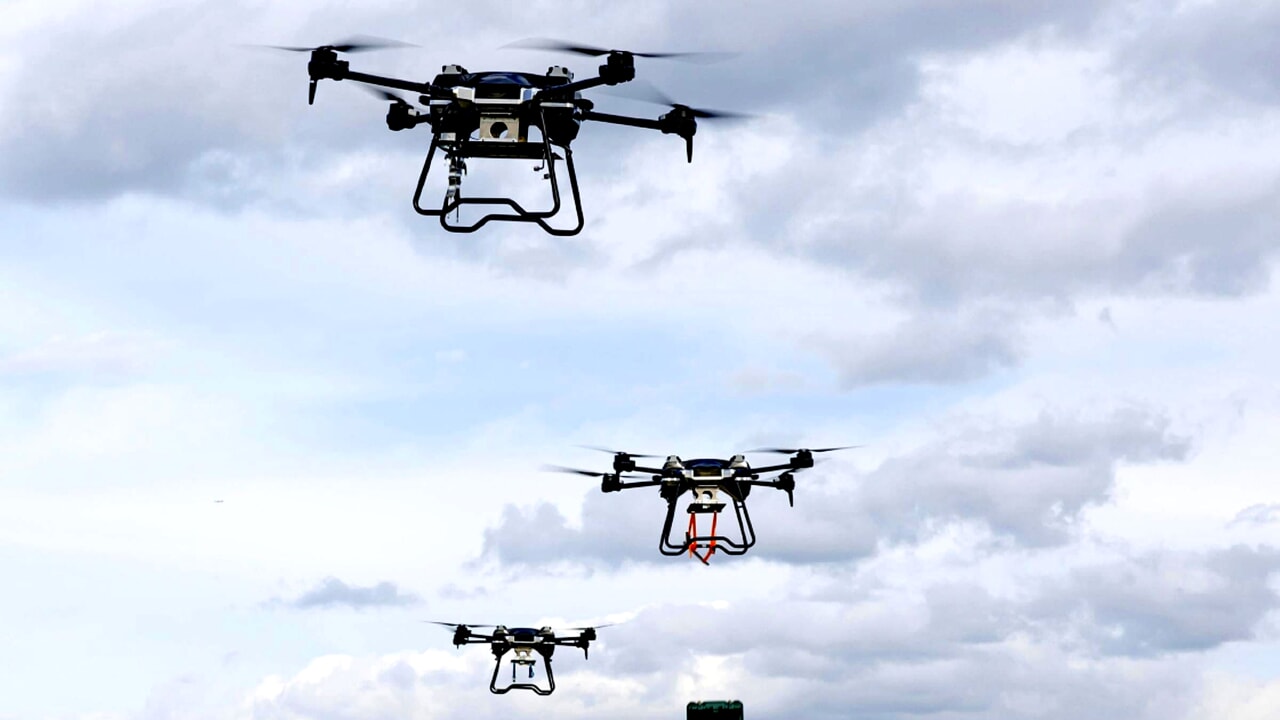
From today’s informal EU summit in Copenhagen, Denmark, the alarm was launched and at the same time the solution on how to defend itself from a possible attack of drones by Russia. A theme that emerged with force in recent weeks and closely connected to the war in Ukraine and the incursions of alleged Russian drones in the European skies.
Because we talk about the “Droni wall”
At the center of the discussion of the 27 European leaders were the costs and benefits of such a measure. Aware that drones are produced at the cost of a few tens of thousands of euros, the member countries know that they cannot rely only on the expensive military skills, such as bullets or patriot missiles of the US anti -aircraft defense system to protect the skies. Therefore, the only possible way to the European Union is to break down drones with drones. Hence the idea of a “Droni wall”.
“Europe must provide a strong and combined response to the incursions of Russian drones on our borders. And that is why we will propose immediate actions to create the wall of drones in the context of the Eastern Flank Watch program (surveillance of the eastern side, editor’s note)”, said the European Commission, Ursula von der Leyen, during a press conference with the secretary of the NATO, Mark Rutte, referring to the European initiative Duplicate Objective: to map the tools available to the most exposed countries (from the Baltic to the Black Sea) and establish how to fill the gaps with common funds and technologies. The roadmap indicated by the number one of the Commission is therefore to create a multilevel system of defense and attack based on aerial technologies without pilot along the eastern border of the Union, that is, the one most exposed to any attacks and hybrid threats of Russia.
What does the defense plan provide with drones
The new European Defense plan – which will be formally presented at the end of the month – identifies nine critical areas of capacity to be filled by 2030: aerial and missile defense, artillery, military mobility, missiles and ammunition, cyber and artificial intelligence, electronic war, drones and anti -drugs, terrestrial combat, maritime skills and strategic qualities.
Member States will have to constitute capacity coalitions, coordinated by the European Defense Agency and supported financially by the new Safe tool, which prepares 150 billion euros of joined loans already signed by 19 countries. On the industrial front, the goal is to strengthen the European technological and productive basis, reduce critical addictions and promote innovation, with particular attention to artificial intelligence and pilot -free systems.
The problems related to the “Droni wall” plan
It is a road full of challenges and critical issues, starting with the methods of implementation at European level: the union, in fact, does not have an army of its own and the defense of the member countries remains responsibility for national governments. Even if NATO has been said to be in favor of the project, it is not clear how the task will be divided with the union.
A second problem concerns the timing: a year could be needed (or even more, according to the German defense minister Boris Pistorius), to create a ‘army’ of European drones capable of reacting to the massive incursions of Russian aircraft. But before exceeding this obstacle, the member countries must find an agreement on the loan. Some governments, such as that of France, said they are skeptical. Premier Giorgia Meloni, on the other hand, claims that the drone system must also cover the southern side of the Union, thus also including Italy.
The union could fill the production void using the competence of the Ukrainians, who have improved their production capacity of drones and defenses against attacks of Russian drones. The Ukrainian government has already started to collaborate with some European countries and the Commission is preparing a help plan to enhance the production of drones in Ukraine, with the idea that the European Union will also be able to benefit from it in the future.
