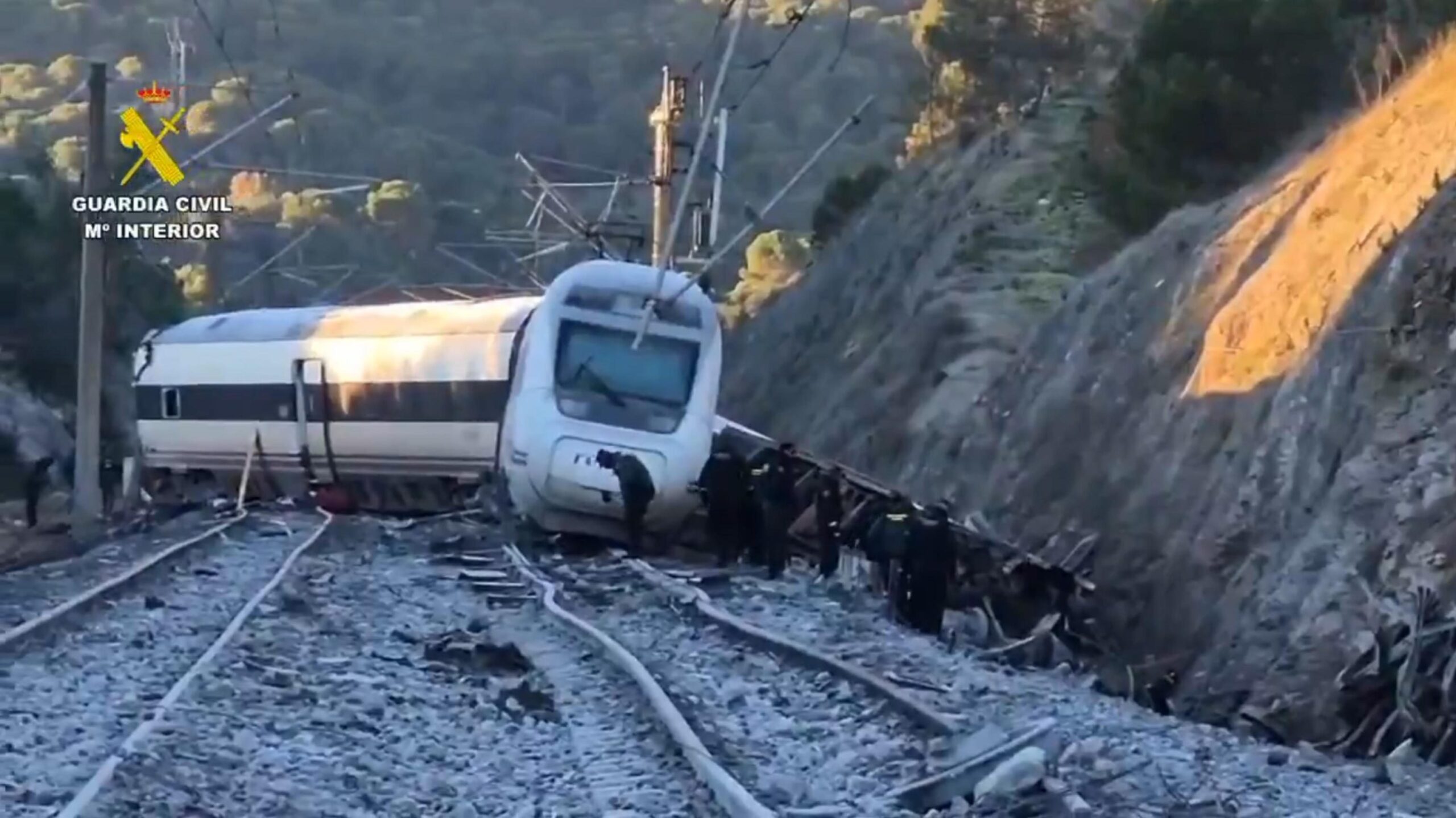
The causes of the train accident which involved two high-speed trains on the Malaga-Madrid route, in southern Spain, causing at least 39 dead. According to the Spanish Minister of Transport, Oscar Puenteit was an “extremely strange” episode, given that part of the straight section of tracks had been renewed last May, while the derailed Iryo train had undergone its last inspection just 4 days ago.
Preliminary hypotheses are focusing mainly on possible breakdowns of rail bogies or infrastructure itself, as stated by the president of Renfe (the state railway company) Álvaro Fernández Heredia. For the moment, in fact, the hypotheses ofhuman error and of high speedgiven that the trains were traveling well below the 250 km/h limit established for that route.
For Spain it is the worst train accident since 2013when near Santiago de Compostela a derailed train caused the death of 80 people. Now it will be the authorities’ task to ascertain the actual causes of the disaster, once the rescue operations are concluded: Fernández Heredia underlined that it could take a month to be able to reconstruct the dynamics with certainty and ascertain the causes of the disaster.
The dynamics of the accident at Adamuz: the facts known at the moment
Train 6189 of the Iryo company, a model Frecciarossa 1000was traveling on the Malaga-Madrid line at a speed of 205 km/h when, at the height of Adamuzthe eighth and last carriage of the train derailed, taking with it the two previous carriages, which ended up on the left track where they met the first two carriages of a train of the Alvia company, which was traveling in the opposite direction to 210 km/h. The two carriages of the Alvia train that were hit fell down an embankment about 4 meters high.
In an interview with Cadena SER, the president of Renfe, Álvaro Fernández Heredia, said that theelapsed time interval from derailment to impact it would have been about 20 seconds.
Given the dynamics of the accident, Heredia has the hypothesis of human error was discardeddecreeing a derailment due to the unlikely‘high speed: the railway section was a straight line and the train was traveling at a speed of approximately 205 km/h, in an area where the maximum limit was 250 km/h.
What may have caused the accident: Infrastructure concerns
The preliminary hypotheses, therefore, are focusing above all on possible infrastructure or train failures of the Iryo company, of which State Railways is the majority shareholder (51%). Specifically, the railway route connecting Andalusia to Madrid has been much discussed in recent months, after the Spanish train drivers’ union (SEMAF) had requested – and subsequently obtained – the lowering of the speed limit from 300 km/h to 250 km/h «due to the effects which, according to their complaint, are caused by the accumulation of a series of imperfections on the tracks».
Specifically, SEMAF had already reported the strong ones in August 2025 vibrations due to traffic more intense railway on the line, vibrations which «could be the basis of events such as the breaking of train bogies”the union wrote at the time.
Among other things, the last track renewal operation dates back to May 2025 (for a total of 700 million euros invested), even if the conditions of the railway section «they should be optimal», as reported by the president of Renfe. The Frecciarossa 1000, however, was inspected on 15 January 2026, just 4 days ago.
As reported by El Pais, in 2025 ADIF (the state company that manages the infrastructure) had found a series of technical malfunctions on the line, right at Adamuz, as problems with the signaling system and with the infrastructure, in the latter case reported on 26 October 2025. On 23 December 2025, however, the company had reported a exchange failure between Adamuz and Corbova.
At the same time, according to some testimonies from passengers on board, they were warned before the accident two gaspsone milder and the second stronger: this is compatible with the hypothesis – yet to be confirmed – that the accident may have been caused by a problem with the railway infrastructurewhich would have prevented the railway trolley from resting correctly on the tracks, ending up derailing the train tail of the trainexactly as it happened.
In his interview, the president Heredia he also spoke of a missing component of the Iryo train’s bogie, which however may have been knocked off during the impact.
In any case, it will be necessary to have certainties wait for the investigations to be carried out by the authorities, who are currently proceeding slowly to give priority to the rescue operations of the people still trapped under the sheet metal of the train.
