It’s getting closer and closer to the first launch opportunity of the mission’s April window Artemis II scheduled for 00:24 in the morning (Italian time) on April 2nd. As per protocol, the astronauts have already been inside for several days forty to minimize the risk of infection or disease that could compromise the launch. Quarantine is one of the preparatory steps at the beginning of the actual mission whose detailed flight plan was released by NASA in an official document publicly available. The mission will have four main phases which include the launchthe translunar injection maneuverThe close flyby of the Moon and the return to Earth. In this article we will see in detail the various phases of flight plan of Artemis II.
The launch phase
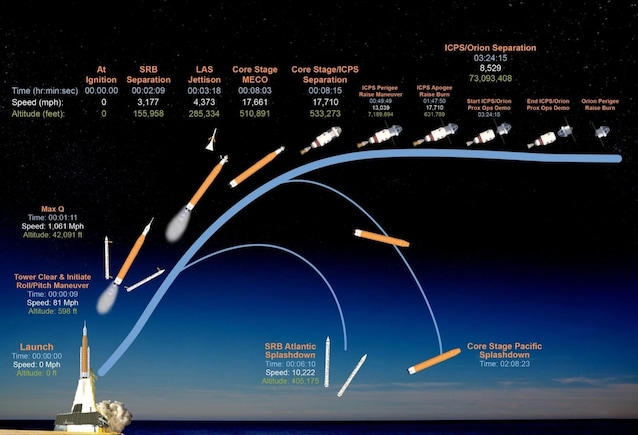
The mission Artemis II is scheduled to launch in one of three possible launch windows: between 7 and 11 Februarybetween 7 and 11 March And 2-4-5-6-7 April. The February and March windows have been blurred due to problems that arose during wet dress reharsalthe first useful opportunity is now at 00:24 in the morning (Italian time) on April 2nd. At launch, the rocket Space Launch System will lift the spacecraft Orion from the ground thanks to the thrust of 39 million Newtons generated by four RS-25 main engines liquid propellant and come on two side boosters solid state. After about one minute and 10 secondsthe rocket and the capsule will already be at a height of 12 km and a speed of 1600 km/h, thus reaching the Max Qi.e. the maximum aerodynamic stress of the system. After two minutes and nine seconds instead, the detachment of boosters solid state laterals, while at the threshold of three minutes and 18 secondsonce the critical phase of the ascent has been overcome, i jettison engines of Launch Abortion System (LAS) will separate the tower from the Orion spacecraft.
After the side boosters have fallen into the Atlantic Ocean, the so-called “MECO” will occur 8 minutes after launch at an altitude of approximately 48 km and a speed of approximately 28,000 km/h (Main Engine Cut Off), that is shutdown of the four RS-25 main engines. A few seconds, the main body of the SLS rocket rises will separate from the upper stage which will instead continue its race towards space.
Earth orbit and translunar injection
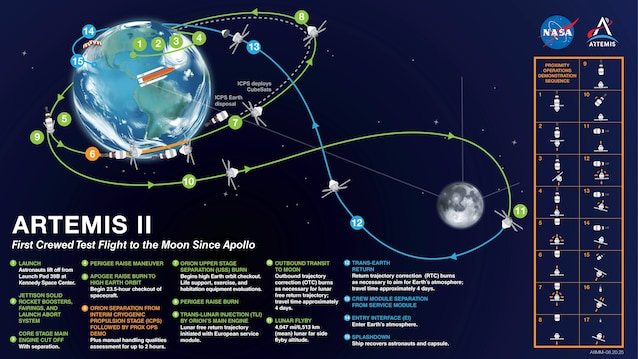
At this point, the spacecraft will be made up ofInterim cryogenic propulsion stage (ICPS)the intermediate stage that provides propulsion for the Orion spacecraft to orbit the Earth, and by Orion itself, with its service and crew modules. Two they are the maneuvers that occur in this phase, both guided by the ICPS: the first will occur 49 minutes after launch and it will serve for raise the altitude to the perigeewhile the second will happen one hour and 47 minutes after launch at orbital apogee to bring the spacecraft onto ahigh earth orbit lasting 24 hours. Three hours and 24 minutes after the launch you will also have the ICPS separation from Orion.
In these 24 hours in Earth orbit, the crew will perform various checks of life support systems of the spacecraft, as well as a demonstration of operations rendezvous into space using the ICPS from which it previously detached as a target. Upon reaching the second perigeethe Orion capsule will carry out the crucial maneuver of Trans-Lunar Injection (TLI) or translunar injection. It is about theprolonged onabout 18 minutesdel service module engine (European construction) which will allow Orion to fit into the orbital trajectory that will take it to the Moon. To be precise, turning on the thruster will increase Orion’s speed until it moves to an elliptical orbit with high eccentricity, whose apogee is close to the Moon.
The journey to the Moon
Following the maneuver of Trans-Lunar Injectionthe Orion capsule and its crew of four astronauts will finally be flying towards the Moon. As Orion moves away from Earth, the crew will continue to evaluate the spacecraft’s systems. The astronauts will practice emergency procedures, they will test the measurements of radiation protection inside the capsule and will carry out demonstrations planned for future missions. Along the way, they will happen small course corrections necessary to put the spacecraft on a correct re-entry trajectory that allows it to exploit the lunar gravity to return to Earth. After four days of travelthe spacecraft will enter the sphere of influence of the Moonwhere lunar gravity becomes stronger than Earth’s.
The close flyby of the Moon
It is at this point that the most fascinating part of the mission. Orion will pass between 6400 and 9600 kilometers above the lunar surfacedepending on the launch date. From the spacecraft’s windows, the Moon will appear about the size of a basketball held at arm’s length. Orion will carry out just a close flyby of our satellite, Not thus having the opportunity to accomplish a complete orbit. During the flyby, at some point Orion will come across the far side of the Moonwhich will cause the crew to lose radio contact with Earth. In this phase the astronauts will be completely isolated, but will have the opportunity to photograph and observe the hidden side of our natural satellite. At the farthest point, the crew will be at a distance from Earth that will make them the humans who have ventured further into space than anyone else in history.

The journey back to Earth
After rounding the Moon, Orion will begin his return to Earth without significant engine ignition. The spaceship does will entrust Indeed to the combined gravity of the Earth and the Moon to head home along a fuel-efficient route. The return journey will also take approx four dayswith sporadic trajectory corrections necessary to correctly enter the land reentry corridor. In these four days, the crew will continue system testingincluding additional ones manual piloting exercises and radiation shielding demonstrations. As Orion approaches Earth, his service module will separate and burn up in the atmosphereexposing the crew capsule’s heat shield. The capsule will re-enter at high speed, heating up to thousands of degrees, while the superheated plasma will briefly block radio communications.
The landing phase
For the phase of re-entry into the atmosphere and landing, Artemis II will attempt the same maneuver used by Artemis Ionly this time it will do it with real humans on board! The maneuver is called “skip reentry” and it is done necessary because of thevery high speed with which the Orion spacecraft will enter the Earth’s atmosphere, almost 40,000 km/hthe highest ever recorded for a human crew. It “skip reentry” is one maneuver in several phases: In the first phase, the Orion crew module will enter briefly in the upper atmosphereup to about 60 km high, except then rotate 180 degrees so as to change its center of gravity and bounce outwards up to a height of 100 km from the ground. By doing so, the spacecraft dissipates energyalso reducing the temperature load on the heat shield as the ship briefly returns to the cold of space.
It “skip reentry” helps not only Orion, but also astronauts since dividing the return into two parts makes it so maximum G-force experienced by astronauts drops from 6.8 to just 4. The idea of carrying out a “skip reentry” had also been aired at the time of the Apollo program, but the poor computational capabilities of the on-board computers of the time made the maneuver too risky to carry out. Once most of the frictional energy has dissipated, Orion will deploy its parachutes landing in the Pacific Ocean off San Diegowhere the US Navy will recover the crew and spacecraft using an amphibious vehicle, thus concluding the historic 10 day mission.
