In the last few hours the US administration has reiterated that “using military force to acquire Greenland is always an option“And if in 2019 Donald Trump’s idea of buying the Arctic island seemed just a provocation, considering what happened in recent months, the perception is now clearly different, because it is now becoming a institutional language.
As stated by the White House spokeswoman Karoline Leavitt in a note:
President Trump has made it known that the acquisition of Greenland is a U.S. national security priority and is critical to deterring our adversaries in the Arctic. The President and his team are discussing a number of options to pursue this important foreign policy objective, and of course, the use of the U.S. military is always an option available to the Commander in Chief.
The spokeswoman’s words came shortly after declarations of support from European leaders for Denmark (Greenland is autonomous, but defense and foreign policy remain in the sphere of the Kingdom of Denmark), who clearly opposed Trump’s desire to get his hands on Arctic land, and who ordered him to respect Danish sovereignty.
In a joint statement with Danish Prime Minister Mette Frederiksen, France, Germany and Britain said that “Arctic security is a top priority for NATO“, a defense alliance which, they recall, also includes the USA and Greenland.
What would happen if the US militarily invaded the Arctic island
While formal annexation currently remains unlikely, military expansion is realistic. In this case, the problem would above all be borne by NATO, because the United States, in addition to being part of it, are also its main financiers, and militarily invading Greenland would mean attacking an allied country.
Then there is a particular issue: according to thearticle 5 of the Treaty, if a country outside the BORN were to attack an allied country, this would mean attacking all the others too. But if it’s a allied country to do so, what would happen?
When there is still only the threat, what is happening now would happen: the other allied countries would seek mediation. If a NATO country actually invaded another allied country, a war would break out internal crisis within NATOwhich should try to stop the escalation with all the diplomatic means available, including diplomatic pressure and negotiating tables. It would not be convenient for the aggressor country, because it risks economic isolation and a series of significant political consequences (primarily sanctions). But the tune could change in this case, because the USA has such a large political, financial and economic weight that it thinks it “can cover its back”, and international sanctions and pressure could be useless in the long run if the army was already on Greenlandic territory. In that case, the only real weapon of contrast is in diplomacy and in one well negotiated solution.
The “soft annexation” hypothesis through militarization and the importance of the base of Pituffik
“Soft annexation” is the strategy with which a State does not legally “annex” a territory with a formal act, but it gradually absorbs functions, dependencies and decision-making levers until you get a check in fact (de facto).
In practice it is one “empty” sovereignty: the territory remains formally autonomous (sovereign), but increasingly depends on an external actor for safety, critical infrastructures, technologies, investments And logistics chainsand accepts permanent “constraints” and “presences” that become difficult to remove without enormous costs. In this sense, militarization, which would inevitably bring with it strategic dependence, would be the strongest and fastest lever.
If the island’s defense were to become “substantially” American (systems, bases, personnel, logistics), over time Greenland would risk perceiving its security as not separable from Washington.
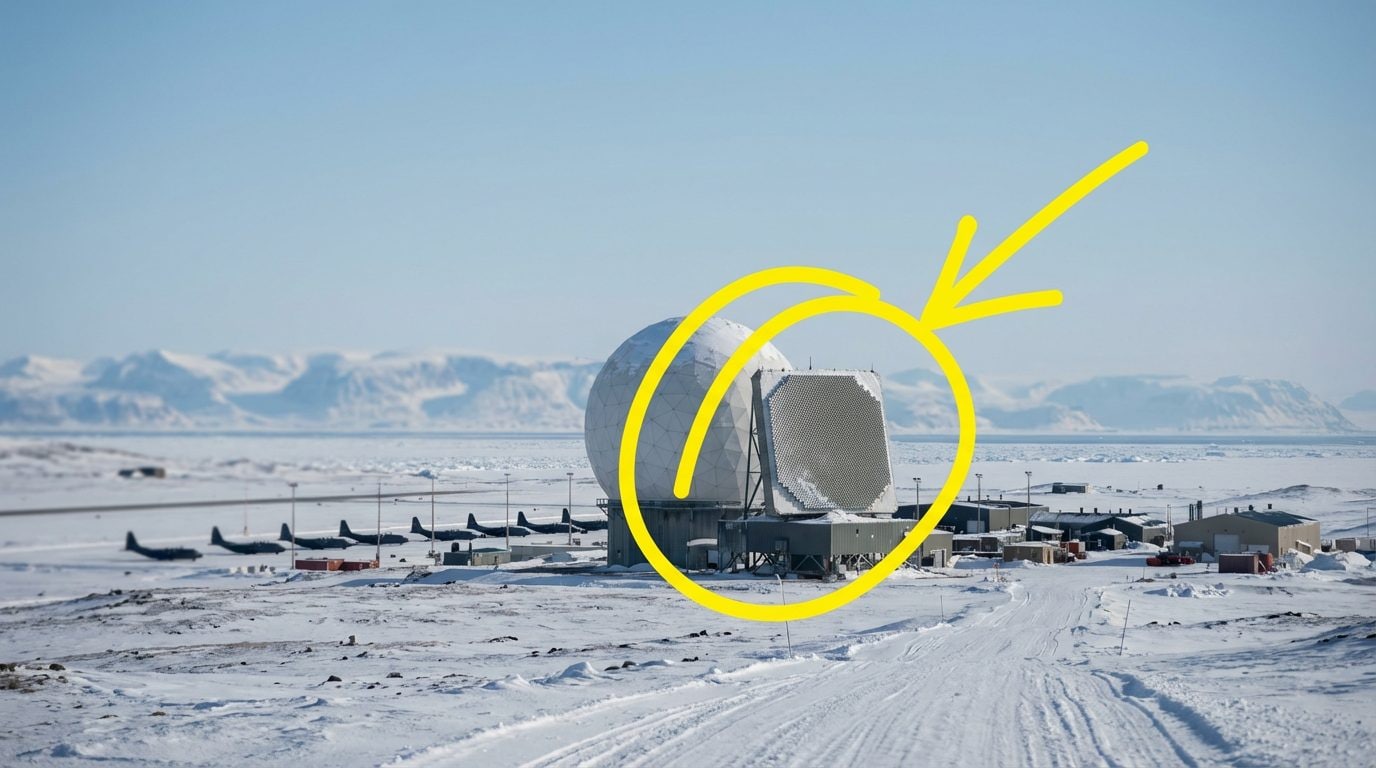
The US already has a key base for doing all this: the Pituffik Space Base (formerly Thule), central for radar and strategic capabilities. Various analyzes link the current geopolitical context to the possibility of upgrades and military infrastructure upgrades on the island.
Even without buying Arctic land, the US could still, in fact, increase its control over it, for example by expanding Pituffik basein northwestern Greenland (above the Arctic Circle). This base has a radar to detect and track ballistic missile launches headed towards North America and also serves for space surveillance. For the US, however, Greenland is a way to control the Arctic and access to the Atlantic Oceanas well as control over trade routes.
Having a larger base in that area therefore does not only mean controlling the land, but also information, response capacity and military presence. Expanding Pituffik would therefore mean upgrading the infrastructure (and accommodating more planes and cargo), supporting operations even in extreme conditions and supporting more modern radar and satellite systems to make the base even more powerful and increase the weight of the United States in the area. According to Washington Technology there would even be a multi-year contract worth hundreds of millions of dollars to modernize the most critical systems (such as energy, for example) linked to the base’s capabilities.
More flights, more supplies, more contracts, and more infrastructure and you would have a major micro-economy at the basewhich would increase the weight of US needs on the territory, which would also become an indispensable node of the US/NORAD (North American Aerospace Defense Command) anti-missile “parachute”. At that point, it would be even more complex for Greenland and Denmark to say no to certain US operational requests.
Meanwhile, according to what was certified by Reuters and Al Jazeera, for the moment the Denmark it is trying to demonstrate that it knows how to defend the territory, and has announced packages and agreements to strengthen the military presence in the Arctic and North Atlantic (multi-billion investments, new naval capabilities, drones, space), also to “lock down” the region.
