
You can build the Bridge over the Strait of Messina in one of the most seismic areas of the Mediterranean? To answer this question, we must first understand what really lies beneath the sea that separates Sicily And Calabria. In this article we will take a journey into the deep geology of the arm of the sea that separates Sicily from Calabria and connects the Ionian Sea with the Tyrrhenian Sea: we will see how the movements of the tectonic plates are moving the two coasts apart, we will analyze the fault system which generates earthquakes and we will try to understand if, from an engineering point of view, it is technically possible to create a work capable of resisting these forces of nature.
To understand the Strait, we need to take a step back 200 million yearswhen all the continents were united in Pangeasurrounded by the ocean Panthalassa. Pangea then divided into two large blocks: Gondwana to the south (Africa, South America, etc.) e Laurasia to the north (Eurasia, North America). In the middle, an arm of the sea called Tethys Ocean. Italy? It didn’t exist yet, or rather, its geological “trace” was submerged right there in the middle.

In the following ones 100 million yearsthe continents began to fragment and drift apart. Africa and India broke away and began traveling northeast, crashing into Eurasia. This titanic clash closed the Tethys Ocean and “squeezed” upwards the rocks that were in the middle, forming the AlpsThe Apennines el’Himalayas. Italy was born precisely in this tectonic grip, crushed between the African plate pushing north and the Eurasian one.
At this point one might think: if we are in a tight grip, then Sicily and Calabria are getting closer, right? But no. The geology is wonderfully complex. Despite the general context of compression, the Strait of Messina is located in an area of extension. In practice, Sicily and Calabria are moving apart.
Why does this happen? Africa pushes north, but at the same time the Tyrrhenian Sea pushes east (towards Calabria). Imagine taking a sheet of paper and pulling it from two opposite sides: it will tear in the center. Here, the Strait is right in the middle of this geological “rip”. Studies confirm that the two shores move apart by approximately 0.5-0.8 mm per year.
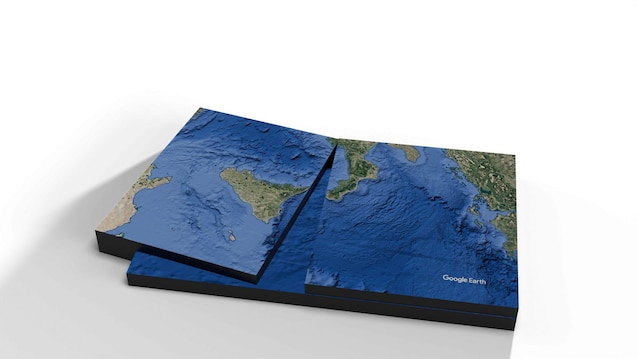
Not only that: there is also a movement of lateral slip (slip fault), like two cars rubbing each other’s sides, and vertical movements. Over the last 700,000 years, theAspromonte in Calabria it rose by about 300 metres, much more than the Messina coast.

All these movements are managed by a complex system of faults that run under the Strait, creating “steps” that descend towards the center. This makes thearea highly seismic. Let’s not forget that right here, in 1908the most powerful earthquake ever recorded in instrumental times occurred in Italy (magnitude 7.1), which caused approximately 80,000 victims.
Build the longest single span bridge in the world in a seismic area and in extension it may seem like a gamble. But there is a “but”. Many bridges in the world (Japan, California, Türkiye) are built in highly seismic areas or on faults. Modern engineering has the tools to absorb geological risk.
The Strait Bridge was designed to withstand a magnitude earthquake 7.2. Someone might object: “What if a 7.5 arrives?”. In the ideal world you would design to resist everything, but in the engineering reality you calculate the maximum historical and geological risk of an area and designs on that basis. Designing for a 7.2 is already a huge technological challenge and covers the scenario of the worst earthquake ever recorded in the area.
From a purely technical and geological point of view, experts agree: the bridge can be built. Engineering can handle subsurface challenges.
The real challenge, perhaps, is not so much building it, but maintain it. Such a work requires constant and impeccable maintenance. Will we be able to guarantee it over time? This is the real question we should be asking ourselves.
