With theattack on Venezuela and the arrest of the President Nicolás Maduro, Donald Trump he’s trying to get his hands on the petrolium Venezuelan: in the last few hours, the USA has also seized two oil tankers linked to Caracas (one of which flies the Russian flag), unleashing the wrath of Moscow with the risk of resulting in an “oil war”.
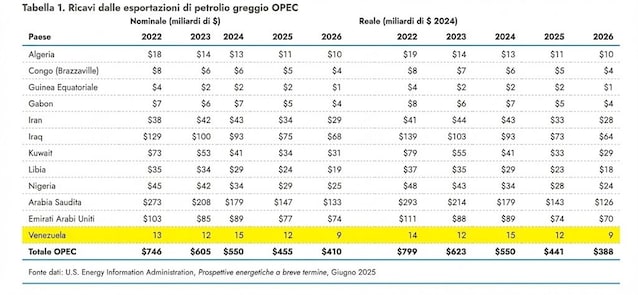
But, at the moment, where Venezuelan oil ends up? The country, in fact, has the largest oil reserve in the world, equal to more 300 billion barrelsapproximately 20% of total global crude oil. Nonetheless, it exports an extremely small quantity when compared to other oil giants – such as Saudi Arabia -, and is able to barely cover the‘1% of global demand of oil. According to official estimates from US Energy Information Administration (EIA), in 2025 the country has gained approx 12 billion dollars from crude oil exports, down by as much as 3 billion compared to 2024. For comparison, in the same 12 months, Saudi Arabia sold oil worth over 143 billion dollars.
How much oil does Venezuela export and to which countries
According to official estimates, Venezuela is the country with the largest oil reserves in the world, equal to over 300 billion barrels, approximately 20% of global oil, the quantity of which is around 1,560 billion barrels. Nonetheless, Caracas it is not among the largest oil exporters in the worldlike Saudi Arabia or Iran, which control 17% (267 billion barrels) and 13% (208 billion barrels) of global crude oil respectively.
According to OPEC (Organization of Petroleum Exporting Countries) estimates, in fact, in 2024 Venezuela exported approximately 874,000 barrels of oil per day, equivalent to just 1% of global production, up slightly from 751,000 barrels per day in 2023.
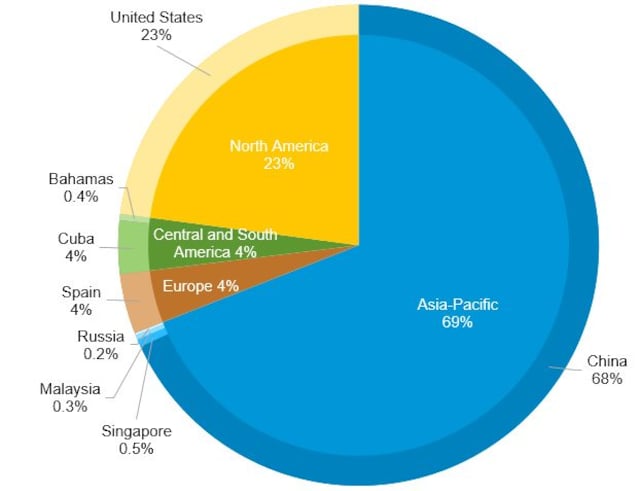
But where does all this oil go? At the moment, the main importer of Venezuelan crude oil is La Chinawhich purchases approximately 68% of the oil exported by Venezuela 594,000 barrels per dayas confirmed by the US Energy Information Administration (EIA). In second place are the United Stateswhich receives the 23% of Venezuelan exports, followed by Cuba (4%), Spain (4%) and from other countries such as Russia And Singapore.
The situation, however, could change in the coming months, especially if Venezuela is really called upon to deliver between 30 to 50 million barrels of oil to the United Statesas announced by Donald Trump.
But why does Caracas export so little crude oil? The reasons have to do with the geology of the area, but also with politics. Specifically, Venezuela is rich in heavy oil and therefore dense, viscous, rich in sulfur and impurities. Precisely for this reason, extracting it is particularly difficult and high pressure steam injections or solvents are needed to thin the crude oil.
At the same time, after the nationalization of the oil industry – desired by President Hugo Chávez in 2007 – the state oil company progressively lost investments and skills to extract extra-heavy oil, with the consequent reduction in the crude oil extracted and, therefore, sold.
How much does Caracas earn from oil exports
In short, Venezuela, like most Latin American states, has found itself hit by the so-called “curse of abundance”: paradoxically, great wealth in terms of natural resources has done nothing but weaken the country economically (and socially).
It is no coincidence that, according to official data from the EIA, in 2025 Venezuela earned approximately 12 billion dollars3 billion less than in 2024 and well 135 million dollars less than‘Saudi Arabia.
According to experts, if Venezuela were to increase the quantity of crude oil extracted, the price of oil would be affected globally: analysts estimate a drop of 4 dollars per barrel by 2030, but only if Venezuelan production were to reach 2 million barrels per day.
