
In the period between 1901 and 2018, the average global level of the sea is increased by approximately 15-25 centimetersmainly because of the Fusion of glacial caps and the thermal expansion of the oceans. Particularly worrying is the acceleration and extent of this phenomenon, testified by the fact that the global rate rate is almost doubled in recent decades. A recent study conducted by researchers from the University of New South Wales and published in the scientific journal Pnas (Proceedings of the National Academy of Sciences) has shown that an increase in 2 ° C of the average temperature of the oceans, regardless of further increases in global warming, would cause the Complete merger of the glacial cap of theWestern Antarcticadetermining a raising the average level of the sea of approx 3.8 meters within a millennium. This dynamic would have a direct impact on the Italian coasts, compromise The safety of urban areas and coastal community with high housing density located at low altitude, from Venice and Ravenna, up to Livorno, Catania and Cagliari.
The complete map of the Italian cities most at risk
In the event that this scenario materialized, the interactive maps developed of the Climate Central indicate that the most exposed Italian areas would be mainly in the area ofHigh Adriatic; in particular, Venice and the Delta pole they would be completely submergedeffectively losing their habitability condition. At the same time, different locations of the Riviera Romagnolaincluding Riccione, Ravenna, Misano, Catholic And Rimini They would suffer significant damage, with the consequent loss of coastal traits of significant symbolic value for seaside tourism. In fact, the territory between the Veneto and Emilia-Romagna, due to its geomorphological characteristics and the phenomenon of subsidence, or the slow and gradual lowering of the earth’s surface, would be particularly exposed to permanent marine entrances. In the South Adriatic, also the Gulf of Manfredonia It represents a high vulnerability area, with urban settlements potentially intended to position itself below sea level.
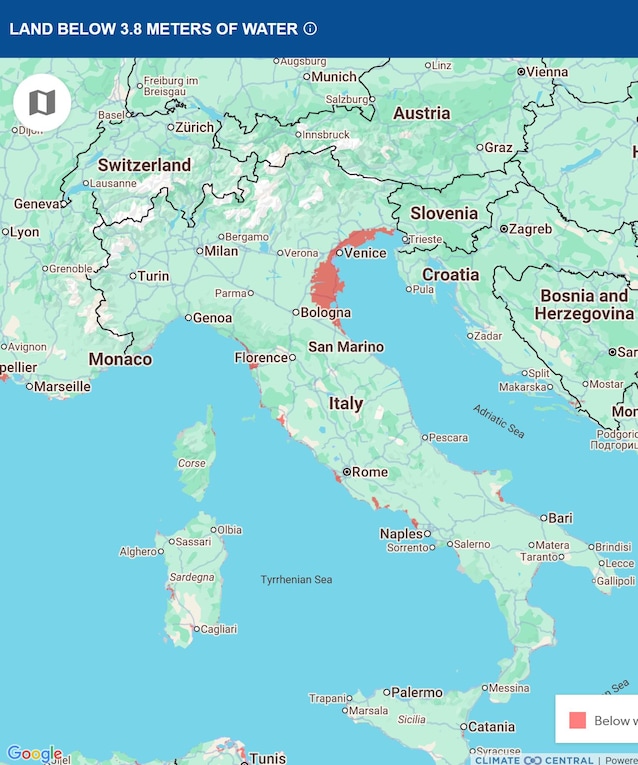
On the Tyrrhenian coastal strip, an increase in the marine level of over 3 meters would cause the flooding of numerous Tuscan locations, extending from Versilia until Livornoincluding some areas of the Marina di Grosseto. In Lazio, the coastal areas of Host And Fiumicino would be submerged, together with tourist locations such as Terracin, Sperlonga And Gaeta. Campania would also be significantly interested: in addition to the city of Naplesone of the most exposed urban centers, a marked vulnerability is highlighted in different locations of coast Domizioincluding Castel Volturno And Lake Patriaas well as in the areas of Cilento adjacent to the plain of the sele.
On the ionic sidethe coastal areas of Basilicata and Calabria would be subject to profound transformations, with particular attention in the areas close to the Plain of Sibari. In Sicily, the coastal areas of Catania they would undergo high risk. Even Sardinia would not be immune from impacts, with critical issues mainly found in Gulf of Cagliaria Oristano and along the South-eastern coast.
Is such a scenario realistic?
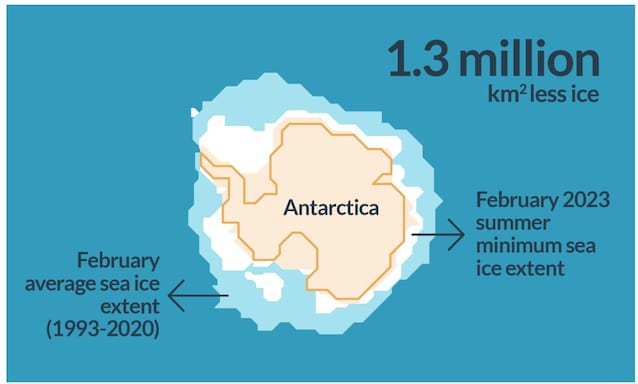
Currently the scientific community is leading in -depth investigations and analyzes aimed at defining the probability of the scenario in question with greater precision. The National Institute of Geophysics and Volcanology (Ingv) indicates that a complete fusion of antarctic polar caps in the near future is not likely. This is supported by the absence of a significant trend in the extension of the Antarctic sea ice, due to one High inner variability which involves an uncertainty substantially comparable to the amplitude of the esteemed tendency itself. However, the Antarctic Peninsula represents one of the most sensitive areas of global warming. In the February 2023this region recorded the historical minimum value of sea ice extension, with a decrease in 38% Compared to the historical average of the period 1979-2022 for the same month, as noted by the program Copernicusintegrated system of earth satellite observations.
Reasonable uncertainties also remain regarding the times and conditions with which the Antarctic glacial cap reaches the “point of no return“, that is the critical threshold beyond which the merger process would become irreversible. Overcoming this limit could determine an increase in sea level protracted for centuries or millenniawith potentially catastrophic consequences for coastal areas on a global scale. Given the seriousness of these risks, it is essential to implement with Urgency measures Sometimes to mitigate terrestrial overheating through synergistic actions, such as the reduction of greenhouse gase emissions and the protection of the most sensitive causes.
