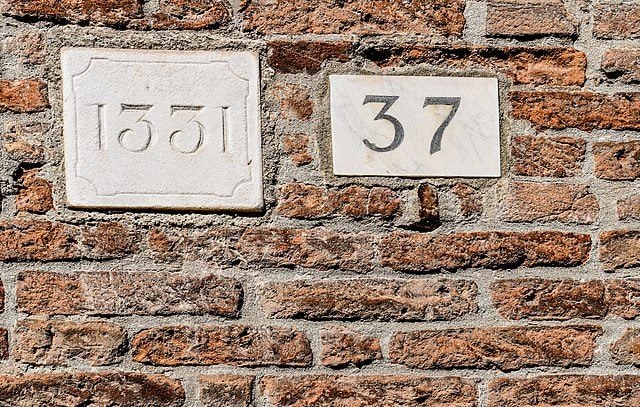
THE civic numbersalphanumeric codes assigned by the municipalities that uniquely identified access to a building, were introduced for the first time by European governments between ‘600 and ‘700with a very practical purpose: tax the citizens and find easily soldiers to be enrolled. First, in fact, the houses were recognizable only by Heraldic signs And symbols. With the increase in the population and urbanization, for the control of the city it became necessary to census not only people but also the buildings, and so each door received a identification number. The turning point came to 1790 in United States For census needs: for the first time the roads were organized with the equal numbers on one side and odd on the othera system that is still the most used in the world today. It is therefore not a question of the invention of a single person, but a system born for degrees in different countries and historical moments, driven by practical needs.
The organization of buildings in antiquity
In antiquity, in urban agglomerations both small and large, There was no real need to classify homes: life was organized for royal – in ancient Rome – or neighborhood, village, sestiereor with the names of the street, of the intersection or the area of the city. Those who lived in the same area knew each other, specific functions and activities were carried out in a specific area – market, shops, financial activities, etc. – the social classes themselves were divided into specific areas. Who had to find someone, he knew where to look for himIn short.
It was only in Middle Ageswhen religious communities, brotherhoods and landowners began to structure the real estate management of lands and buildingsthat the need to adequately organize the collection of taxes and taxes with more organized systems: therefore the Heraldic signs for homes and commercial activitiessometimes even accompanied by numbers.
When civic numbers were born
When the large land and real estate properties were confiscated and the entities that managed them suppressedthe urgency of clarifying was born: what he now possessed Statewhere was it and what value did he have? Meanwhile, the cities they grew Disessure: a London The first identification numbers appeared in the early years of 1700a Paris Around 1720 and, in the same period, in the Jewish ghetto of Prague. They weren’t true yet civic numbersbut numbering systems indicating the building overall. The real turning point came to 1770: in the’Habsburg Empirethe queen Maria Teresa He ordered to number each door to facilitate the search for young people to be enrolled. The officers arrived in the villages and, following them, a painter traced a number on each door: so no house was skipped.
The practice spread rapidly and, in the following decades, the civic number reached Also Londonuseful to even control i Political dissidentsand then Paris And Madrid. In the’Nineteenth centurywith the birth of the postal systemthe civic numbers were already in use but were perfected to make delivery, a process made even more efficient by the invention of the stamp.
Who invented the division of civic numbers on par and odd
The most popular numbering and system system in the world, that in buildings with progressive number equal from one side and odd on the otherhas been experimented rudimentary already by 1779 from a French journalistwho wanted to quickly deliver his almanac, a newspaper called Almanach de Paris. Thus, in the night, he had written numbers on one side and odd of the other in the streets belonging to his directization.
It seems that the method has been adopted officially in 1790, promoted by the same city administration, a Philadelphiain the USA, On the occasion of the first census of the populationwhen the Colonel Clement Biddle – who was a friend of George Washington and fought in the American war of independence – he proposed to separate the numbering to order homes, for make it easier for data or research of any kind.
