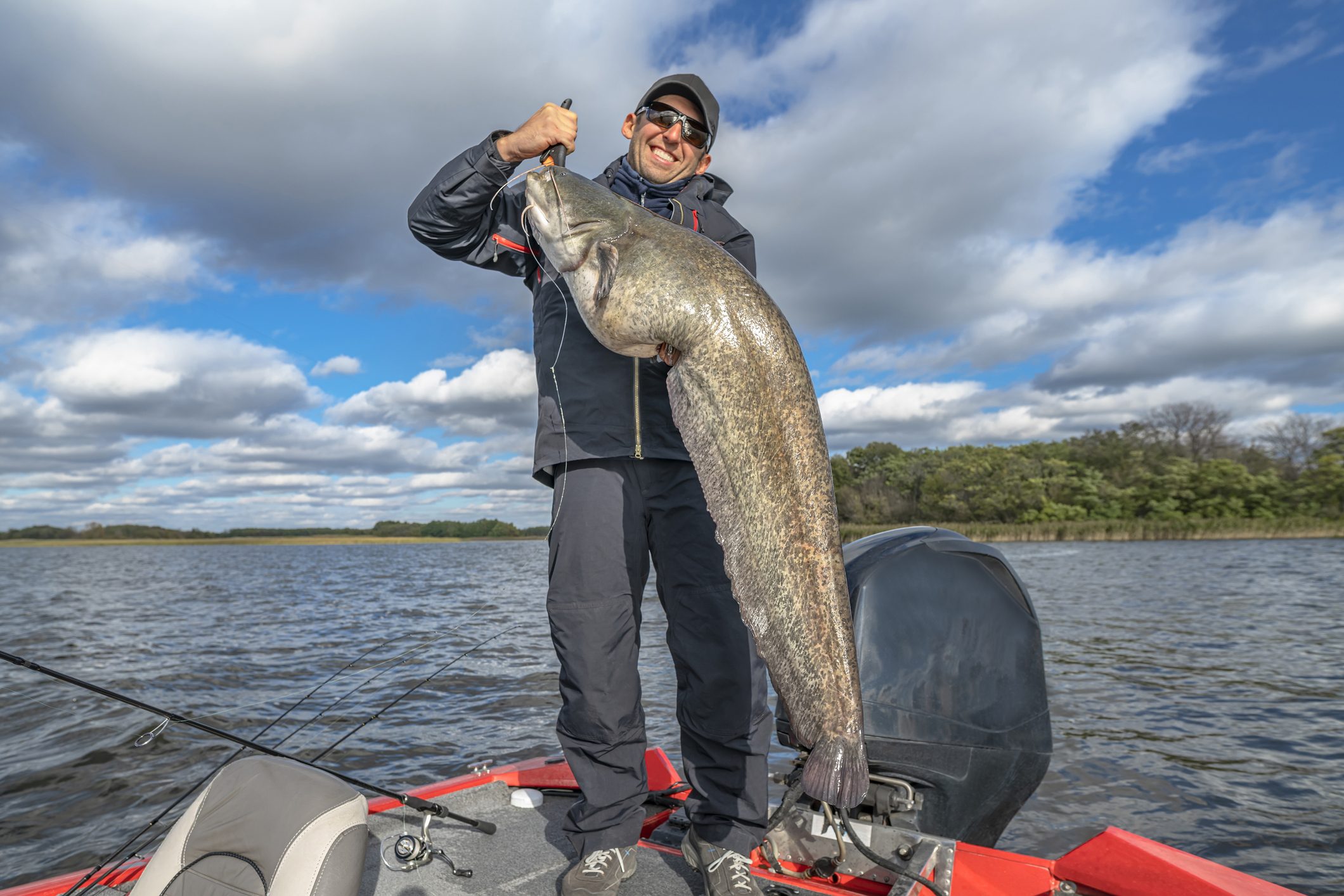
A catfish (Silurus glanis) long 2.8 meters and the weight of 68 kg it was caught in October in Lake Alserio in Lombardy. Record size, but definitely not rare for this fish species: in fact in Rybnik, Poland, again in 2025, a 2.92 meter long catfish was caught and in 2023 along the Po river in Revere in the province of Mantua, a 2.85 meter specimen was caught. After all, already the historian Pliny the Elder, who lived between 24 and 79 AD, compared the torpedoes observed on the Main and the Rhine in Germany to tunas, considering their size. Its considerable size often fascinates many fishermen and in some countries its meat is appreciated, which is why these enormous predatory fish, native to Eastern Europe and Western Asia, in particular the Danube basin, have been voluntarily introduced into other European areas for sport fishing, now, they invaded the lake and river waters of western and southern Europe. They proliferate in large rivers such as the Po, the Rhone, the Loire and the Ebro, in environments that have very favorable to their development. The higher the water temperature, the faster their growth and this is why in the rivers of Italy, Spain and France they reach record sizes. It is a predator at the top of the freshwater food chain, it is highly adaptable, very prolific and long-lived, equipped with a surprisingly fast metabolism and, given its voracity, it massacres fish and invertebrates in the waters in which it lives. It is not dangerous and absolutely does not attack humans, but in some cases some people were slightly injured in an arm or a leg because they had accidentally approached the male during the period of egg defense newly fertilized.
Silurus glanis: characteristics and where he lives
It can be said that his appearance and habits make him a decidedly suitable subject for a thriller set in a lake or on a river, a true River Monster. The Silurus glanis is a bony fish from the Siluridae family, which it lives exclusively in fresh waterin rivers with high flow or in lakes. The body, which recalls the appearance of a torpedois elongated and narrows at the back, while the head and especially the mouth are of considerable size and decidedly disproportionate compared to the rest of the animal. The skin is slimy, covered with a thick layer of protective mucus and completely free of scales.
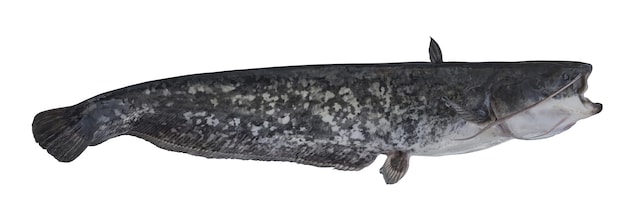
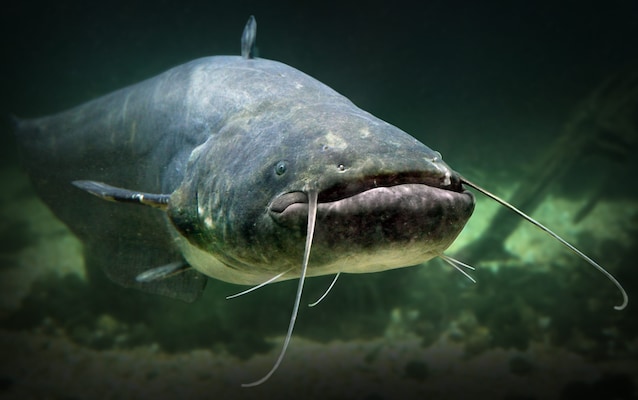
The highly developed jaws have a row of pointed teeth suitable for holding prey once captured and the gills are also equipped with a rack locking system to prevent prey from escaping from the gill openings. The eyes are very small, but the torpedo uses its sight very little in the depths of the water, relying instead on its sense of smell and long barbelswhich similarly to the cat’s vibrissae (whiskers), allow it to explore the environment and detect prey. Predation activity is predominantly nocturnalgenerally the catfish approaches its prey with a lightning-fast sprint, grabs it with its sharp teeth and then swallows it.
In winter it slows down its feeding and goes into a sort of hibernation, when the water temperature begins to rise to around 12°C it resumes its activities and begins to reproduce when the water reaches a temperature of around 20-22°; in Italy the reproductive period is quite long and goes from May to September. A peculiarity of this species is that the male builds a sort of “nest” among the aquatic vegetation where it induces the female to lay her eggs and then remains to guard the nestkeeping the eggs well oxygenated with continuous movements of the tail. The female can lay 20-30,000 eggs per kg of body weight, therefore, females of 60 kg they produce over 1,000,000 eggs. It is also a very long-lived animal that can outlast 60 years of age and despite its size it is not dangerous for humans.
Feeding of the ravenous freshwater predator
The diet varies according to size: the young feed on zooplankton, as the size increases they switch to the consumption of insect larvae, crustaceans and molluscs. The adult specimens are ichthyophagous (i.e. they feed on fish) and sometimes they also prey on birds, amphibians and reptiles. There have been documented cases of catfish approaching the shores of lakes to hunt pigeons. Some phenomena are also known cannibalism. With a very particular technique, catfish often gather close to dams and intake structures to open their mouths and swallow enormous quantities of fish that arrive under the dams. Among other things, they prey on eels which are now at high risk of extinction.
How it arrived in Europe and how far the invasive species has spread
This fish has a truly heterogeneous distribution in Europe: in some areas it is rare and protected in others it is invasive and represents a threat. An example of this are some countries in its original range, where it is now numerically rarefied and even protected also due to the effect of fishing pressure; on the contrary, in the rivers where it was introduced, the waters with higher temperatures and the absence of natural competitors have favored its proliferation. So it happens that in Denmark, Finland, Sweden and Switzerland the species is at risk of extinction, while in countries like Spain and Italy where it was introduced it is undergoing ademographic explosion is worrying and not without consequences.
A threat to biodiversity
An ancient saying dating back to the times of the Western Roman Empire said “every fish is prey to another fish, but all are prey to the catfishToday in many Italian rivers it has become a real threat to the conservation of other fish species. Not everyone agrees, so much so that some sport fishermen define themselves as true friends of catfish and therefore fish them, photograph them and then release them into the water without considering their deleterious effects on other species. Size, longevity, rapid growth and the ability to exploit a wide range of prey in different habitats definitely make it an unstoppable scourge. In Italy, complex programs for the numerical containment of this species have been active for years, but it is often a battle that is almost impossible to win.
